You brush after a long day in Walnut Creek and notice pink foam in the sink. Then you taste something sour, catch persistent bad breath that mouthwash only disguises, or feel a tooth shift slightly when you bite. These signs are easy to postpone, especially when nothing hurts.
The gum disease treatment before and after story is more than a comparison of two smile photographs. It includes the symptoms you notice, the measurements your dentist records, the treatment selected for your stage, the cosmetic changes that can appear as swelling settles, and the maintenance that protects the result. With more than 25 years of chairside experience, Dr. Schneider approaches gum care as a conversation about keeping your natural teeth healthy for the long term, not as a quick fix.
What Walnut Creek Patients Notice Before Treatment
A Walnut Creek professional may first notice bleeding while brushing after work. A sour taste or breath that returns soon after rinsing can make the problem harder to ignore. These symptoms don't prove how advanced the disease is, but they give your dentist a reason to look beneath the gumline.
During a periodontal evaluation, a family dentist measures the space between each tooth and gum with a periodontal probe. The chart records pocket measurements and whether those sites bleed, while the examination also checks recession, tooth mobility, and the way your teeth fit together. Dental x-rays help reveal changes in the bone levels that aren't visible in a bathroom mirror.

What the first examination can show
Gingivitis causes inflamed gums that may bleed, but it doesn't involve the bone loss associated with periodontitis. The CDC explains that gingivitis is preventable and reversible with daily brushing and flossing together with professional treatment, while periodontitis can be managed and slowed through professional care. CDC periodontal disease guidance also reports that about 42% of U.S. adults age 30 and older had periodontitis during 2009–2014, including about 8% with severe disease. Among adults 65 and older, prevalence was about 60%, and current smokers were affected at about 62%.
The distinction matters. Inflamed gum tissue can improve substantially, but bone that has already disappeared won't grow back because bleeding stopped. Coffee with sugar, nighttime snacking, and missed hygiene visits after a job change in the East Bay can all make daily plaque control more difficult, but they aren't a verdict on your future.
Practical rule: What you noticed is useful clinical data, not a final judgment. A periodontal evaluation establishes the baseline for every follow-up chart, photograph, and treatment decision.
The earlier you call after noticing a change, the more options your dentist may have. A short evaluation in Walnut Creek can separate reversible gingivitis from a condition requiring active periodontal treatment.
Stages of Gum Disease and How Each Is Treated
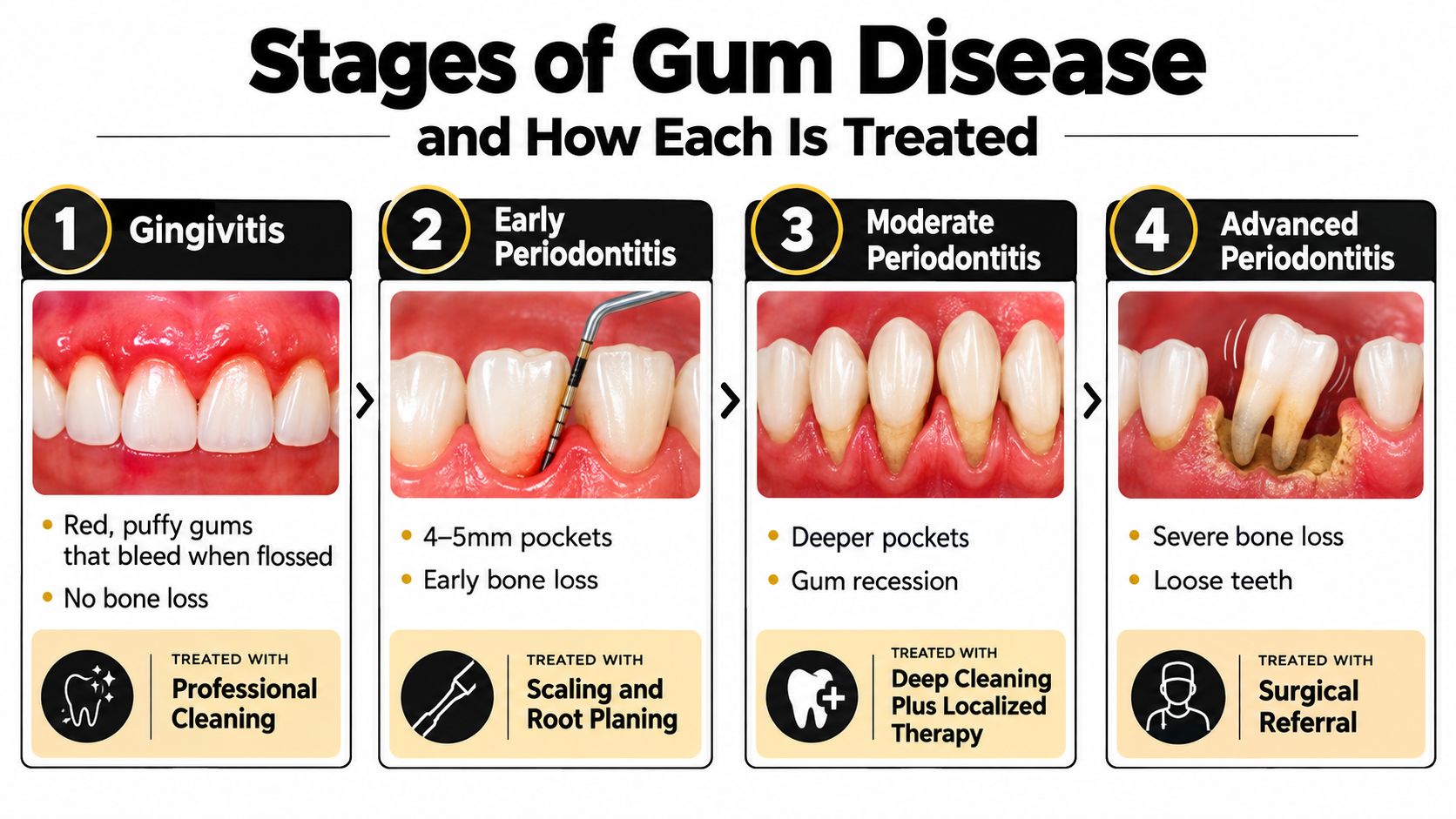
A dentist can usually explain gum disease as a four-level progression, although real mouths don't always fit perfectly into four boxes. The stage depends on probing measurements, bleeding, recession, bone support, tooth mobility, and other findings.
Stage one and early periodontitis
Gingivitis appears as red, puffy gums that bleed during brushing or flossing. There isn't bone loss at this point. A professional cleaning, improved brushing and interdental cleaning, and better daily consistency can produce a near-complete visual rebound because the main problem is inflammation rather than lost support.
Mild periodontitis may involve pockets around 4 to 5 millimeters, with early bone changes visible on radiographs. Scaling and root planing, often called SRP or deep cleaning, removes deposits below the gumline and smooths the roots so the tissue can heal more closely around the teeth. The likely before-and-after change is less bleeding and inflammation, not restoration of bone that has already been lost.
Moderate and advanced periodontitis
Moderate periodontitis can produce pockets around 5 to 7 millimeters, recession, bleeding, and cold sensitivity. SRP remains central, while localized antimicrobial treatment may be considered for sites that continue to show infection. Closer periodontal recalls help the dental team identify whether the pockets are stabilizing.
Advanced periodontitis involves deeper pockets, substantial bone loss, and possible tooth mobility. When support has been lost past half the root, care may involve periodontal surgery, soft tissue grafting, regenerative procedures, or referral to a periodontal specialist. The goal may shift from reducing inflammation to preserving strategic teeth, rebuilding selected defects, or planning replacement when a tooth can't be saved.
The National Institute of Dental and Craniofacial Research documents a decline in moderate and severe periodontal disease among adults and seniors since the early 1970s, attributing the improvement to better prevention, diagnosis, and treatment practices over time. NIDCR periodontal disease data also notes that the condition remains a major public-health concern, while the World Health Organization estimates that severe periodontal diseases affect more than 1 billion cases worldwide.
The stage tells us what happened before treatment. The treatment response tells us what can be protected next.
Scaling and Root Planing as the First-Line Deep Clean
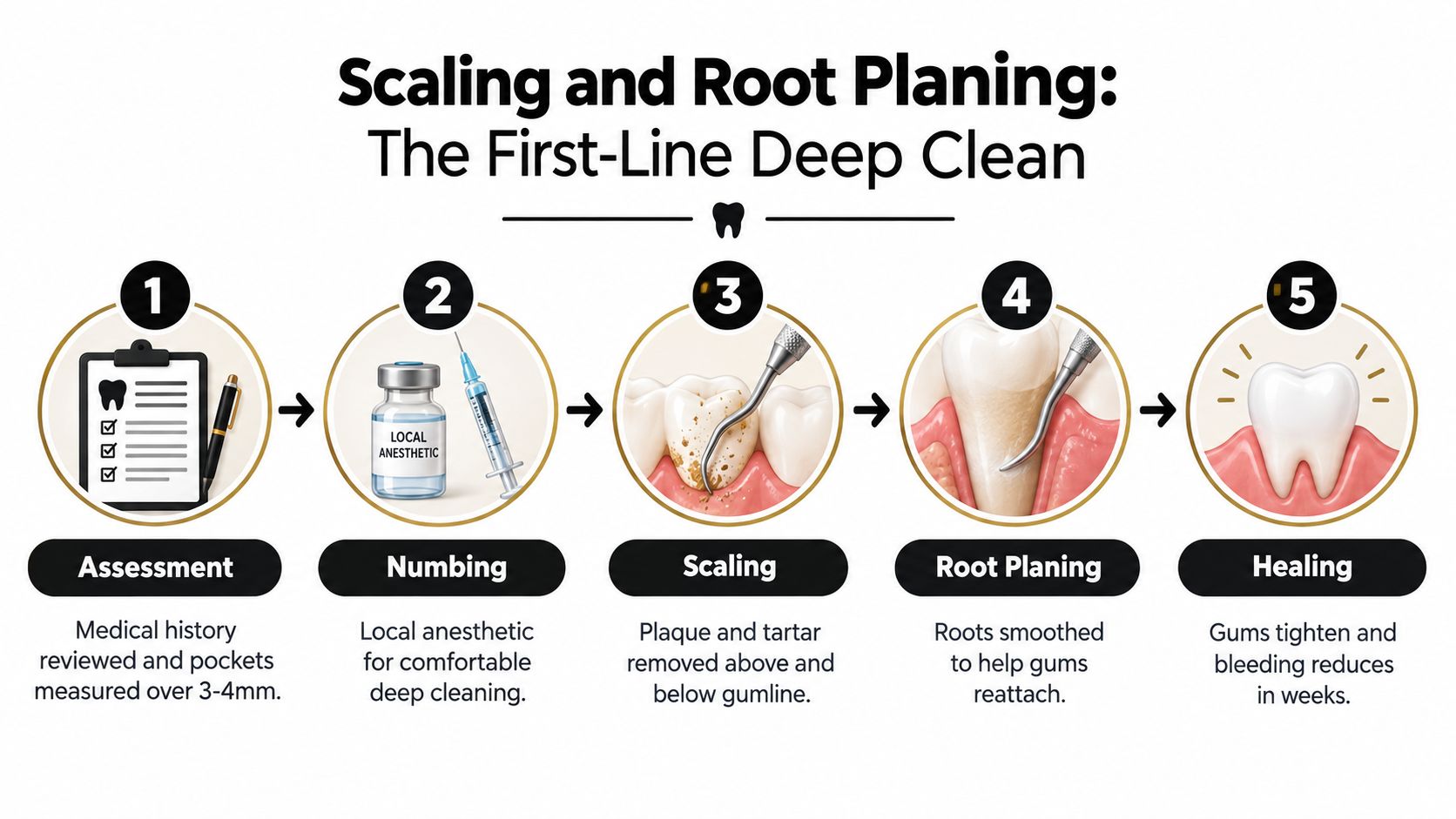
Once gum pockets are too deep for a routine cleaning, scaling and root planing is often the first treatment for mild to moderate disease. Scaling removes plaque and tartar above and below the gumline. Root planing smooths contaminated root surfaces so the gum tissue can heal against them. The ADA explanation of scaling and root planing notes that treatment may take more than one visit and may involve local anesthetic.
What happens in the chair
Before treatment, the dental team reviews your medical history and identifies the areas that need attention. Local anesthetic numbs one side or section of the mouth. Ultrasonic instruments loosen hardened calculus, followed by hand instruments that clean and smooth the root surfaces beneath the gumline.
Treatment is commonly divided into two appointments, with each visit covering part of the mouth. Pressure and vibration are normal, but you should not feel sharp pain while the area is numb. SRP uses no incisions or sutures, making it less invasive than flap surgery. The Cleveland Clinic overview of tooth scaling and root planing describes it as a first-line approach for mild to moderate gum disease.
How the response varies by pocket depth
Healing differs from one site to another. In moderate periodontitis with probing depths around 4 to 7 millimeters, average probing depth reduction is about 1.5 millimeters. Sites deeper than 6 millimeters may show greater pocket reduction and clinical attachment gain than shallower sites. As inflammation settles, some recession may become visible, making a tooth appear longer. Most measurable improvement occurs within about 5 months, as explained in the clinical review of non-surgical periodontal response.
For pockets above 6 to 7 millimeters, reported averages are roughly 2.19 millimeters of probing depth reduction and 1.19 millimeters of clinical attachment gain. The continuing education review of periodontal antibiotics and treatment notes that results generally plateau by 6 months, remain maintainable through 24 months with appropriate care, and may improve further with additional treatment.
The expected change after healing is less bleeding and inflammation, not restoration of bone already lost. Your home-care routine controls new biofilm while the tissues recover, so brushing, cleaning between the teeth, and scheduled periodontal reviews matter as much as the appointment.
For a closer explanation of the appointment, review our scaling and root planing procedure.
Surgical and Regenerative Options Beyond Deep Cleaning
SRP is often enough to stabilize mild or moderate disease, but it isn't a guarantee that every deep site will resolve. If bleeding, deep pockets, or an irregular bone defect remains after healing, the next treatment should match the specific problem rather than follow a preset menu.
Antimicrobial treatment after SRP
A dentist may place a topical antimicrobial, such as Arestin, directly into selected pockets. Short-course systemic antibiotics may also be considered in particular situations. These medications can support infection control, but they don't replace removal of tartar and biofilm, and they aren't a substitute for daily plaque control.
Access surgery for deep deposits and defects
Flap or osseous surgery allows the clinician to lift the gum tissue and see the root and bone contours more clearly. After deposits are removed, the tissue is repositioned to make the area easier to maintain and reduce the depth of the pocket. The expected before-and-after change is usually less bleeding and a more stable gumline, although recession can be more noticeable as inflamed tissue resolves.
Patients who need this level of care can review osseous surgery for advanced gum and bone care before deciding whether a referral or a staged plan makes sense.
Grafting and regeneration
A soft tissue graft covers exposed roots with tissue taken from a donor source or the palate. It can reduce sensitivity and improve the appearance of the gumline, but it doesn't erase every cause of recession.
Regenerative treatment uses materials such as bone grafts, membranes, or enamel matrix proteins in carefully selected defects. The objective is to encourage lost bone and ligament to reform around a compromised tooth. Regeneration isn't predictable in every pattern of bone loss, so the decision depends on defect shape, remaining support, pocket depth, esthetic priorities, and overall health.
A Walnut Creek general dentist can evaluate those factors, explain what is realistic, and coordinate specialist care when the condition exceeds the scope of non-surgical treatment. The right option is the one that balances tooth preservation, comfort, appearance, maintenance demands, and long-term stability.
A Realistic Before and After Timeline in Everyday Life
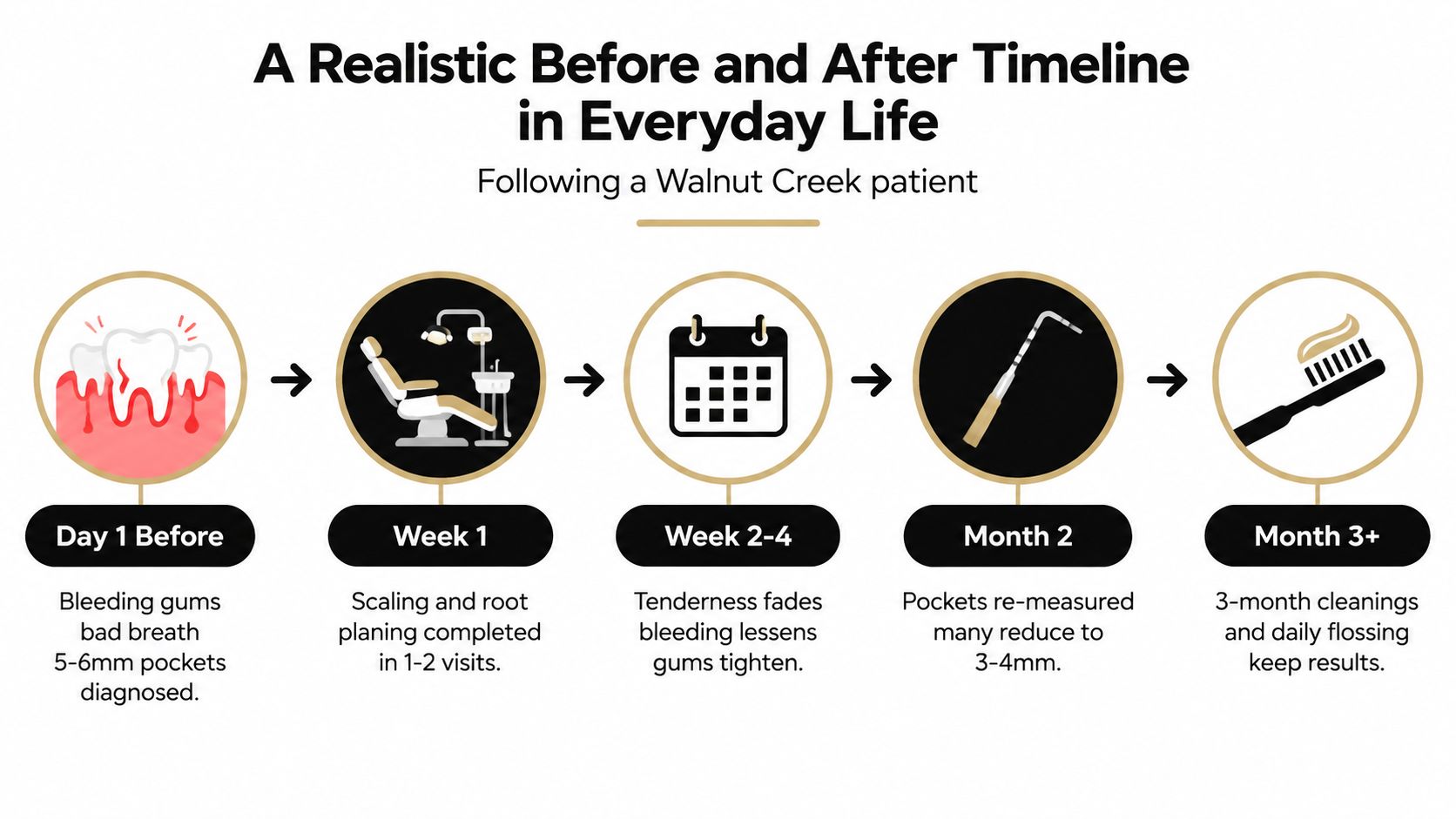
Consider a representative Walnut Creek adult who arrives with bleeding gums, persistent bad breath, and a 5 to 6 millimeter pocket measurement. That finding moves the patient beyond a routine cleaning and into periodontal treatment planning.
Two SRP visits, spaced a week apart, address the lower right and lower left areas under local anesthesia. By the third day, mild tenderness and temperature sensitivity are common parts of the healing experience, and over-the-counter pain relief may be sufficient when the treating dentist agrees it is appropriate.
What changes at the re-evaluation
At the four-week review, pockets may have dropped 1 to 2 millimeters in a moderate case, but the exact response varies by site and risk factors. The clinical picture often looks calmer, and bleeding should be reduced, yet the mirror may reveal an unexpected change.
As swelling resolves, the gums can tighten and the teeth may look longer. Small triangular spaces between teeth can become more visible where inflammation had previously filled the area and where supporting bone has been lost. This isn't necessarily treatment damage. It can be the honest appearance of tissue after infection and swelling have subsided.
Healthy gum tissue doesn't always recreate the pre-treatment cosmetic outline. A cleaner, firmer gumline can reveal recession and spaces that were previously hidden.
During months two through six, the patient works on brushing, interdental cleaning, and the habits that caused plaque to remain undisturbed. A first periodontal maintenance visit around three months provides another opportunity to measure pockets, inspect bleeding, and remove new deposits before they become established.
What the six-month comparison should show
By six months, before-and-after photographs may show calmer tissue color and a firmer gum tone. The periodontal chart should provide a more useful comparison than a smile photo alone, because it shows whether pockets and bleeding have stabilized.
The aim isn't to promise a gumline identical to the one you had at age twenty. It is to control infection, preserve remaining bone and tooth support, improve comfort, and create a condition that you and your dental team can maintain.
Recovery, Maintenance, and When to Call the Dentist
Non-surgical periodontal therapy usually has a short recovery period, but the first day is when most patients notice the treatment. Soft foods, careful brushing around sensitive areas, and the rinse your dentist recommends can protect healing tissue. Some patients are directed to use saltwater, while others receive chlorhexidine, so follow the instructions given for your mouth rather than borrowing someone else's routine.
Tenderness should settle as the gums tighten. Cold sensitivity can occur when inflamed tissue shrinks away from the root surface. Avoid tobacco because smoking is associated with poorer periodontal outcomes, and tell the office if you have diabetes or another condition that may affect healing.
The maintenance rhythm
Periodontal treatment isn't one appointment followed by a return to ordinary cleaning intervals. Many patients with a history of gum disease are scheduled for maintenance every 3 to 4 months, according to clinical periodontal maintenance guidance. The exact interval is individualized around remaining pocket depth, bleeding, smoking, diabetes control, and how consistently new deposits return.
At home, use a soft-bristle brush and clean between teeth with interdental brushes or a water flosser when those tools fit your needs. The professional visit disrupts deposits you can't reach easily, while daily care limits the film that feeds inflammation between appointments.
Call the office promptly if you develop:
- Persistent bleeding: Bleeding that continues beyond two weeks deserves an examination.
- Swelling or pus: These signs may indicate active infection.
- A loose tooth: Mobility can reflect changing support and shouldn't wait for a routine recall.
- A new gap or returning bad taste: A sudden change may signal inflammation or movement.
- Worsening discomfort: Pain that doesn't follow the expected recovery pattern needs review.
A same-week assessment is safer than waiting for the next maintenance visit when these symptoms appear.
Scheduling Gum Disease Care in Walnut Creek
The next step doesn't commit you to a procedure. It gives you a clear picture of what is happening and lets you compare treatment choices before the condition becomes harder to manage.
At a periodontal evaluation in Walnut Creek, Dr. Schneider reviews your medical history, completes periodontal charting, examines the gumline, and reviews appropriate radiographs. The visit can clarify whether you have reversible gingivitis, moderate periodontitis, or advanced disease requiring coordinated care. You can ask direct questions about the proposed sequence, expected healing, insurance, financing, and which parts of treatment can be phased.
A practical first visit
New patients are welcomed for a full examination with time to discuss concerns rather than rushing through a problem-focused appointment. Bring a current medication list and any recent dental records or x-rays you have, because those details can help the team move efficiently from diagnosis to a personalized roadmap.
The office is located at 1855 San Miguel Dr., Suite 31, Walnut Creek, CA, with easy parking and care for adults and families throughout Walnut Creek and the broader Lamorinda and Contra Costa communities. Patients seeking a dentist near me, a dentist in Walnut Creek, CA, or an emergency dentist for active swelling, bleeding, or a loose tooth can call to ask about appointment availability. Same-week visits may be available when symptoms are active.
Gum stability also matters when other dental goals are part of your plan. Once infection is controlled, restorative dentistry, crowns, bridges, tooth extraction, or dental implants near me may be discussed when teeth can't be preserved. Cosmetic dentistry, Invisalign, or teeth whitening should come after the gums are healthy enough to support a stable result, especially for adults searching for a cosmetic dentist near me.
Book a consultation with Dr. Schneider and bring your questions, medication list, and recent records. A careful examination can replace uncertainty with a staged plan for healthier gums and a more confident smile.
William M. Schneider, DDS offers periodontal evaluations, scaling and root planing, restorative care, and coordinated solutions for teeth affected by gum disease. Visit William M. Schneider, DDS to schedule a Walnut Creek consultation and take the first step toward stable, maintainable gum health.