You notice blood on the floss after brushing, or a metallic taste that seems to return no matter how carefully you clean your teeth. Maybe your gums feel tender, your breath stays unpleasant, or a tooth seems less stable than it used to. These signs can feel alarming, but gum disease usually develops in stages, and timely care can make treatment more manageable.
For patients searching for a dentist near me or a dentist in Walnut Creek, CA, the practical question isn't only whether gum disease is present. It's how far it has progressed, what treatment can realistically accomplish, and how to keep the condition controlled after the first round of care. At William M. Schneider, DDS, a general dental practice can evaluate gum health, provide nonsurgical treatment when appropriate, coordinate specialist care when needed, and support long-term maintenance.
Recognizing the Early Signs of Gum Disease
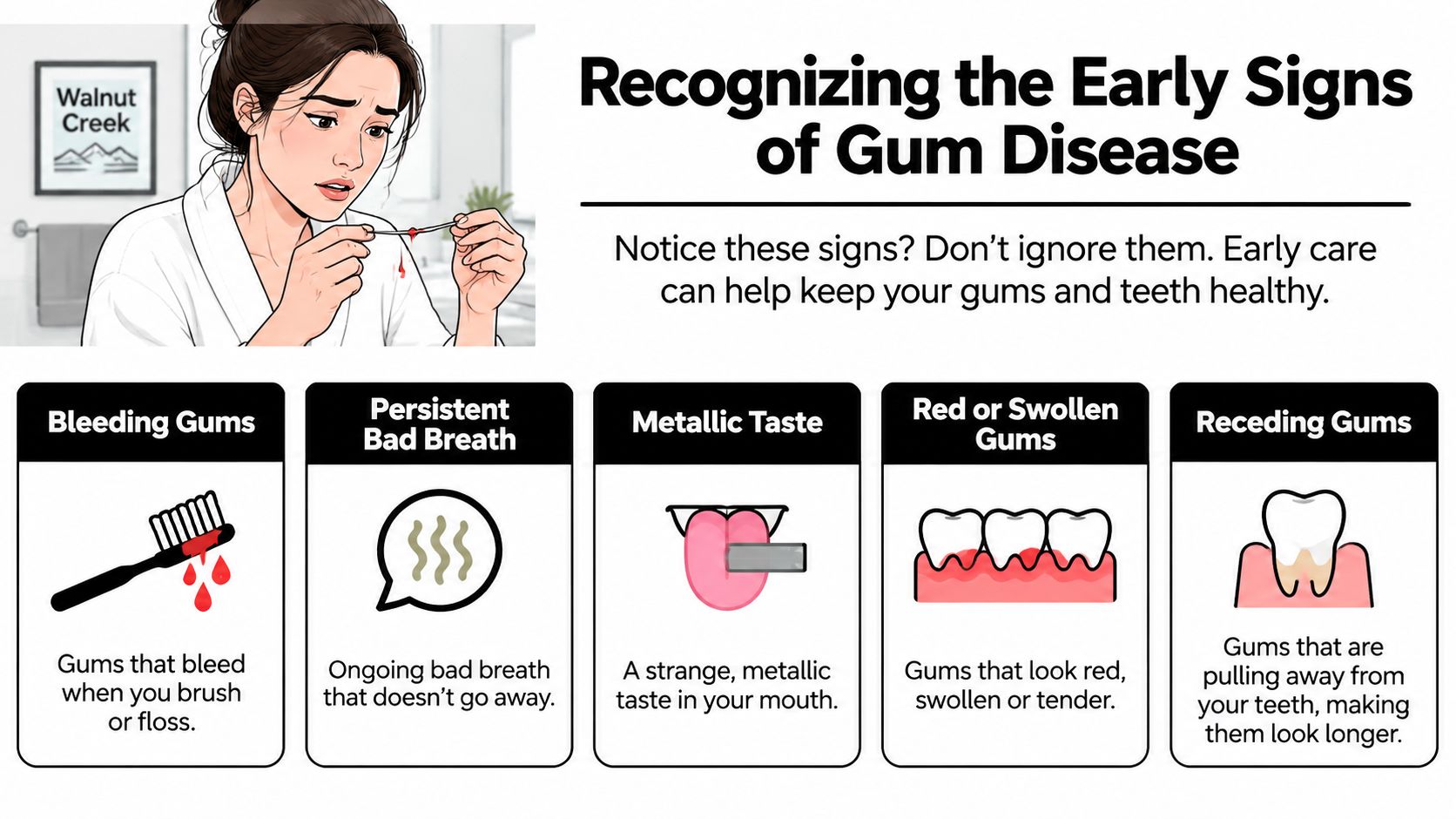
A small red mark on the floss may be the first sign a Walnut Creek patient notices. The gums might not hurt, and the teeth may look unchanged, which makes bleeding easy to dismiss. Persistent bad breath, a metallic taste, tenderness, redness, swelling, or a gumline that appears to pull away from the teeth add useful clues.
Gum disease is usually a slow, staged condition. Gingivitis affects gum tissue and may improve after professional plaque removal, consistent brushing, and daily cleaning between the teeth. Periodontitis affects the supporting tissues around the teeth. Attachment loss and bone loss can develop without dramatic pain, so the treatment plan depends on findings that cannot be judged from appearance alone.
Symptoms that deserve prompt attention
Some changes warrant an evaluation rather than waiting for the next routine cleaning:
- Bleeding gums: Bleeding during brushing or flossing usually reflects inflammation, not a normal response to cleaning.
- Persistent odor or taste: Bad breath or a metallic taste can result from bacterial buildup beneath the gumline.
- Receding gums: Exposed roots may cause sensitivity and can signal reduced gum support.
- Shifting or loose teeth: Movement suggests that the tissues supporting a tooth may have weakened.
Diabetes can make gum inflammation harder to control. Gum disease and cardiovascular risk are also considered together when reviewing a patient's health history. Dental treatment does not replace medical care, but these connections make a complete evaluation worthwhile.
42% of dentate adults age 30 and older in the United States had periodontitis in NHANES data from 2009 to 2014, with prevalence increasing with age. The figure is reported in the European Federation of Periodontology guideline publication. What appears in the mirror is only an initial clue. At a general dental practice, pocket measurements, radiographs, and your symptom history help distinguish early inflammation from disease involving deeper support, including stages I through III.
How Gum Disease Is Diagnosed and Staged
A patient may notice bleeding or gum changes, yet the severity of disease often sits below the gumline. At a Walnut Creek general dental visit, diagnosis starts with your history and a periodontal examination. The dentist uses a slender periodontal probe to measure the space between each tooth and its surrounding gum. Measurements are commonly recorded at six points around every tooth, creating a map of inflammation, attachment loss, and sites that need closer attention.
A reading of 1 to 3 millimeters is generally considered healthy when there is no bleeding or other evidence of disease. A 4-millimeter pocket may call for monitoring and better plaque control. Readings of 5 millimeters or more can indicate periodontitis, especially when bleeding, attachment loss, or bone loss is also present.
What the measurements mean
The diagnosis depends on the pattern of findings, not one measurement alone:
- Pocket depth: Shows how far the probe travels below the gumline.
- Bleeding on probing: Indicates active inflammation at that site.
- Clinical attachment loss: Helps show how much support the tooth has lost over time.
- Radiographs: Reveal the pattern and extent of bone loss that cannot be seen in a mirror.
- Mobility and furcation involvement: Show whether a tooth moves or whether disease has reached the area where its roots divide.
The 2017 World Workshop classification organizes periodontitis into Stages I through III. Grade A, B, or C describes the risk and pace of progression. Staging helps the dental team connect clinical findings with what treatment may involve. Stage I usually reflects early support changes. Stage II involves more established pockets and attachment loss. Stage III may include deeper pockets, significant bone loss, mobility, or anatomy that is difficult to clean.
| Stage | Pocket Depth | Bone Loss | Treatment Direction |
|---|---|---|---|
| Stage I | Usually shallow to moderately increased pockets | Early or limited loss of support | Nonsurgical therapy, home-care coaching, and maintenance |
| Stage II | Deeper or more established pockets | Moderate attachment and bone loss | Scaling and root planing, reassessment, and structured maintenance |
| Stage III | Residual deep pockets, mobility, or complex defects | More advanced support loss | Nonsurgical therapy with specialist or surgical evaluation for complex defects |
A practical treatment plan connects each finding to a next step. Deeper, bleeding pockets may lead to scaling and root planing, followed by reassessment. Stable readings may support preventive cleanings and closer monitoring. Gum disease requires ongoing supportive care, because the goal is to control inflammation, preserve remaining support, and identify recurrence before it causes further damage.
Immediate Home Care Steps That Make a Difference
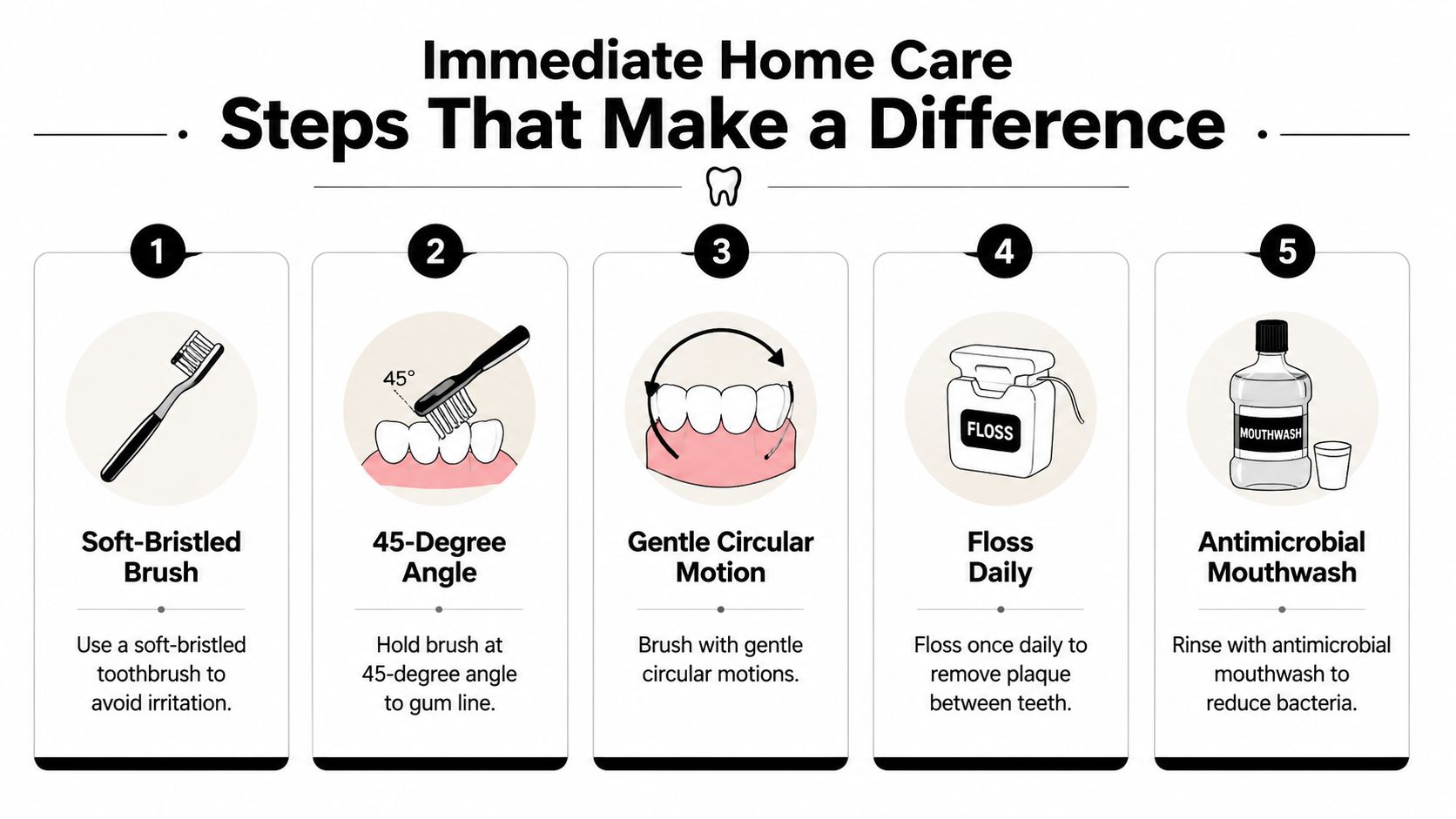
You can start supporting your gums this week, even before a periodontal appointment. Use a soft-bristled toothbrush and hold it at about a 45-degree angle toward the gumline. Brush gently for two minutes twice daily, focusing on the edge where plaque collects instead of scrubbing hard enough to irritate the tissue.
Clean between the teeth every day. Floss may work well where contacts are tight, while interdental brushes can be more effective where there are larger spaces, recession, or periodontal pockets. A water flosser can help patients who struggle with thread floss, but the right tool depends on your tooth spacing and dexterity.
Habits that support healing
- Stop tobacco use: Smoking and other tobacco exposure can interfere with gum healing and make inflammation harder to manage.
- Manage blood sugar: Patients with diabetes should work with their medical team to maintain appropriate glucose control.
- Choose supportive nutrition: A balanced diet containing vitamin C and omega-3 sources can support general health and healing.
- Replace worn brushes: Change a toothbrush when the bristles become worn, or follow the replacement schedule recommended by your dental team.
- Use rinses carefully: Chlorhexidine may be prescribed for a specific situation, but it isn't a substitute for mechanical plaque removal and shouldn't be used casually.
These steps lower the bacterial load around the gums and make professional treatment and maintenance more effective. They can't remove hardened tartar beneath the gumline, repair lost bone, or reliably close deep periodontal pockets by themselves.
For practical guidance on brushing and interdental cleaning, review these oral hygiene best practices from a Walnut Creek dental practice.
Practical rule: Home care controls the daily buildup. Professional care reaches the deposits and anatomy you can't access safely at home.
Professional Treatments from Deep Cleaning to Surgery
The central treatment for active periodontitis is mechanical removal of plaque and tartar below the gumline. Scaling and root planing, often called deep cleaning, uses specialized instruments to remove deposits and smooth contaminated root surfaces so bacteria are less likely to remain attached. The American Dental Association guideline on nonsurgical periodontitis treatment supports scaling and root planing as the initial nonsurgical treatment for chronic periodontitis.
Treatment is stepwise. After subgingival instrumentation and healing, the dentist reassesses pocket depth, bleeding, and the sites that remain diseased. A level-S3 evidence synthesis reported an average probing-pocket-depth reduction of 1.7 millimeters at 6 to 8 months, a mean bleeding-on-probing reduction of 63%, and a mean closed-pocket rate of 74% after nonsurgical therapy, with pockets deeper than 6 millimeters improving by a mean of 2.6 millimeters. These figures come from the SDCEP clinical parameters guidance, and individual results vary with starting severity, anatomy, home care, tobacco exposure, and maintenance attendance.
Choosing the next level of care
Routine systemic antibiotics aren't recommended for general periodontitis management, and local antimicrobials aren't routine substitutes for mechanical treatment, as outlined in European periodontitis treatment guidance. The purpose of treatment is to remove the biofilm, control risk factors, and maintain the result.
Residual 4 to 5 millimeter pockets may need repeat instrumentation, while pockets of 6 millimeters or more often require surgical consideration instead of repeated debridement alone. Osseous surgery can provide access to deep areas, and guided tissue regeneration or connective tissue grafting may be considered for selected defects or recession patterns. A general practice can often provide evaluation, diagnosis, scaling and root planing, and maintenance, while a periodontist may handle complex surgical or regenerative procedures.
| Treatment | Best For | Expected Pocket Reduction | General or Specialist Practice |
|---|---|---|---|
| Professional periodontal evaluation | Bleeding, recession, odor, or suspected gum disease | Establishes baseline measurements | General practice |
| Scaling and root planing | Active pockets with subgingival deposits | Variable, with deeper sites often improving more | General practice, depending on complexity |
| Repeat subgingival instrumentation | Residual bleeding pockets after healing | Further reduction at responsive sites | General practice or specialist |
| Periodontal surgery | Persistent deep pockets or complex defects | Determined by anatomy and procedure | Usually specialist-led |
| Supportive periodontal therapy | Stabilized disease after active treatment | Maintains controlled pocket conditions | General practice and specialist coordination |
The scaling and root planing procedure is usually followed by reassessment after healing. A reevaluation around 4 to 6 weeks may be appropriate in a general treatment sequence, although timing depends on the clinical situation.
Maintenance and Prevention for Lasting Results
Initial treatment lowers the active burden of gum disease. Maintenance protects the result. Gums may become stable after therapy, but a history of periodontitis still affects the care plan. Plaque and calculus can build up again, while inflammation may remain painless until supporting bone or gum tissue is affected.
The appropriate recall interval depends on disease severity, risk factors, home care, smoking, medical conditions, and findings at previous visits. Many treated patients return for periodontal maintenance every 3 to 4 months, rather than automatically following a six-month cleaning schedule. Guidance supports individualized intervals from 3 to 12 months, with some patients needing visits every 2 to 4 months.
What happens during maintenance
A maintenance visit has a different purpose from a routine polishing. The dental team may:
- Recheck pocket depths and bleeding: A change at one site can signal returning inflammation before symptoms become obvious.
- Remove plaque and calculus: Deposits are cleared above and, when needed, below the gumline.
- Review home-care fit: Brush size, interdental tools, and technique can be adjusted when a current method is not reaching a problem area.
- Address risk factors: Tobacco use, blood-sugar control, and grinding may affect stability.
- Update the plan: Persistent pockets may require repeat instrumentation or evaluation by a periodontist.
Long-term evidence supports continuing care after active treatment. A published adult periodontitis cohort found that continuous nonsurgical therapy over three successive years reduced subsequent tooth mortality by 58%, with a relative rate of 0.42 and a 95% confidence interval of 0.29 to 0.61, compared with no therapy, as reported in the published adult periodontitis cohort.
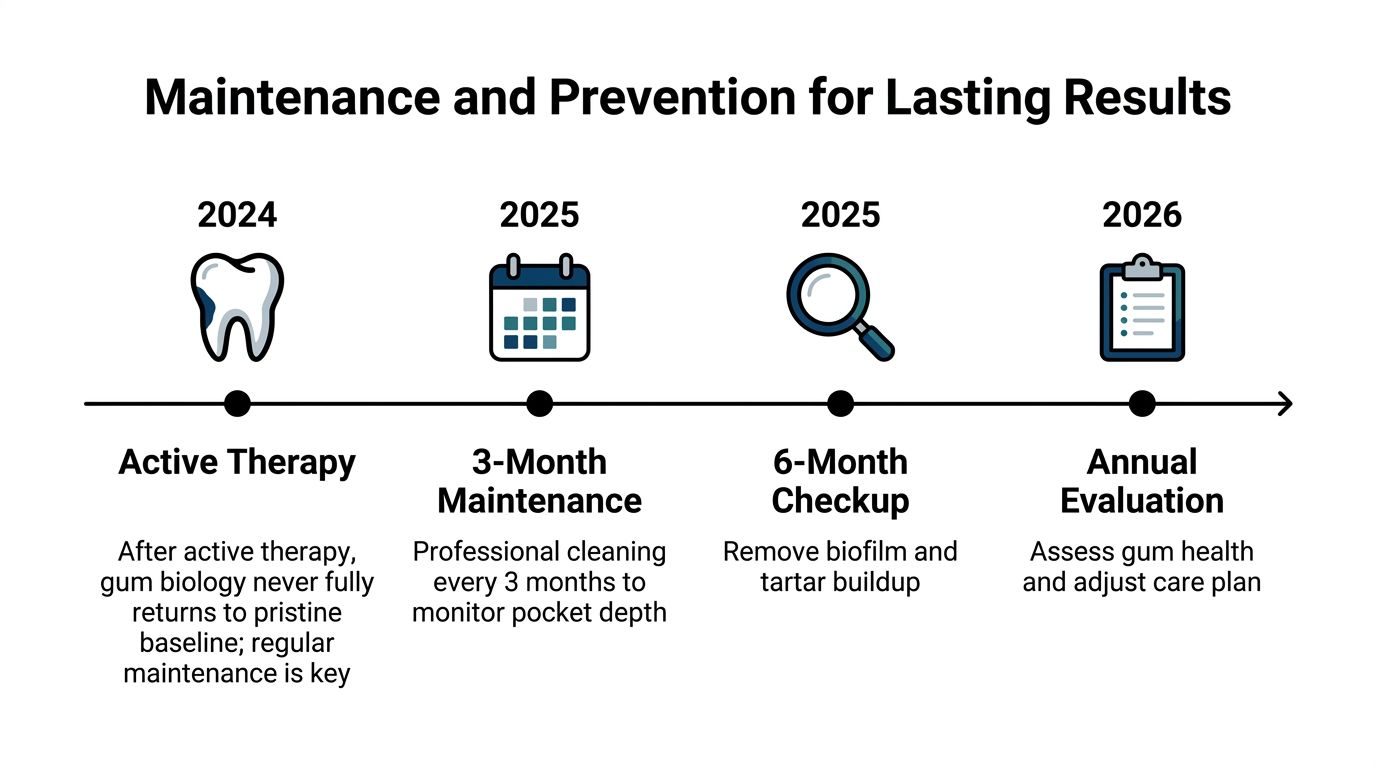
Maintenance appointments also reveal recurrence early. A pocket that bleeds at today's visit may have been stable six months ago, so the comparison with prior measurements matters. The dentist can then respond while the change is localized, rather than waiting for swelling, odor, looseness, or discomfort to appear. Consistent follow-up keeps controlled disease from becoming active again.
What to Expect at a Walnut Creek Dental Visit
The process should begin with a real conversation, not a rushed handoff. When you call a Walnut Creek dental office, ask whether the team can discuss your symptoms, insurance questions, scheduling needs, and dental anxiety before the appointment. Searching for a dentist near me, that first interaction can tell you whether the practice is prepared to listen.
At the first visit, expect more than a quick polish if bleeding, recession, bad breath, or tooth movement is part of the concern. An evaluation may include six-point periodontal probing, dental x-rays when indicated, an oral examination, and a discussion of your medical and dental history. The dentist should explain what each finding means instead of handing you a diagnosis without context.
A clear plan from the first visit
Patients often understand treatment better when the dentist uses the actual radiographs and intraoral images at chairside. You should be able to see where bone support has changed, which pockets bleed, and why one area may need scaling and root planing while another only needs improved home care.
A written plan can outline staged options, estimated costs, insurance considerations, and the next appointment. It may also coordinate gum treatment with restorative dentistry, a root canal, a crown, or a tooth extraction if a severely compromised tooth can't be maintained. When replacement is appropriate, the conversation may later include bridges or dental implants near me, but preserving a natural tooth remains the first consideration whenever the prognosis allows.
A good periodontal visit should leave you knowing what was found, what happens next, and what you can do between appointments.
Anxiety deserves practical accommodations. Nitrous oxide may be available when appropriate, and blankets, noise-canceling headphones, painless injection techniques, and permission to pause can make care easier for patients who have delayed treatment. Early morning scheduling can also help Walnut Creek professionals and families fit evaluation and maintenance into demanding routines.
When to Seek Specialist Care and How to Schedule
A general dentist can manage many gum-disease cases, but some findings call for a periodontist's expertise. Referral is especially reasonable when pockets remain deeper than 6 millimeters after scaling and root planing, radiographs show rapid or advanced bone loss, recession exposes vulnerable root surfaces, or tooth mobility and furcation involvement make cleaning unusually complex.
Surgery isn't automatically the first answer. Current stepwise guidance generally supports nonsurgical treatment first, followed by reassessment. If deep residual pockets remain, a periodontist can evaluate procedures such as access surgery, osseous surgery, guided tissue regeneration, or grafting. A general dentist can continue overseeing the rest of your oral health, including decay prevention, restorative dentistry, crowns, bridges, dental implants, cosmetic dentistry, teeth whitening, and emergency dental services.
A practical Walnut Creek scheduling path
- Call the office: Walnut Creek patients can contact William M. Schneider, DDS at (925) 930-8188 and explain that they're concerned about bleeding, recession, bad breath, loose teeth, or a previous gum-disease diagnosis.
- Request a periodontal evaluation: Ask whether the visit will include pocket measurements, bleeding assessment, and radiographs when clinically indicated.
- Gather records: Request recent x-rays, periodontal charts, medication information, and records from another dental office if a specialist referral is already being considered.
- Discuss sequencing: Ask what should happen first, when healing will be reassessed, and which findings would trigger a specialist referral.
- Reserve maintenance: Don't wait until symptoms return to schedule the follow-up that protects the treatment result.
Early scheduling can help preserve remaining bone support, reduce treatment complexity, and protect the work already completed. It also gives you time to address related problems before they interfere with chewing, comfort, or plans for tooth replacement.
William M. Schneider, DDS provides periodontal evaluations, scaling and root planing, preventive care, and coordinated general, cosmetic, and restorative dentistry for patients in Walnut Creek, CA. Visit William M. Schneider, DDS to request an appointment, discuss your gum symptoms, and take the next step toward a stable, comfortable smile.