Considering Invisalign and trying to picture your own smile after treatment? That's usually the first real question patients ask when they sit down with me in Walnut Creek. They want to know whether the changes will be subtle or dramatic, how long the process may take, and what happens after the aligners come off.
At William M. Schneider, DDS, we help patients sort through those questions with a clear plan and realistic expectations. Invisalign results before and after can be impressive, but the best outcome depends on the starting bite, the treatment plan, and how carefully the results are maintained afterward. If you've been searching for a dentist near me, a cosmetic dentist near me, or a dentist in Walnut Creek, CA who can explain the process in plain language, this guide is a good place to start.
1. What Happens After Invisalign, Retainers, Results, and Maintenance
The most overlooked part of Invisalign is the part that protects the smile you just earned. After active treatment, teeth don't stay put on their own, so retention matters just as much as the aligners did. In our Walnut Creek office, we walk patients through that transition carefully, because the after photo is only useful if the result holds up in real life.
Retainers are part of the treatment, not an extra
Most patients leave active Invisalign treatment with a clear removable retainer, a fixed bonded retainer, or a combination of both. The right choice depends on the bite, the amount of movement completed, and how stable the result looks at the end of treatment. Our job is to fit that retainer properly, monitor it over time, and replace it when needed so the teeth don't drift.
Practical rule: if the retainer feels tight, stops fitting, or shows cracks, don't wait. Small changes are easier to correct than relapse that has been left alone.
Daily care is straightforward, but it has to be consistent. Clean the retainer gently, keep up with checkups, and bring it in if it starts to look worn. Patients who want a refresher on aligner care can also review our guide on how to clean Invisalign, because clean trays and clean retainers support better long-term wear.
What to watch for after treatment
A little movement can happen slowly, which is why we pay attention to small warning signs. If the bite feels different, teeth stop meeting the way they should, or flossing becomes harder again, those changes deserve an exam. Our team also supports patients with periodic monitoring, custom retainers, and adjustments when the bite needs a closer look.
The best Invisalign finish is not just straight teeth, it's a stable bite that still looks natural months and years later.
That long view matters in a family practice like ours. We focus on preventive cleanings and exams, cosmetic dentistry, and restorative care, so if a patient later needs a crown, whitening, or another service, we're already tracking the full picture of oral health.
2. Invisalign Before and After Cases from the Official Gallery
The manufacturer's own gallery is a good starting point because it shows real patient cases rather than marketing-only imagery. The official Invisalign case library includes before-and-after photos across different ages and bite patterns, and it also gives a first look at what aligner treatment can do for crowding, spacing, and bite correction. For patients who want a broad overview before booking a consultation, it's a useful, credible place to begin.
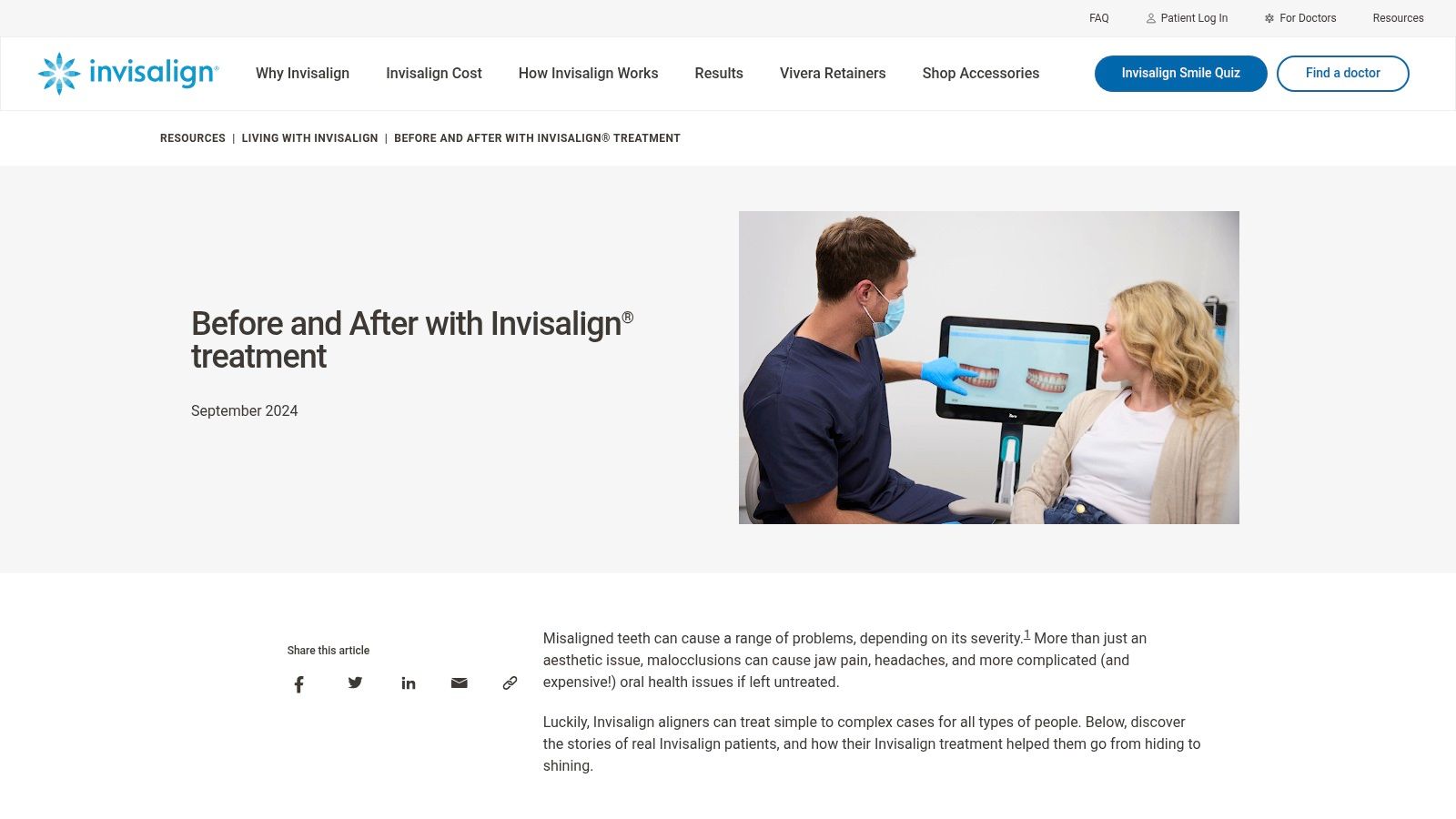
The biggest strength of the official gallery is its consistency. You can compare cases without wondering whether the images have been cherry-picked from unrelated sources. It also pairs well with the basics of treatment planning, so patients can connect the pictures to how Invisalign works in practice. For a plain-English explanation of that process, see our page on how Invisalign works.
The limitation is just as important. A gallery photo rarely tells you whether the case needed refinements, how stable the bite became, or whether the patient needed another round of aligners near the end. That's why I tell Walnut Creek patients not to stop at the photo. A good result is measured by alignment, function, and retention, not only by appearance.
A few things make the official cases especially helpful:
- Real patient examples: The library shows actual treatment outcomes rather than artist's impressions.
- Broad starting points: You'll see that Invisalign is used for more than one kind of smile concern.
- Expectation setting: The photos help patients see that results can be natural-looking, not overdone.
- Provider connection: The site makes it easy to locate an Invisalign-trained clinician for an in-person exam.
If you're comparing options for cosmetic dentistry or thinking about teeth whitening after alignment, this kind of gallery can help you picture the sequence. Straighten first, then refine the smile if needed.
3. Inspired Orthodontics Case Gallery for Invisalign Variety
A specialized orthodontic gallery shows a different side of treatment, especially when the starting bite is more complex. The Inspired Orthodontics case gallery organizes examples by treatment type, so you can compare Invisalign outcomes alongside other orthodontic care rather than viewing aligners in isolation. That makes it useful for patients who want to understand when Invisalign fits well and when a more advanced orthodontic plan may be needed.
The practical advantage here is range. You can scroll through Invisalign cases and then compare them with crossbite or jaw surgery examples elsewhere in the gallery. That matters because not every smile issue lives in the front teeth alone. Some patients need more than a cosmetic correction, they need a plan that accounts for how the upper and lower teeth meet.
Why specialists' galleries are worth reviewing
The photos tend to reflect a broader case mix, including routine and more advanced treatment. That helps patients see where aligners perform nicely and where the bite may call for more involved management. For anyone in Walnut Creek trying to understand whether Invisalign is a good fit before seeing a local dentist, that context is valuable.
A gallery becomes more useful when it shows more than straight teeth. It should show how the bite changed and whether the result makes sense for the starting problem.
The downside is the lack of narrative. You may see a strong before-and-after transformation, but not the clinical reasoning behind it. That's where an in-person consultation becomes essential. At William M. Schneider, DDS, we use modern technology and a careful exam to determine whether Invisalign, another form of restorative dentistry, or a different approach will give the patient the safest and most predictable result.
For local patients searching for a dentist near me who explains options without pressure, that matters. A good Invisalign plan is less about chasing the biggest visual change and more about choosing the right tool for the right mouth.
4. FORME Dental Before and After Gallery for Cosmetic Planning
FORME Dental's gallery is built for patients who care about presentation as much as movement. The Orthodontics and Invisalign section emphasizes digital planning and natural-looking results, which makes it appealing to anyone who wants a smile that looks refined without appearing artificial. That combination is especially relevant when the patient is also thinking about whitening, bonding, or a broader cosmetic dentistry plan.
The photos are polished and easy to review. Lighting is clear, framing is consistent, and the cases feel curated for people who want to visualize how Invisalign can fit into a full smile makeover. For some patients, that visual confidence is the main reason they keep moving forward.
What this kind of gallery does well
It helps patients compare subtle improvements with larger changes in smile appearance. It also shows that Invisalign can be part of a cosmetic plan, not just an orthodontic correction. That distinction matters in private-practice dentistry, where patients often want healthy alignment and a better overall look.
The limit is that fewer cases are dedicated solely to Invisalign, so the gallery leans more cosmetic than clinical. That's not a weakness if you're mainly evaluating aesthetics. It is a limitation if you need a deeper discussion about bite mechanics, retention, or whether a more functional concern needs another treatment path.
For Walnut Creek patients, the takeaway is simple. A clean before-and-after photo can be encouraging, but the key question is whether the result can be maintained and supported by regular dental care. Our practice treats that as part of the same conversation, not as an afterthought. That's true whether a patient is coming in for Invisalign, tooth extraction, a root canal, or another restorative need later on.
5. Goldenberg Orthodontics Smile Gallery for Condition-Based Cases
Goldenberg Orthodontics makes its gallery easier to use by labeling Invisalign cases according to the condition treated. That sounds like a small detail, but it's very helpful. A patient with a deep bite doesn't need to guess which case might resemble theirs, and someone concerned about open bite or rotated incisors can look for a similar starting point.
That kind of organization is useful because invisalign results before and after are not one-size-fits-all. The same aligner system can be used for crowding, crossbite, open bite, overjet, and more, but the visual outcome depends on the problem being solved. When you can match the case label to your own concern, expectations get more realistic.
Reading the gallery the right way
Condition-based galleries can help patients focus on the right questions. Did the bite improve? Did the front teeth align without making the smile look forced? Did the case need extractions or another orthodontic strategy to finish well? Those details matter more than a generic smile makeover photo.
The best gallery photos answer a functional question, not just a cosmetic one.
The site also gives patients a sense of where Invisalign fits among other orthodontic options. That comparison is useful for anyone who wants to understand treatment selection before scheduling a consultation. In our Walnut Creek practice, we use the same mindset when planning care. If the goal is a straighter smile, Invisalign may be the right tool. If the issue is a more urgent dental problem, such as infection or a broken tooth, the better starting point may be emergency dentist care or a different restorative treatment first.
For patients who want a cosmetic dentist near me but still care about bite health, this is the right way to think. A beautiful smile should also be comfortable, functional, and stable.
6. Southern Smiles Orthodontics for Complex Open-Bite Treatment
Some of the most honest before-and-after content is the kind that shows when Invisalign alone is not enough. The Southern Smiles Orthodontics case of a severe open-bite patient treated with Invisalign plus orthognathic surgery is a strong example of that honesty. It shows a treatment path that used aligners as part of a larger plan instead of pretending a single appliance could solve everything.
That matters because complex bite problems often need interdisciplinary care. A dramatic photo can hide the fact that the patient required surgery, specialized planning, and close follow-up to reach a stable result. For readers trying to understand the limits of aligners, that kind of case is more useful than a polished gallery of mild crowding only.
Why complex cases deserve special attention
Open bite and crossbite issues can involve more than tooth position. They can affect chewing, speech, and long-term stability if the underlying bite relationship isn't addressed. A combined approach gives the patient a better shot at a result that is both visible and functional.
The benefit of reviewing this type of case is that it sets a fair boundary. Invisalign is powerful, but it isn't magic. Some smiles need surgery, some need braces, and some need a combination of approaches. That's not a failure, it's good treatment planning.
In our Walnut Creek office, we explain those limits early so patients aren't surprised later. If a case is appropriate for Invisalign, we move forward with a personalized plan. If not, we discuss other options, whether that means restorative dentistry, a different orthodontic approach, or coordination with specialists. That level of honesty is part of why patients keep looking for a trusted local practice instead of chasing a one-size-fits-all promise.
7. Central Dental Associates Before and After Gallery for Dentist-Led Care
Central Dental Associates offers a useful comparison point because it presents Invisalign results within a general dentistry setting. That helps patients who are deciding whether they want care from a dentist-led practice or an orthodontic specialty office. The gallery includes multiple cases and states that the images are unaltered, which supports visual credibility.
The appeal here is straightforward. Patients can see a range of malocclusions and get a feel for how Invisalign performs in everyday dental practice. For some people, that's reassuring. They want to know that aligner treatment can be coordinated with routine care, cleanings, exams, and other services they already need.
Why this matters to local patients
A dentist-led Invisalign plan can be a practical fit when a patient also wants continuity for other needs. One office can track the smile from the first consult through maintenance, and that makes follow-up simpler. It also helps when a patient later needs dental x-rays, a new patient exam, a filling, or another service tied to long-term mouth health.
The right Invisalign provider should be able to talk about more than straight teeth. They should know how the bite, the gums, and the rest of the mouth work together.
That's the model we use in Walnut Creek. Dr. Schneider's approach combines cosmetic dentistry with broader family care, so the smile you're improving today stays connected to your long-term oral health. If you're comparing dentist near me searches and looking for a practice that can handle both aligners and everyday care, that continuity can make a real difference.
Invisalign Before & After: 7-Case Comparison
| Source | Implementation complexity | Resource requirements | Expected outcomes | Ideal use cases | Key advantages |
|---|---|---|---|---|---|
| What Happens After Invisalign? (William M. Schneider, DDS) | Low, informational guide | Low time investment; in‑office retainer services may be required | Improved retention if compliant; clear maintenance plan | Patients completing Invisalign who need aftercare and retention guidance | Personalized retention plans, clinic follow‑up, practical care tips |
| Invisalign, Before and After Cases (official) | Low, browseable gallery & tools | Minimal; optional SmileView photo input | Manufacturer-verified transformations; broad expectation setting | Early research to gauge possible results and find providers | Authoritative cases, example durations/costs, provider locator |
| Inspired Orthodontics, Invisalign Case Gallery | Low, filterable gallery | Minimal (online browsing) | Specialist-managed outcomes across routine and complex cases | Compare Invisalign to other orthodontic treatments, specialist examples | Filterable by treatment, depth of orthodontic cases |
| FORME Dental, Before & After Gallery | Low, visual gallery | Minimal; online booking available | High-quality cosmetic outcomes with digital planning emphasis | Patients prioritizing aesthetics and natural-looking results | Professional photography, emphasis on digital planning and visuals |
| Goldenberg Orthodontics, Smile Gallery | Low, categorized gallery | Minimal | Condition-labeled results demonstrating a range of problems | Patients seeking examples matching a specific diagnosis | Condition-based labeling, variety of treated case types |
| Southern Smiles Orthodontics, Complex Case | Moderate, interdisciplinary treatment | High, aligners plus surgery and specialist coordination | Significant correction for severe cases when aligners alone insufficient | Patients with severe open-bite or cases needing surgery | Detailed diagnostic rationale, clear interdisciplinary timeline |
| Central Dental Associates, Invisalign Gallery | Low, focused gallery | Minimal; bilingual navigation | Dentist-led Invisalign outcomes, claimed unaltered photos | Compare dentist vs orthodontist-managed Invisalign care | Focused Invisalign examples, bilingual site, unaltered image claim |
Start Your Invisalign Journey in Walnut Creek
These before-and-after stories show how much Invisalign can change, from mild crowding to more complicated bite problems. They also show something just as important, the final result depends on the right diagnosis, careful planning, and follow-through after treatment. A great before-and-after photo is encouraging, but a stable bite and a smile that still looks natural months later is what really matters.
At William M. Schneider, DDS, we take that seriously. Dr. Schneider brings more than 25 years of experience to care that blends modern technology, clear explanations, and a calm, patient-focused setting. Whether you're interested in Invisalign, teeth whitening, crowns, bridges, dental implants, or another form of restorative dentistry, we build the plan around your mouth, your goals, and your comfort.
If you live in Walnut Creek or anywhere in the East Bay, our team can help you understand whether Invisalign is the right fit, what kind of changes to expect, and how to protect the result long term with retainers and follow-up care. Patients who want a dentist in Walnut Creek, CA often tell us they value practical guidance as much as the treatment itself. That's exactly what we aim to provide.
If you're ready to stop wondering what your smile could look like and start planning it, schedule a consultation with our office. We'll review your bite, talk through your options, and help you decide whether Invisalign is the best path toward the healthy, confident smile you want.
William M. Schneider, DDS offers personalized Invisalign care in Walnut Creek, along with the follow-up support that helps preserve your results long term. If you're considering aligners and want a trusted local dentist to explain your options clearly, visit William M. Schneider, DDS and schedule a consultation today.