Seeking an oral surgeon in Walnut Creek, CA, is rarely a recreational activity. Usually, something has already happened. A tooth cracked. A wisdom tooth started throbbing. A dentist told you an implant may be the right next step. Or maybe you've been putting off care because the idea of surgery makes your stomach tighten.
That reaction is common. Most patients don't worry about a routine cleaning and exam the way they worry about a tooth extraction, dental implants, or jaw-related treatment. Surgery feels bigger. It sounds more serious. It raises questions fast. Who should do it? Will it hurt? Do you really need a specialist? Can this be done close to home?
In Walnut Creek, patients don't have to travel far for advanced care. Walnut Creek serves as a central hub for specialized dental care in the East Bay, with access to advanced surgical procedures close to home. That matters because surgical care is easier when your consultation, treatment, and follow-up visits are nearby.
Your Guide to Specialized Dental Care in Walnut Creek
A patient might come in thinking they need a simple filling and leave with news they weren't expecting. The tooth can't be saved. A tooth extraction is the safer option. Or a missing tooth that has been ignored for years now affects chewing, neighboring teeth, and confidence when smiling. In those moments, people often feel two things at once. Relief that there's an answer, and fear about what comes next.
That's where specialized surgical care helps. Oral surgery isn't just about pulling teeth. It can involve removing impacted wisdom teeth, placing dental implants, rebuilding bone, or treating problems that affect the jaw and surrounding structures. For many patients, the biggest benefit is clarity. You finally understand what the problem is, why a certain procedure is recommended, and what the path forward looks like.
Why patients often feel unsure
Many people hear the phrase "oral surgeon" and immediately assume the problem must be extreme. That's not always true. A specialist may be involved because the tooth position is difficult, the roots are close to a nerve, the area needs reconstruction for an implant, or anxiety makes sedation important.
A few common situations include:
- Persistent pain: A toothache that doesn't settle down may point to infection, fracture, or an impacted tooth.
- Missing teeth: Patients looking up "dental implants near me" often learn that replacing a tooth can involve surgical planning, not just a crown.
- Crowding or pressure: Wisdom teeth can create pain, swelling, and cleaning problems even before they visibly erupt.
- Jaw concerns: Bite changes, facial discomfort, and structural issues sometimes need care beyond general dentistry.
Many patients don't need more information as much as they need someone to translate the information into plain English.
Why local guidance matters
When care is nearby, patients usually feel more comfortable asking questions, bringing in family members, and returning for follow-up if healing needs to be checked. That's especially important when you're dealing with discomfort, swelling, or the stress that can come before a procedure.
For patients who also need a dentist in Walnut Creek, CA for ongoing cleanings, exams, restorative dentistry, or emergency dentist visits, it helps to think of oral surgery as one part of a larger care plan. The goal isn't just to get through the procedure. It's to restore function, reduce pain, and make sure your smile stays healthy long after the surgical visit.
What Is an Oral and Maxillofacial Surgeon
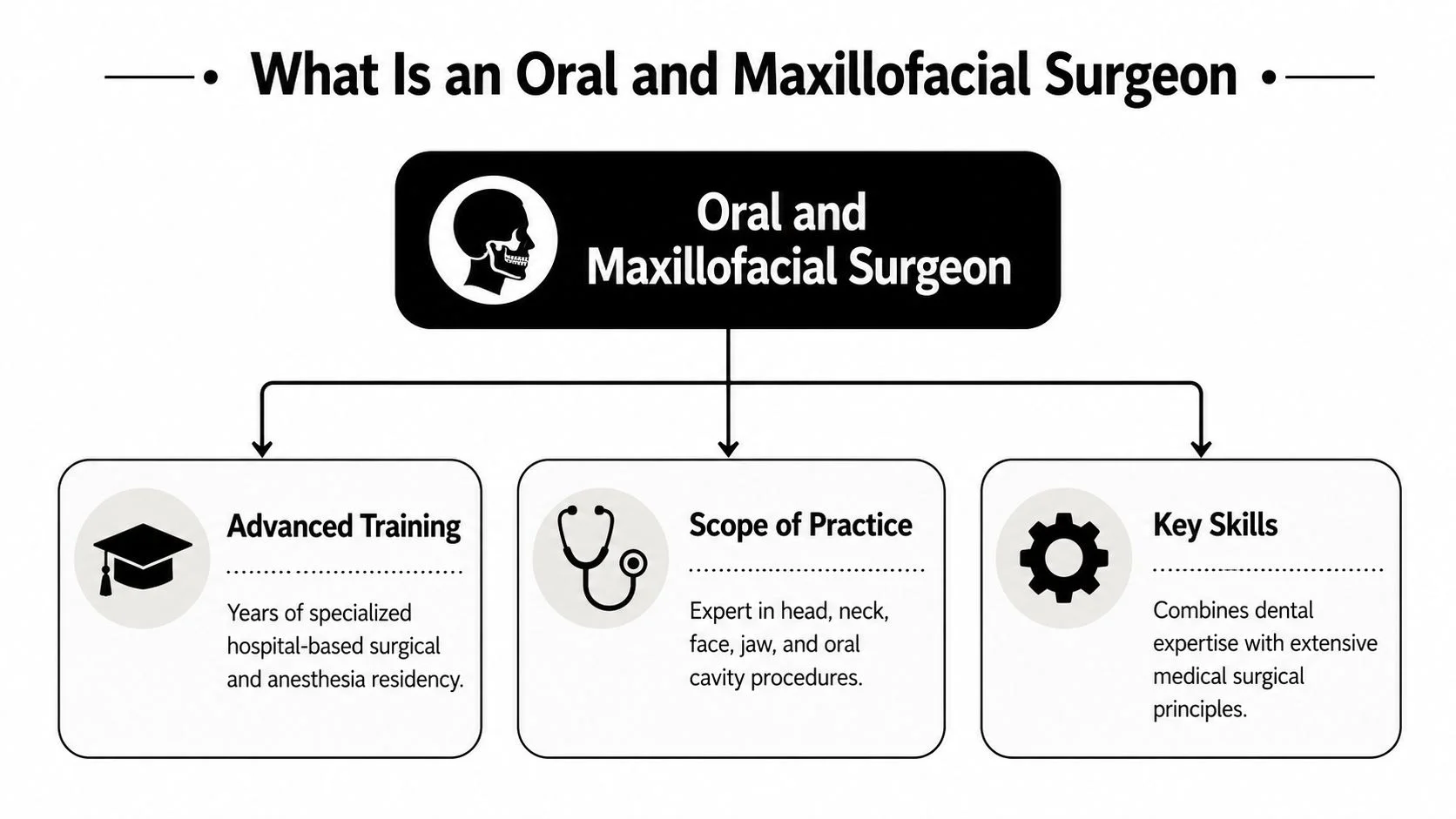
You may hear your dentist say, "This would be better handled by an oral surgeon," and wonder what that means for you. In simple terms, an oral and maxillofacial surgeon is a dental specialist trained to perform surgery involving the mouth, jaws, face, and surrounding bone and tissue. "Oral" means the mouth. "Maxillofacial" refers to the jaws and face.
How this differs from a general dentist
A general dentist is usually the first stop for exams, fillings, crowns, gum care, and routine treatment planning. Some general dentists also remove certain teeth or place implants in straightforward cases.
An oral surgeon handles cases where surgery itself is the central part of treatment, especially when the tooth position is difficult, the anatomy is delicate, the bone needs rebuilding, or sedation may make care more comfortable and controlled.
The easiest comparison is medical care. Your primary doctor can manage many health concerns, but a surgeon is the person you want when the procedure becomes more technical and the planning needs to go deeper.
| Provider | Typical role |
|---|---|
| General dentist | Preventive care, diagnosis, fillings, crowns, routine dental treatment |
| Oral and maxillofacial surgeon | Surgical treatment involving difficult extractions, implants, jaw conditions, and more advanced procedures |
What kinds of problems they treat
This specialty often becomes the right fit when treatment involves surgical access, bone, or nearby nerves and sinuses. Common examples include:
- Impacted teeth: Teeth trapped under the gums or bone, often wisdom teeth
- Complex tooth extraction: Teeth with difficult root shapes, fractures, or infection
- Dental implants: Surgical placement of replacement tooth roots
- Bone grafting: Building support in the jaw before or during implant treatment
- Jaw procedures: Conditions involving bite, jaw structure, or facial support
If your dentist has mentioned preserving the jaw after a tooth is removed, this guide to dental extraction with bone grafting explains why that extra step can matter for future implant options.
Why the word specialist matters
A lot of patients ask the same practical question. Why refer this out instead of doing it in the general dental office?
The answer depends on the details of your case. A tooth that is fully visible and easy to reach may be removed by a general dentist without difficulty. A tooth buried in bone, sitting near a nerve, or broken below the gumline calls for a different level of surgical planning. The same is true when a procedure involves shaping bone, preparing for an implant, or choosing the safest form of sedation.
The distinction matters because oral surgery often includes more than removing a problem tooth. It can involve protecting nearby structures, rebuilding the area for long-term function, and planning for a smoother recovery afterward.
If you are comparing options for an oral surgeon in Walnut Creek, do not stop at "Do they offer this procedure?" Ask better questions. How often do they treat cases like mine? What imaging do they use before surgery? If a complication happens, how is it handled? What should recovery realistically feel like over the first few days?
Those questions help you choose with more confidence, which is the primary goal.
Common Oral Surgery Procedures We Offer
Most patients don't think in terms of procedure names. They think in terms of problems. "My back tooth hurts." "I hate the gap when I smile." "I've been told my wisdom teeth should come out." That's the right place to start.

Wisdom teeth and difficult extractions
Wisdom teeth often become a problem because they don't have enough room to come in normally. They may stay trapped, come in sideways, partially erupt, or create areas that are hard to keep clean. Patients usually notice pressure, swelling, bad taste, gum irritation, or pain that seems to come and go.
Other teeth may also need surgical removal. A tooth can break at the gumline, develop a deep infection, or have roots that make a standard extraction harder than expected. In those cases, the treatment goal is simple. Remove the source of pain and protect the surrounding bone and tissue as much as possible.
If your case may involve rebuilding the area afterward, this page on dental extraction with bone grafting can help you understand why preserving the site matters for future restoration.
Dental implants for missing teeth
When patients search for dental implants near me, they're usually looking for something that feels more stable and natural than a removable option. An implant replaces the root of a missing tooth, and the final restoration is designed to help you chew, speak, and smile with confidence.
Implant treatment can help in situations like these:
- One missing tooth: Replace a gap without relying on neighboring teeth for support
- Several missing teeth: Support a bridge or larger restoration
- A failing tooth: Remove the damaged tooth and plan the next step with long-term function in mind
The biggest point of confusion is often timing. Some patients can move toward implant treatment soon after extraction. Others need healing, bone grafting, or phased care first. That's why surgical evaluation matters.
Jaw surgery and related structural care
Some patients need care that goes beyond teeth alone. Jaw surgery can relate to bite function, jaw alignment, facial balance, or conditions that affect how the upper and lower jaws work together. While that kind of treatment is more specialized, the reason for it is still patient-centered. Better function. Better comfort. Better long-term stability.
Later in the decision process, many patients find it helpful to hear a visual explanation of how surgery solves everyday problems.
Sedation can make treatment easier
Fear of discomfort keeps many people from moving forward. That's one reason sedation dentistry matters in surgical care. For Walnut Creek patients, sedation is commonly integrated with implant placement, third-molar extraction, and jaw surgery to improve tolerance and procedural completion, as described by Walnut Creek Dental's surgical dentistry page.
That doesn't mean every patient needs the same approach. Some people do well with local anesthesia alone. Others need added support because they're highly anxious, have a strong gag reflex, or are having a longer procedure.
If you've been delaying surgery because you're afraid you won't be able to get through it, sedation is one of the first topics worth discussing.
Your Surgical Journey From Consultation to Recovery
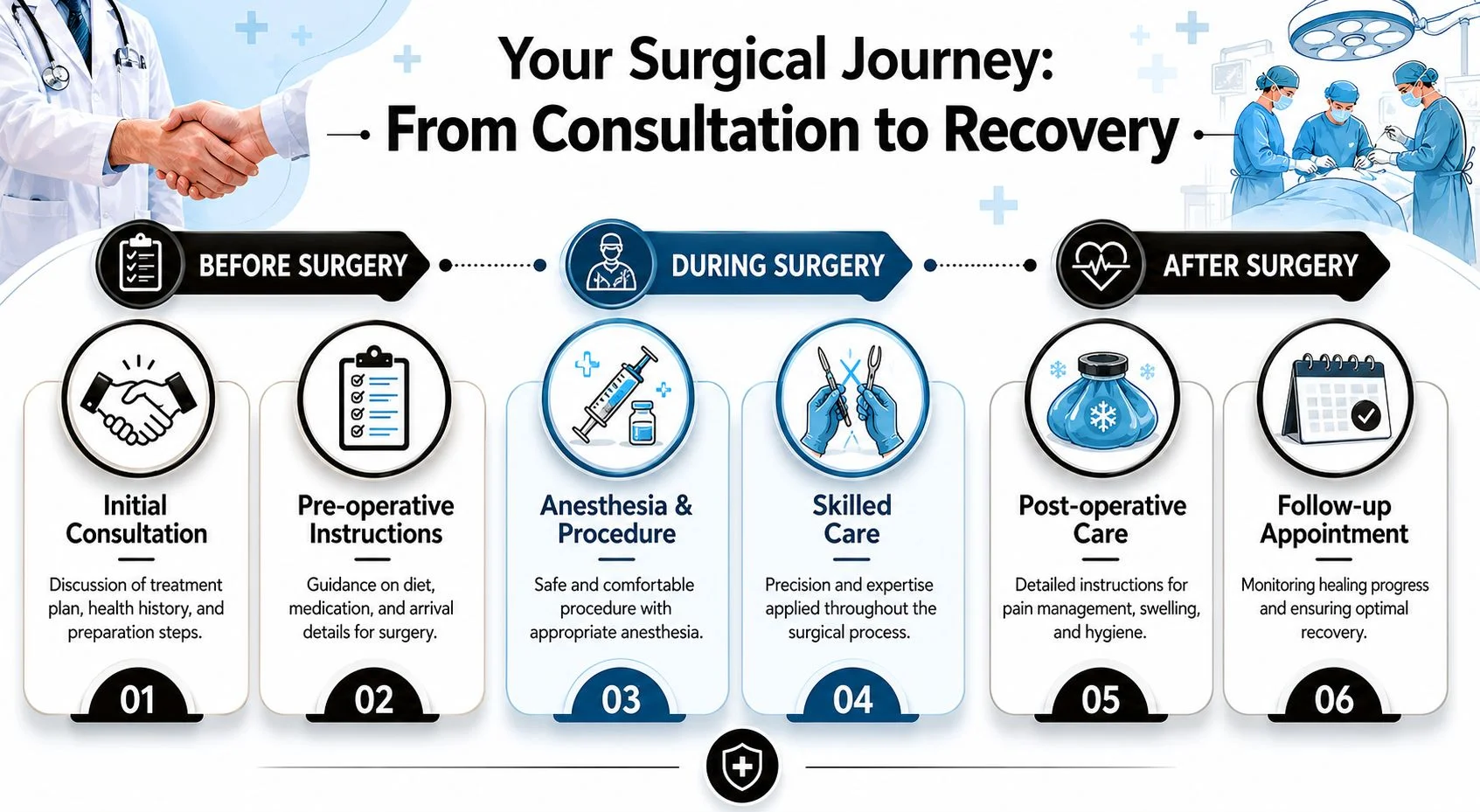
The unknown is often the hardest part. Patients usually feel better once they know what the process looks like. Surgical care tends to feel much more manageable when it's broken into stages.
Before surgery
The first visit is usually a conversation before it's anything else. You'll talk about the problem, what you're feeling, your health history, and what outcome you're hoping for. If you're dealing with pain, swelling, a broken tooth, or a missing tooth, the goal is to identify what needs treatment and whether surgery is the right step.
This is also when patients should bring up practical concerns. Scheduling. Time away from work. Anxiety. Transportation if sedation is planned. Questions about whether treatment happens in one visit or in stages.
Modern practices also recognize that patients need flexible communication and help with urgent scheduling. Current Walnut Creek hiring language around oral surgery care highlights scheduling clarity, urgent access for infections, and accommodations for anxious or medically complex patients.
During surgery
The procedure day is usually calmer than patients expect. By then, you should know what is being done, what type of anesthesia or sedation is planned, and what the immediate recovery will involve. If you're nervous about complex treatment, this overview of sedation dentistry for complex procedures explains how comfort support can fit into care.
A helpful way to think about surgery day is this:
- Arrival and review: Final questions are answered and instructions are confirmed.
- Comfort setup: Local anesthesia, sedation, or both are used as planned.
- Treatment: The surgical team performs the procedure with a focus on precision and tissue protection.
- Recovery guidance: You leave with instructions specific to the procedure performed.
After surgery
Recovery is where good communication really matters. Patients want to know what's normal, what to eat, how to manage soreness, and when to call if something feels off. They also want to know they won't be left guessing.
Typical aftercare conversations include:
- Eating and drinking: Softer foods at first, with clear guidance on what to avoid
- Swelling and soreness: What to expect and how to manage it
- Cleaning the area: How to protect healing tissue without neglecting oral hygiene
- Follow-up: When healing should be checked and what comes next if implants or restorative work are planned
Good surgical care doesn't end when the procedure ends. The follow-up instructions are part of the treatment.
How to Choose the Right Oral Surgeon in Walnut Creek
If you've searched "oral surgeon Walnut Creek" or "tooth extraction near me," you've probably seen a long list of provider pages. The hard part isn't finding someone who offers oral surgery. The hard part is knowing how to compare them.
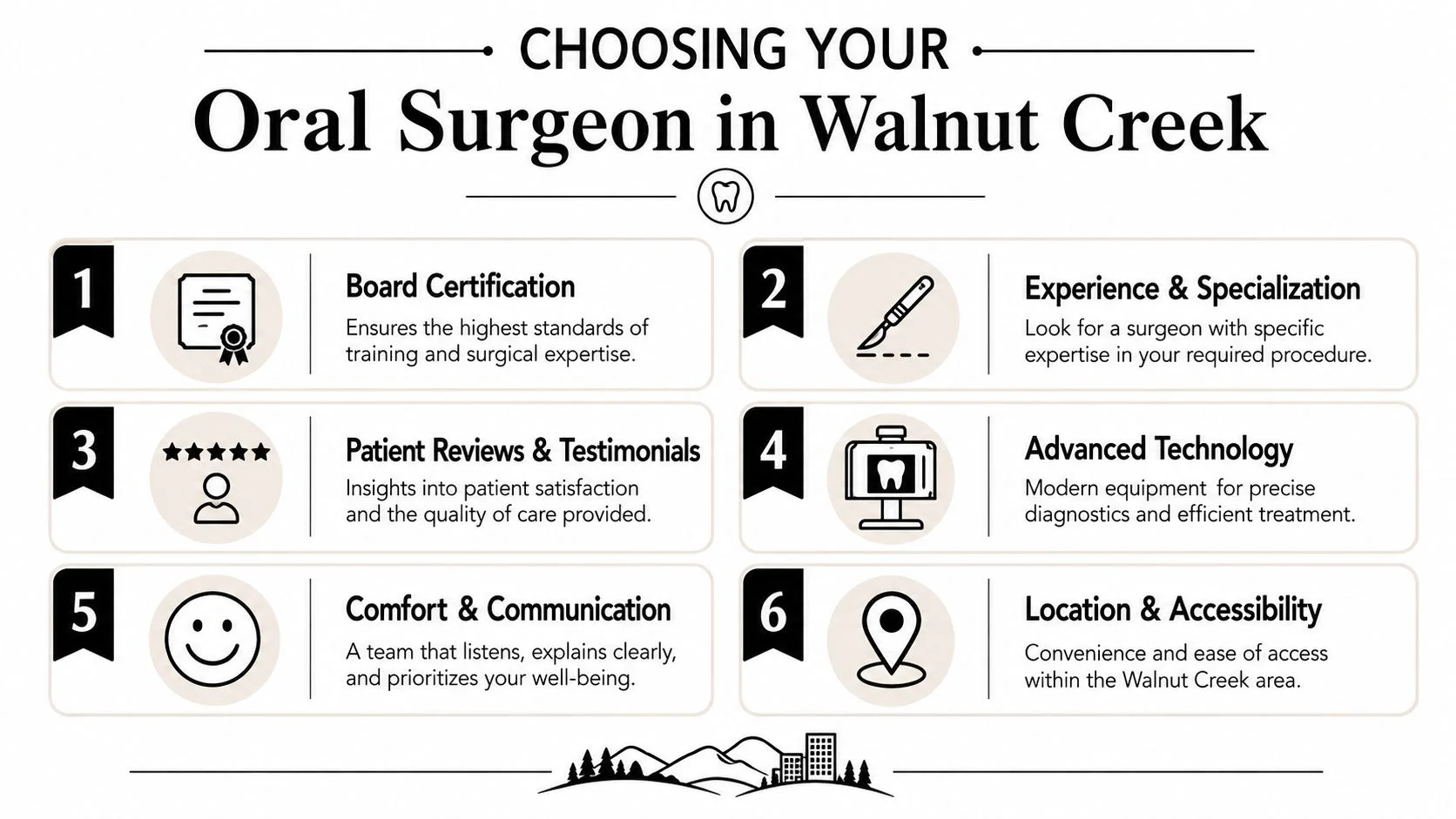
Patients should ask clear questions before choosing an oral surgeon in Walnut Creek, including what is your experience with my specific procedure, what sedation options are available, how do you use technology like 3D imaging for planning, and how are potential complications managed, as noted by Olympic Dental Walnut Creek's oral surgery guidance.
A practical checklist for patients
Not every question has the same weight. Some points are critical because they affect safety and planning.
- Training and credentials: Ask who will perform the procedure and what their background is in that exact type of surgery.
- Procedure-specific experience: A surgeon may do many things well, but your case should match their routine scope of care.
- Sedation options: If anxiety, gagging, or procedure length is a concern, comfort planning matters.
- Imaging and planning: Complex extractions and implant cases often benefit from advanced imaging and careful mapping.
- Complication management: Ask what happens if the roots are difficult, the tooth is impacted, or healing needs closer follow-up.
What often gets overlooked
Patients sometimes focus only on the procedure itself and forget the office experience around it. That's a mistake. Communication can change the entire experience.
A strong office should make it easy to understand:
| What to ask | Why it matters |
|---|---|
| How urgent is this? | Helps you know whether to act quickly or schedule thoughtfully |
| Can treatment be phased? | Useful if you're balancing budget, work, or anxiety |
| Who handles follow-up questions? | Reduces uncertainty after surgery |
| How do you coordinate restorative care? | Important if implants, crowns, or ongoing dental care are involved |
How local patients can think about fit
Convenience isn't everything, but it matters. A Walnut Creek location can make consultation, treatment, and recovery visits simpler, especially if swelling or sedation make travel harder.
For patients who want a single office for broader care, William M. Schneider, DDS provides general, cosmetic, and restorative dentistry in Walnut Creek, including dental implants and sedation when appropriate. That kind of setting can help when surgical needs overlap with long-term dental care, such as replacing a missing tooth after extraction or coordinating follow-up restoration.
The right provider should make you feel informed, not rushed. If you leave a consultation more confused than when you arrived, keep asking questions.
Your Oral Surgery Questions Answered
A lot of anxiety comes from not knowing what happens next. Patients often feel better once the questions are out in the open and answered plainly.
Do I need a referral to see an oral surgeon
You may not. Some patients are sent by a general dentist, while others reach out on their own because of swelling, a cracked tooth, jaw pain, or concern about a missing tooth. If you are unsure, call the office and describe what you are feeling, when it started, and whether it is getting worse. That first conversation often helps sort out whether you need an oral surgery evaluation, a general dental visit, or faster care.
How do I know if my problem is urgent
Urgent problems usually have a pattern. Swelling that spreads, signs of infection, bleeding that does not settle down, severe pain, or trouble chewing or opening your mouth should be checked promptly. If breathing or swallowing feels difficult, seek emergency care right away.
A simple way to think about urgency is this: if the problem is growing, not easing, or interfering with eating, sleeping, or normal function, do not wait for it to "settle." Ask.
Will I be asleep for the procedure
Some procedures are done with local anesthesia only. That numbs the area while you stay awake. Other cases may involve sedation, especially if the surgery is longer, more complex, or if dental anxiety makes it hard to relax.
Sedation is not one-size-fits-all. It works more like a comfort scale, and your surgeon should explain where your treatment fits on that scale before the day of surgery.
Can the office help me understand insurance
Yes, and you should expect clear guidance. A good office can help you review benefits, explain pre-treatment estimates, and tell you what may or may not be covered before you commit to care.
This is also a smart time to ask specific questions, not just "Do you take my insurance?" Ask what your estimated out-of-pocket cost could be, whether there are separate fees for sedation, and if payment can be phased when treatment involves more than one step.
How long does recovery take
Recovery depends on the procedure, your overall health, and how closely you follow instructions at home. A straightforward extraction may have a shorter recovery window. Implants, bone grafting, and more involved surgery often take longer to heal.
Patients get confused here because soreness and healing are not the same thing. You may feel better in a few days but still be in the early stages of tissue healing. That is why follow-up instructions matter so much.
Does local experience really matter
Yes, because experience often shapes judgment. An oral surgeon who has treated patients in Walnut Creek for many years may be more familiar with common referral patterns, recovery concerns, and how to coordinate care with local general dentists and specialists.
That does not mean you should choose based on years alone. Ask what procedures the surgeon handles often, how they plan for complications, and who you can reach if you have questions after surgery. Those answers usually tell you more than a slogan ever will.
If you need help deciding whether your symptoms point to oral surgery, a consultation is the clearest next step. William M. Schneider, DDS in Walnut Creek can help review your concerns, explain treatment options, and discuss what type of care makes sense for your health, comfort, and long-term dental plan.