When you're searching for a pediatric dentist in Walnut Creek, CA, you're usually not just looking for someone who can count teeth and recommend floss. You're looking for someone your child won't fear. Someone who'll notice the small things early. Someone who'll talk to you clearly if your child is anxious, wiggly, sensory-sensitive, or already dealing with a sore tooth.
That search matters more than many parents realize. Walnut Creek families are choosing within a child-focused dental submarket, rather than solely a general dentistry setting. Multiple pediatric-oriented providers operate in the same area, which shows how strongly this community values early oral health and how important it is to choose a provider you can trust for the long term, as reflected in local Walnut Creek practice information from Walnut Creek Kids Dentist.
For many families, the right fit is a practice that can care for children gently while also supporting the rest of the family under one roof. That kind of family-centered approach helps children feel that dental care is normal, familiar, and safe from the start.
Your Trusted Partner for Children's Dentistry in Walnut Creek
A lot of parents arrive with the same concern. Their child may be cheerful at home but shuts down in new settings. Or maybe brushing is already a struggle, and they're worried the first dental visit could set the wrong tone. In those moments, technique matters, but so does atmosphere.

Children usually respond best when the dental office doesn't feel rushed. They need time to look around, hear simple words they understand, and see that the adults in the room are calm. Parents need that too. A good pediatric experience starts before any instrument is picked up.
What parents are really looking for
Most families aren't comparing offices by a list of services alone. They want answers to practical questions like:
- Will my child be pressured if they're nervous: Gentle care means the team adjusts the pace instead of forcing cooperation.
- Will someone explain what's happening: Parents should understand what the dentist sees, what can wait, and what needs attention now.
- Can this relationship last: A child who feels safe in the office is much more likely to keep up with regular care as they grow.
Practical rule: The right dental home for a child should lower stress for both the child and the parent, not just complete the appointment.
Why a long-term relationship matters
Pediatric care works best when it's consistent. A dentist who sees your child over time can watch how the teeth are erupting, how the bite is changing, and how your child responds emotionally to care. That context is useful. It helps the team tell the difference between a short-term phase and a problem that needs action.
That's one reason many parents prefer a family-centered practice. It creates continuity. A child can grow up in an office where preventive visits, fillings, emergency care, and later restorative or cosmetic concerns for other family members all feel like part of the same trusted system.
In a community like Walnut Creek, where families have options, trust becomes the deciding factor. Parents don't need flashy promises. They need a dental team that's steady, observant, and kind.
Your Child's First Dental Visit and What to Expect
Parents often ask two questions first. When should my child come in? And what happens at that first visit? Both are important because uncertainty is often what makes families delay.
A first visit shouldn't feel dramatic. In most cases, it's a gentle introduction built around comfort, observation, and coaching. The goal is to make the dental office familiar before your child ever needs more than routine care.
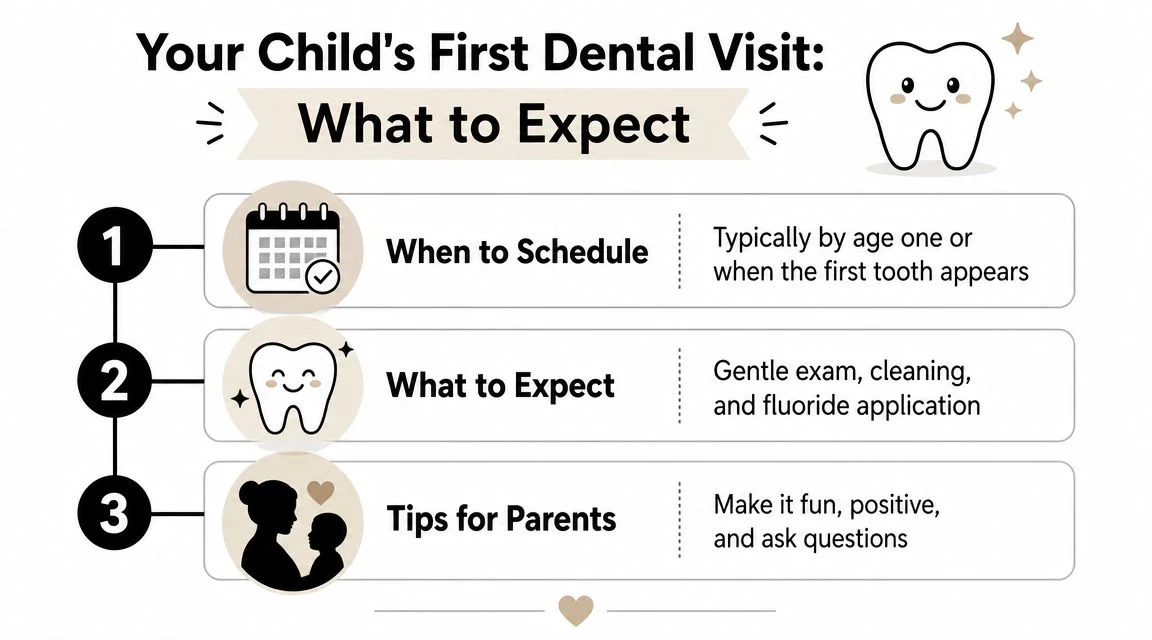
When to schedule that first appointment
The practical guideline many parents follow is simple. Schedule the first dental visit by the first tooth or around the first birthday. That early appointment gives the dentist a baseline and gives you a chance to ask about brushing, feeding habits, fluoride, teething, and home routines before small issues become bigger ones.
Early detection matters. In one study involving 3,174 children, 57.09% had dental disease requiring specialist treatment, which underscores how often children present with needs that go beyond casual observation at home or during a routine pediatric visit, according to this pediatric oral health study published in PMC.
What usually happens at the first visit
Most first visits are short and low-pressure. Depending on age and comfort level, the appointment may include:
- A gentle look inside the mouth to check teeth, gums, and visible development.
- A discussion with the parent about habits, risk factors, and anything unusual you've noticed.
- Age-appropriate cleaning or fluoride guidance if your child is ready for it.
- A plan for follow-up care based on what the dentist sees.
For parents who want a more detailed walkthrough of the basics, this overview of what happens during a dental exam can help take some of the mystery out of the process.
A successful first visit doesn't depend on a child sitting perfectly still. It depends on leaving with more comfort and less fear than when they arrived.
How parents can help
You don't need to overprepare your child. In fact, too much buildup can make the visit feel intimidating. What helps most is a calm tone and simple language.
- Keep it light: Say the dentist is going to count and check the teeth.
- Avoid scary words: Skip terms like shot, drill, pain, or pull.
- Bring comfort if needed: A favorite toy or blanket can make a big difference.
- Stay matter-of-fact: Children often mirror your energy.
Comprehensive Dental Care for Every Stage of Childhood
Children don't stay in one dental stage for long. They move from baby teeth to mixed dentition and then into a more permanent bite, and each phase brings different risks, decisions, and timing. Good pediatric care pays attention to those transitions instead of treating every child the same way.
That's why developmental monitoring is central to children's dentistry. Pediatric dental care is designed to track tooth eruption, jaw growth, and caries risk at each stage, with the goal of catching concerns before they become harder to treat, as described in this Walnut Creek pediatric dentistry guide.
What changes from one stage to the next
A toddler's needs are different from a grade-school child's, and both are different from a teen's. The clinical approach should shift with that reality.
| Stage | What the dentist watches closely |
|---|---|
| Early childhood | Eruption patterns, brushing tolerance, early decay risk, feeding-related concerns |
| Mixed dentition | Spacing, crowding, bite changes, oral hygiene around newly erupting teeth |
| Adolescence | Permanent tooth health, sports protection, cosmetic concerns, long-term maintenance habits |
What comprehensive care actually includes
Parents sometimes hear “pediatric dentistry” and think only of cleanings. In practice, thorough child-focused care usually includes several layers working together.
- Preventive care: Regular cleanings, exams, fluoride support, and cavity prevention strategies.
- Growth monitoring: Watching the gums, jaws, and bite so developing issues can be addressed at the right time.
- Behavior guidance: Helping children learn how to participate in their own care without shame or pressure.
- Parent education: Clear advice on brushing, diet, habits, and what changes are normal.
This is also where a full-service practice can be helpful. A family dental office may support children with preventive services now while also being equipped for later needs that affect older siblings or parents, such as emergency dentist visits, restorative dentistry, cosmetic dentistry, or even questions adults often search under terms like dentist near me, dentist in Walnut Creek, CA, tooth extraction, teeth whitening, or dental implants near me.
What doesn't work well
What tends to fail is a reactive approach. Waiting until a child complains of pain often means the problem has already advanced. Another common mistake is focusing only on the visible front teeth while missing how the bite, back teeth, or home habits are affecting the whole mouth.
Children benefit from dentistry that's timed to development, not just symptoms. That's what helps keep care simpler.
Gentle Treatments to Protect and Restore Young Smiles
When a child needs treatment, parents usually want the least invasive option that will still solve the problem well. That instinct is right. In children's dentistry, conservative care often produces the best long-term result because it protects tooth structure, avoids escalation when possible, and keeps the experience manageable for the child.
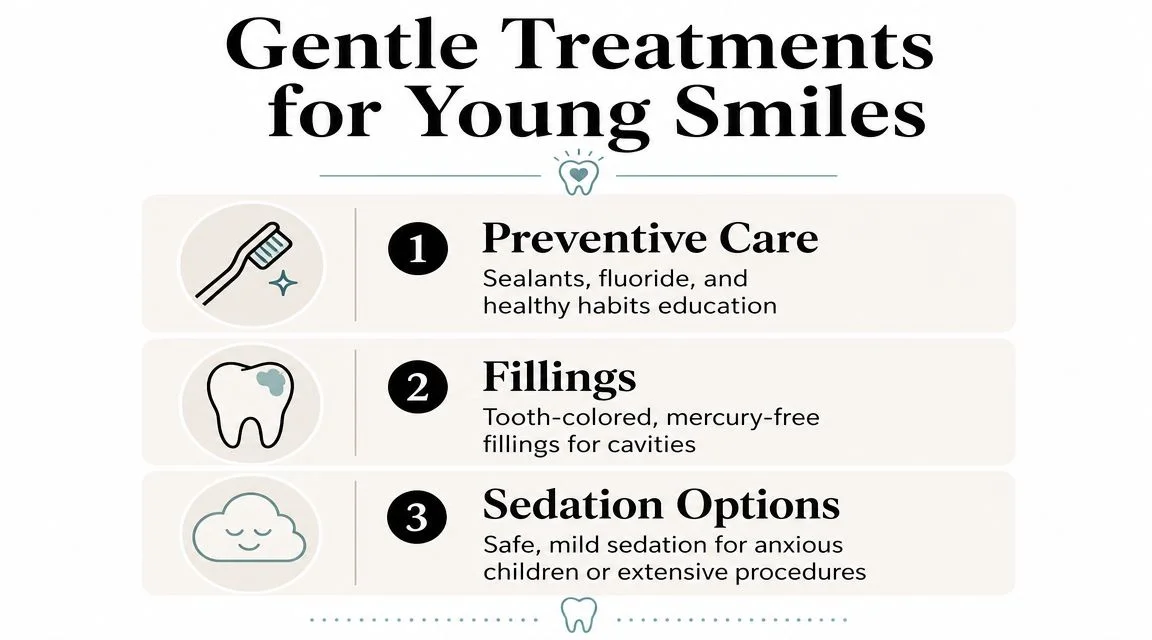
Early caries control is the highest-yield intervention in pediatric dentistry because decay can move quickly in primary teeth. Preventive care and conservative treatment, including baby root canals when necessary, help preserve tooth structure and reduce the chance that a child will need more invasive care later, as noted by Creekside Kids Dentistry.
The treatments parents ask about most
Not every cavity leads to the same treatment. The right choice depends on the tooth, the depth of decay, the child's comfort, and whether preserving that tooth will protect chewing, speech, and spacing for adult teeth.
Here's how common options differ:
| Treatment | When it helps | Why it matters |
|---|---|---|
| Sealants | On cavity-prone chewing surfaces | Adds a protective barrier where food and plaque collect easily |
| Tooth-colored fillings | Small to moderate areas of decay | Repairs damage while keeping the tooth functional |
| Pulp therapy or a baby root canal | When decay or trauma reaches the inner portion of the tooth | Helps save a tooth that still plays an important developmental role |
For parents dealing with an injured front tooth or sudden chip, this page on baby chipped tooth repair explains what dentists evaluate and when treatment may be needed.
What works better than a wait-and-see approach
A common misconception is that baby teeth don't matter because they fall out anyway. The problem with that thinking is simple. A child still has to chew with those teeth, speak with them, and hold space for the adult teeth that follow.
When a primary tooth can be preserved comfortably, saving it is often better than losing it early.
That doesn't mean every tooth should be treated at all costs. Sometimes extraction is the more sensible route. But good pediatric decision-making looks at function, timing, symptoms, and the child's ability to tolerate treatment. It doesn't default to the biggest procedure, and it doesn't ignore problems just because the tooth is temporary.
One practical example of this balanced approach is William M. Schneider, DDS, a Walnut Creek practice that offers preventive services such as sealants and fluoride treatment within a broader family dental setting.
A Comforting Environment for Anxious Children
Dental anxiety in children isn't a minor issue. It shapes how they respond to care now and how they'll feel about dentistry later. Some children are naturally cautious in new environments. Others have had a bad medical experience, strong gag reflexes, sensory sensitivities, difficulty sitting still, or developmental needs that make a standard appointment unrealistic.

A child-centered office plans for those differences instead of treating them as exceptions.
What a calm approach looks like in real life
Children usually do better when the team slows the appointment down and breaks it into manageable pieces. One of the most effective methods is a simple pattern: tell, show, then do. That means the child hears a short explanation, sees the tool or step in a non-threatening way, and only then experiences it.
Other practical strategies often help:
- Kid-friendly language: Saying “we're going to count teeth” lands better than technical language.
- Short, predictable visits: Children relax when they can sense the appointment has structure.
- Positive reinforcement: Specific praise works better than vague reassurance.
- Parental partnership: Parents can often help the team understand triggers, motivators, and calming routines.
When more support is needed
Some children can't tolerate routine treatment comfortably, even with patience and coaching. That doesn't mean they should go without care. It means the care plan needs to fit the child.
A frequently overlooked part of pediatric dentistry is treatment for children with special needs, medical complexity, or high anxiety. Independent clinic information shows that these cases may require conscious sedation, general anesthesia, or referral pathways, which goes beyond the usual “kid-friendly” marketing language parents often see, according to LLU Pediatric Dentistry Clinic.
The right question isn't whether a child is “good” at the dentist. The right question is what support that child needs to receive care safely and without trauma.
For some families, that support may involve a quieter scheduling time, a desensitization visit, or a shorter first appointment focused only on trust-building. For others, sedation may be the most responsible option.
A short video like this can also help parents think through how child-focused dental visits can feel less overwhelming before they ever arrive at the office.
What parents should ask before booking
If your child is anxious, ask direct questions. Don't settle for vague reassurance.
- How does the office introduce nervous children to treatment
- What happens if my child can't complete the visit
- Are sedation options available when appropriate
- How do you adapt care for children with sensory or developmental needs
Those answers tell you a lot about whether the office is prepared.
Schedule Your Child's Visit in Walnut Creek Today
For families searching for a pediatric dentist in Walnut Creek, CA, the best fit is often a practice that combines prevention, thoughtful treatment planning, and genuine patience. Children need more than technical dental work. They need a setting where early visits feel manageable, where developing smiles are monitored carefully, and where anxious or higher-needs children aren't treated as difficult cases.
That's especially important in a community where families have choices. The office you choose now can shape how your child thinks about dental care for years. A positive first relationship often makes future cleanings, exams, dental x-rays, and treatment decisions smoother for everyone involved.
What new families can expect
At a family-centered Walnut Creek practice, the first step should feel clear and straightforward. Parents should expect:
- A real conversation: You should be able to discuss concerns, habits, symptoms, and previous dental experiences.
- A practical care plan: The dentist should explain what needs attention now, what can be monitored, and why.
- Transparent logistics: Insurance, scheduling, and treatment recommendations should be communicated plainly.
- Room for the whole family: A full-service office can support pediatric needs while also serving adults looking for preventive, restorative, cosmetic, or emergency dentist services.
Practice details
If you're ready to establish care, William M. Schneider, DDS is located at 1855 San Miguel Dr., Suite 31, Walnut Creek, CA. Families can call (925) 935-2700 to schedule an appointment and ask about new patient availability, or visit the practice website for online scheduling options and general office information.
A child's dental home should make care easier to continue, easier to understand, and easier to trust.
If your child is due for a first visit, has started showing signs of discomfort, or needs a calm place for routine dental care, now is a good time to get that relationship started.
If you're looking for compassionate family dental care in Walnut Creek, William M. Schneider, DDS offers a welcoming setting for children and parents alike. You can contact the office to schedule your child's visit, ask questions about preventive care, or learn what to expect as a new patient.