A root canal without insurance typically costs about $700 to $1,800 for the treatment, depending on the tooth, and the crown usually adds another $800 to $3,000. For one tooth, the end-to-end bill commonly lands between $1,500 and $4,700.
You may be sitting in your car after biting into dinner and feeling a sharp jolt from a back tooth. Or perhaps the pain has become a steady pulse that keeps you awake, while you search for a dentist near me and try to understand what saving the tooth might cost. In Walnut Creek, the most useful question isn't only, “How much is the root canal?” It's, “What will I pay to finish the tooth properly?”
A written estimate should separate the root canal, buildup, crown, imaging, and follow-up care. National consumer pricing guides place the uninsured procedure near $1,200 on average, with a broad range of roughly $500 to $1,800, while large metropolitan pricing can reach $700 to $2,500 for the procedure alone, as explained by GoodRx's root canal cost guide. The sections below focus on the cash-pay decisions that matter to Walnut Creek patients, including tooth type, hidden fees, and alternatives such as tooth extraction and dental implants near me.
What a Cash-Pay Root Canal Really Costs in Walnut Creek
A Walnut Creek patient recently received a written estimate for a molar root canal and a permanent crown. She sat in her car outside the office, reading the line items twice. The root canal was one fee. The crown was another. A buildup and imaging appeared elsewhere on the page, and she wasn't sure whether the quoted total represented a finished, protected tooth or only the first appointment.
That confusion is common because dental offices usually bill root canal treatment and the final restoration separately. For an uninsured patient, a practical local budgeting range is roughly $700 to $1,800 for the root canal itself, depending primarily on the tooth. The permanent crown can add about $800 to $3,000, bringing the likely total for saving one tooth to $1,500 to $4,700 when the crown is included, according to consumer dental cost guidance on root canals and crowns.
Practical rule: Never approve a root canal estimate until you know whether it includes the buildup, crown, diagnostic images, and follow-up appointments.
A front tooth usually costs less to treat than a molar because access and canal anatomy are simpler. A specialist may charge more than a general dentist for a difficult case, and some offices bundle follow-up X-rays or the buildup while others list them separately. Those choices can change the final cash amount without changing the treatment name.
The historical benchmark is also useful. CareCredit has cited a national root canal estimate of $1,165, which helps explain why uninsured pricing has clustered around the low four figures for years, as shown in its root canal cost overview. A clear estimate should let you compare the tooth-by-tooth procedure fee with the finished restoration, not leave you to calculate the bill in your car.
Why a Root Canal Is Worth Saving the Tooth
A root canal treats the soft tissue inside a tooth when infection or severe inflammation has damaged it. Think of the tooth as a small protected tube. The dentist opens it, removes the inflamed pulp, cleans the internal canals, disinfects them, fills the space, and seals the tooth so bacteria have less opportunity to return.
The purpose isn't cosmetic. It's to remove the source of pain and infection while preserving the natural tooth. Symptoms that may lead to an evaluation include pain when chewing, lingering sensitivity, swelling, tenderness, discoloration, or a recurring bump on the gum. A diagnostic exam and dental X-rays determine whether the pulp can recover or whether endodontic treatment is appropriate.
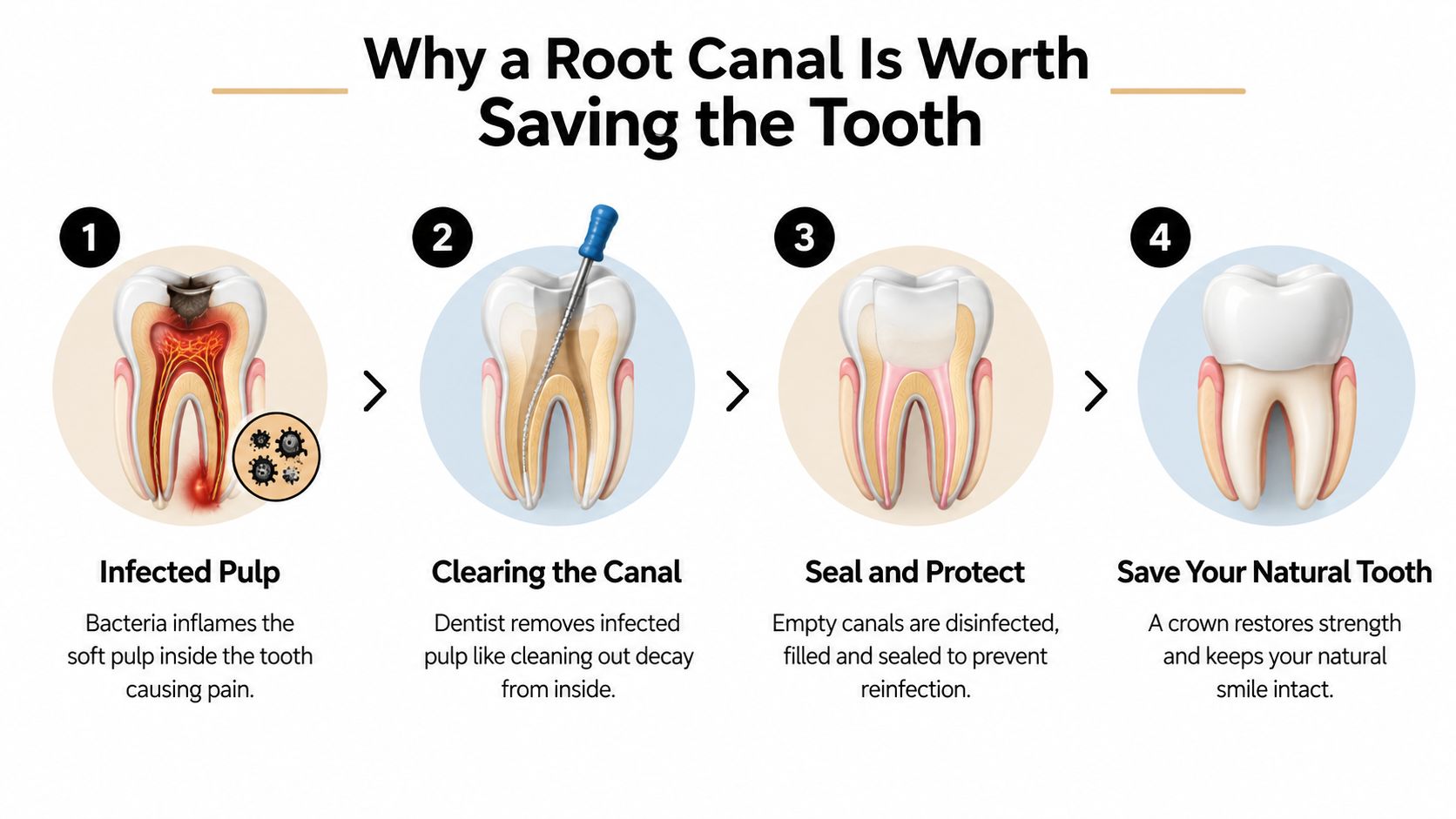
Untreated infection can spread into surrounding tissues and the jawbone, causing swelling and making the eventual treatment more involved. Removing the tooth may stop the immediate source, but it leaves a space that can affect neighboring teeth and chewing balance. Over time, nearby teeth may shift, the bite can change, and the jawbone in the empty area can lose support.
That's why I generally view a root canal as the conservative option when the tooth is restorable. It protects your natural bite and avoids making extraction the first step toward replacement treatment. Patients who want a plain-language symptom guide can review how to know if you need a root canal before arranging an evaluation.
A root canal also isn't the entire restoration. The treated tooth often needs a crown or other protective restoration because removing internal tissue and existing decay can leave it vulnerable to fracture. The value question is therefore end-to-end: compare preserving a usable natural tooth with the future work required after extraction.
Walnut Creek Price Ranges by Tooth Type
The tooth itself is one of the strongest predictors of cash-pay pricing. Front teeth are generally easier to reach and often have a simpler canal pattern. Premolars occupy the middle ground, while molars usually require more time because their canals can be numerous, curved, and harder to access.
The following ranges describe the root canal procedure only. They don't include the crown, buildup, post, or separate diagnostic services. National consumer financing and dental pricing references place front teeth around $700 to $1,100, premolars around $800 to $1,300, and molars around $1,000 to $1,600 or more, with the national average near $1,165 to $1,200, according to Advanced Smile Dental's tooth-specific cost explanation.
| Walnut Creek root canal cost ranges by tooth type, uninsured | Typical cash range, general dentist | Specialist endodontist range | Average number of canals |
|---|---|---|---|
| Front teeth | $700 to $1,100 | Varies by case | Usually simpler anatomy |
| Premolars | $900 to $1,400 | Varies by case | One or two canals |
| Molars | $1,200 to $1,800 | $1,500 to $2,200 | Multiple canals |
The specialist range for molars reflects the additional complexity of difficult posterior cases. A general dentist may treat many molars in the office, while an endodontist may be the better choice when canals are unusually curved, calcified, or difficult to locate. The correct provider isn't determined by price alone. It depends on whether the tooth can be treated predictably in that setting.
What changes the estimate
Ask whether the quoted procedure includes temporary sealing, postoperative imaging, and any necessary emergency visit. Also ask whether the dentist expects a separate referral. A lower procedure line can become less attractive if it excludes essential steps that appear later on the bill.
The key distinction is simple: a tooth-type range describes the canal treatment, not the finished tooth. The crown and structural buildup belong in the same financial conversation from the beginning.
Procedure-Only Versus the Real Total Bill
A procedure-only quote can make treatment look manageable while leaving out the restoration that protects the tooth afterward. The crown commonly adds $800 to $3,000, and the combined uninsured total can reach $1,500 to $4,700, according to root canal and crown cost guidance.
| Root canal cost in Walnut Creek, uninsured | Procedure-only range | Crown add-on | Realistic total |
|---|---|---|---|
| Front tooth | $700 to $1,100 | Separate restoration fee | Often within the overall $1,500 to $4,700 range |
| Premolar | $900 to $1,400 | Separate restoration fee | Often within the overall $1,500 to $4,700 range |
| Molar | $1,200 to $1,800 | Separate restoration fee | Often within the overall $1,500 to $4,700 range |
The table intentionally keeps the crown category separate because material, laboratory choice, preparation, and local pricing can move that fee substantially. A patient shouldn't assume that a low root canal quote represents the final cost of a protected tooth.
Molars are the main outlier. Compared with anterior teeth, posterior treatment can cost roughly 40% to 80% more in cash-pay settings because molars typically have more canals, more difficult access, longer chair time, and a greater chance of specialist involvement, as explained by tooth-dependent root canal pricing guidance. The difference reflects anatomy-driven labor, not an arbitrary premium.
A clearer way to read the math
Suppose a front-tooth root canal is quoted at $900. The finished tooth still requires its restorative phase, so the total is higher than the first procedure line. A molar quoted at $1,600 can become a much larger finished-tooth expense once the crown and any structural support are added.
For that reason, ask for two totals in writing:
- Treatment phase: Root canal, anesthesia, imaging, and temporary seal.
- Restoration phase: Buildup, post if needed, crown, and crown delivery.
This format makes it easier to compare a general dentist with an endodontist, evaluate financing, and decide whether a restorative dentistry plan is financially realistic.
Add-On Fees Most Uninsured Patients Forget
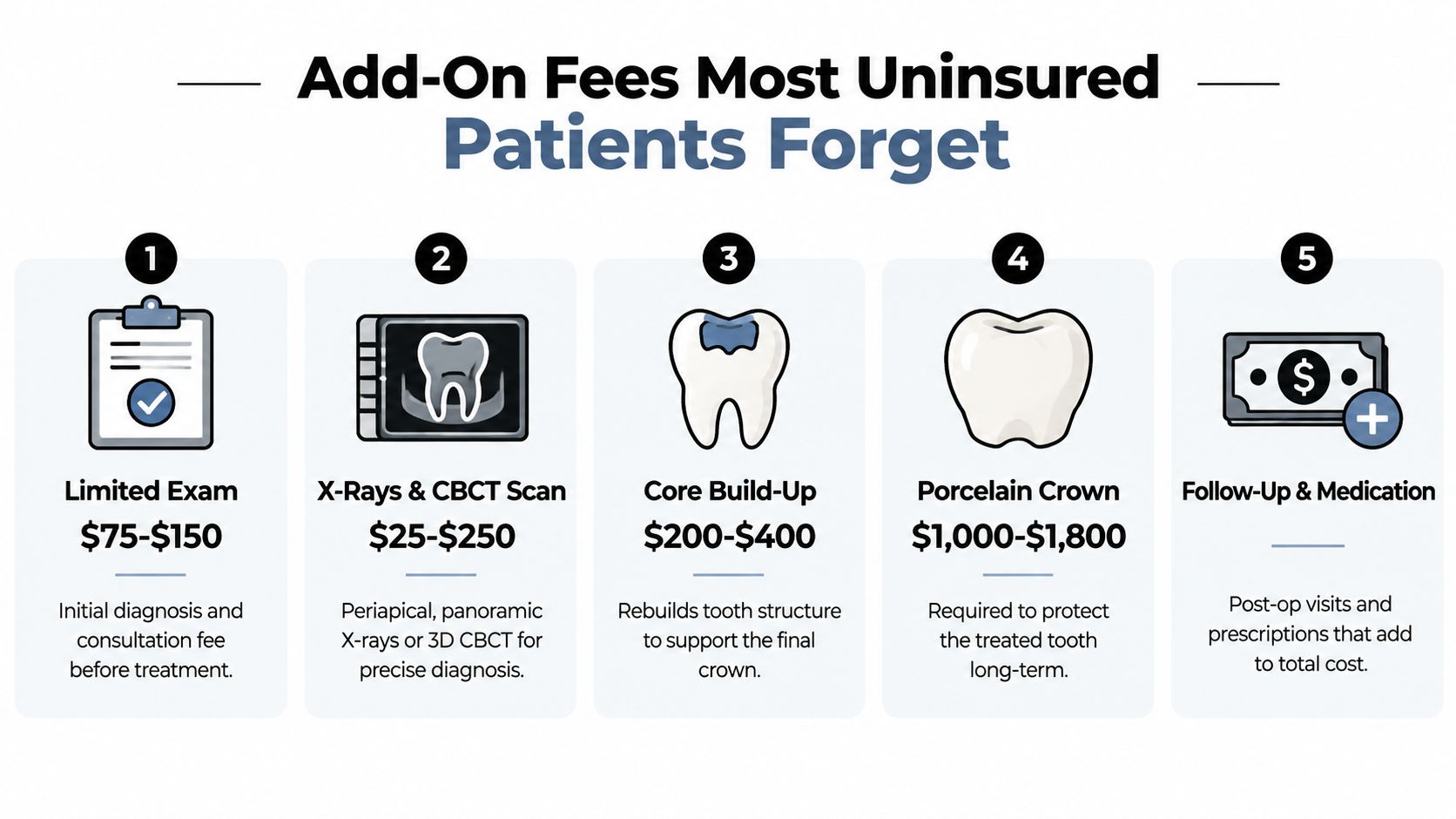
Cash-pay patients often focus on the root canal code and overlook the services surrounding it. The initial exam, diagnostic images, structural rebuilding, and crown appointment may each appear as separate line items.
Common items to discuss include:
- Limited exam: The diagnostic visit may be billed separately.
- Dental X-rays: A periapical image, panoramic image, or 3D CBCT may be recommended when the anatomy or infection isn't clear.
- Core buildup: The dentist may need to rebuild missing tooth structure before placing the crown.
- Post: A fiber or metal post may be considered when the remaining tooth structure needs additional support.
- Sedation: Local anesthesia is often part of treatment, while sedation may carry a separate fee.
- Follow-up care: Postoperative checks, medications, and the crown seat appointment may not be included in the initial quote.
The exact amount matters less than whether the estimate identifies each service. A patient should know which items are required, which are case-dependent, and which are already included.
Ask this before treatment: “Is this the price to complete the root canal, or the price to restore the tooth so I can chew normally again?”
At Dr. Schneider's Walnut Creek office, the front desk can explain which services are bundled into a quoted treatment plan and which are billed separately. Don't assume every office handles this the same way. Request the estimate by email or printout, including the expected follow-up visit and crown pathway.
Patients who are already in severe pain shouldn't delay urgent evaluation while trying to predict every fee. An emergency dentist can first determine whether infection or a fracture requires prompt care, then provide a complete treatment estimate.
Alternatives Worth Comparing on Price
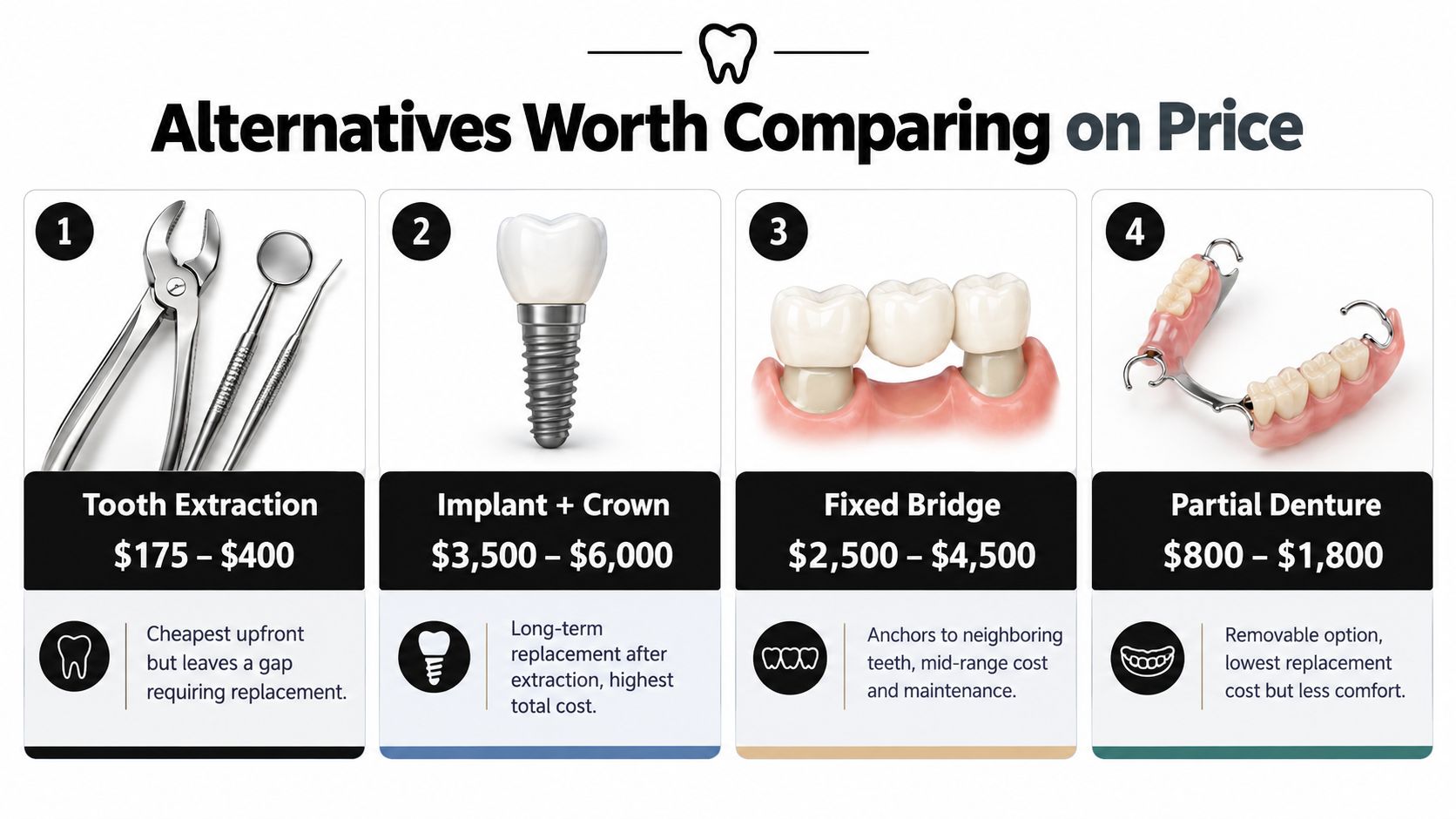
Extraction is often the least expensive immediate procedure, but it isn't automatically the least expensive treatment plan. Once a tooth is removed, you still need to decide whether to leave the space or replace the missing tooth.
| Option | Upfront cash-pay trade-off | Long-term consideration |
|---|---|---|
| Tooth extraction | Lower immediate procedure cost | Leaves a gap and may lead to replacement costs |
| Dental implant and crown | Higher total replacement expense | Restores a standalone tooth without relying on neighboring teeth |
| Fixed bridge | Mid-range replacement approach | Uses neighboring teeth for support |
| Partial denture | Removable replacement option | Less invasive financially, but comfort and maintenance differ |
The verified consumer guidance places extraction, implant, bridge, and partial-denture prices across broad ranges, but those figures vary by the required surgical, restorative, and laboratory steps. Ask for a complete replacement quote rather than comparing the extraction fee with the root canal fee alone.
Leaving the space untreated can affect chewing and allow neighboring teeth to shift. It may also complicate later replacement planning. The cheapest choice today can become the most expensive over a longer period if it leads to additional procedures, emergency care, or a more involved replacement.
The right comparison is therefore:
- Immediate payment: What must you pay now?
- Finished result: What treatment restores function?
- Effect on nearby teeth: Does the option involve adjacent teeth?
- Recovery and maintenance: What appointments and upkeep follow?
Read root canal alternative treatments before consenting to extraction when the tooth may still be restorable.
If preservation is possible, I usually recommend comparing the complete root canal plus crown plan with the complete replacement plan. That keeps the decision clinical and financial instead of making an extraction look artificially inexpensive.
Smart Ways to Lower Your Out-of-Pocket Bill
Start by asking the office to separate the bill into treatment and restoration phases. That lets you understand what must happen immediately and what follows after the tooth has been sealed and evaluated.
An in-office membership or savings plan may reduce eligible fees for uninsured patients. Some plans advertise discounts in the 15% to 25% range, but the actual reduction depends on the office, service, exclusions, and enrollment terms, as described in the consumer root canal cost guide from GoodRx. Get the discount applied to a written estimate, not just discussed verbally.
Payment choices to review
- Monthly financing: CareCredit and similar lenders may let qualified applicants divide the bill into scheduled payments. Promotional terms, approval standards, and interest charges vary, so read the complete agreement.
- HSA or FSA funds: Eligible dental treatment may be payable with HSA or FSA funds. Confirm eligibility and documentation requirements with your plan administrator.
- Phased treatment: If clinically appropriate, schedule the root canal and crown as separate phases while keeping the restoration timeline clear.
- Pay-in-full request: Ask whether the office offers a courtesy adjustment for paying the quoted balance in full.
- Specialist comparison: If a referral is recommended, request the general dentist's estimate and the specialist's estimate, including imaging and follow-up.
The calendar can matter when you use an employer benefit account. A January treatment date and a December treatment date fall into different tax years, but you should never postpone urgent infection care for financial timing alone. Ask the office whether a new-patient exam bundle includes the necessary periapical X-rays, and confirm exactly what the bundle covers.
For a local cash-pay patient, the most practical script is: “Please give me the root canal fee, crown fee, required buildup, imaging, follow-up visits, and payment options in writing.” That one request prevents the most common budgeting mistake, treating the first procedure fee as the finished cost.
Questions to Ask and Next Steps in Walnut Creek
Bring these questions to your diagnostic visit:
- Is the root canal quote separate from the crown quote?
- Does the estimate include the buildup and final X-rays?
- How many follow-up visits should I expect?
- What happens if symptoms return within a year?
- Is sedation available, and is it billed separately?
- Will treatment stay at one location, or will I need a referral?
A clear answer should identify the treatment sequence, the expected restoration, and the fees that could change if the dentist finds a crack or insufficient tooth structure. It should also explain whether a general dentist can complete the case or whether an endodontist is more appropriate.
William M. Schneider, DDS offers consultation, restorative treatment, crowns, root canals, dental implants, preventive cleaning and exams, cosmetic dentistry, Invisalign, and teeth whitening in Walnut Creek. The practice describes a single-location pathway for consultation, treatment, and crown care, along with convenient parking and more than 25 years of endodontic experience, based on the practice information provided. Patients seeking a dentist in Walnut Creek, CA, a cosmetic dentist near me, or restorative care can ask the office to build the estimate around their specific tooth and budget.
Don't wait for worsening pain to force an emergency decision. Call the Walnut Creek office, request a cash-pay estimate, and book your diagnostic visit within the week so you can compare saving the tooth with extraction and replacement based on the complete financial picture.
William M. Schneider, DDS provides root canal evaluations, restorative dentistry, crowns, dental implants, and emergency dental services for patients in Walnut Creek and the East Bay. Visit William M. Schneider, DDS to request a cash-pay estimate, arrange a consultation, and take the next step toward comfortable, predictable care.