A cracked tooth can turn an ordinary morning into a series of uncomfortable decisions. You may be searching for a dentist near me, wondering whether you'll need several appointments, a temporary crown, and more time away from work. If the tooth is painful, the urgency feels even greater, especially when you're trying to find an emergency dentist in Walnut Creek, CA.
Same-day crowns can offer a practical alternative for many patients. Using digital scanning, chairside design, and in-office milling, a dentist may be able to restore a damaged tooth during one visit. At 1855 San Miguel Dr, William M. Schneider, DDS provides general, cosmetic, and restorative dental care for Walnut Creek and the broader East Bay community, with more than 25 years of experience.
The important question isn't only whether a crown can be completed quickly. The tooth's condition, the bonding process, the material, and your bite all influence long-term success. This guide explains how same-day crowns work, what your appointment may feel like, how they compare with traditional laboratory crowns, and when another treatment may be more appropriate.
Find Same Day Crowns Near You in Walnut Creek CA
You might notice the problem while eating. A back tooth catches on a piece of food, a sharp edge cuts your tongue, or a familiar filling suddenly feels loose. Perhaps a front tooth has chipped, and every conversation now makes you think about your smile. When you search for a dentist in Walnut Creek, CA, you're often looking for more than information. You want to know whether someone can relieve the discomfort and give you a clear plan.
Traditional crown treatment has often involved a preparation appointment, a physical impression, a temporary crown, and a later visit for the permanent restoration. That process can be difficult for professionals, parents, travelers, and anyone managing dental anxiety. Same-day crowns reduce that scheduling burden for cases that are suitable for a chairside restoration.
At William M. Schneider, DDS, patients can discuss whether a same-day crown fits their tooth, their bite, and their priorities. The office serves Walnut Creek and the surrounding East Bay, offering restorative care alongside dental cleanings and exams, dental x-rays, cosmetic dentistry, root canals, bridges, and dental implants. A cracked or severely damaged tooth may need a crown, but an examination is necessary to determine whether the tooth can be restored.
A local example
Consider someone who breaks a tooth shortly before an important workweek. They may want a same-day crown near Walnut Creek because a second appointment would mean another absence from work and another period of uncertainty. If the tooth has enough healthy structure and the gumline can be managed properly, a digital crown may provide a single-visit path.
That doesn't mean every urgent dental problem should receive a crown. Severe pain can also result from infection, a deep fracture, or a problem that calls for root canal treatment or extraction. An emergency dentist can first identify the cause, control pain, and explain whether a crown, another restorative service, or a different solution makes sense.
A practical starting point: If a tooth is painful, broken, or changing your bite, schedule an evaluation rather than choosing a restoration based only on speed.
Understanding What Same Day Crowns Are and How They Work
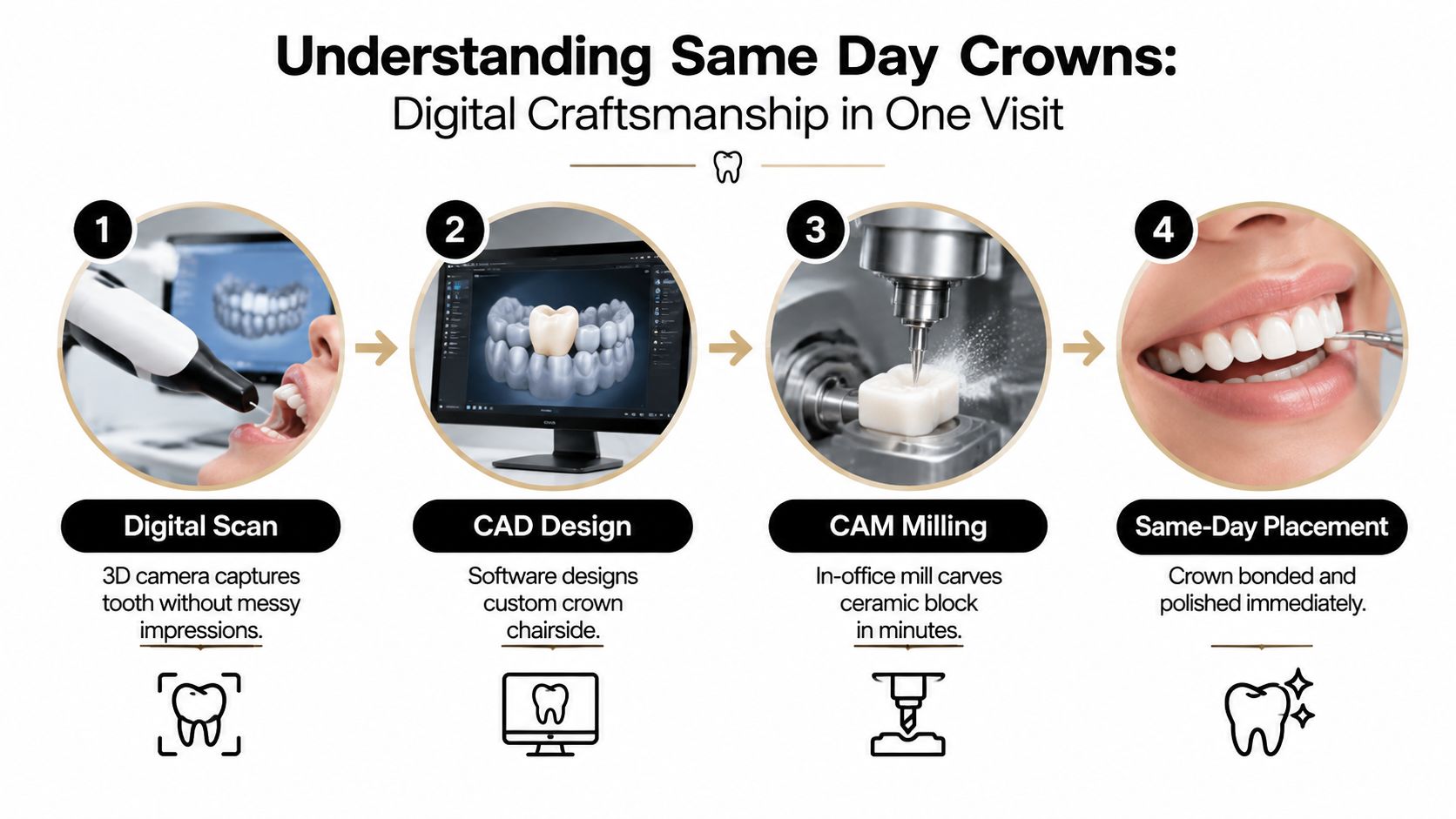
A same-day crown is made through a chairside CAD/CAM workflow. CAD means computer-aided design, while CAM means computer-aided manufacturing. In plain language, the dentist scans the prepared tooth, designs the restoration digitally, and uses an in-office milling unit to shape it from a ceramic block.
Think of the difference between having clothing made-to-measure in the same shop and sending measurements to an off-site tailor. Traditional laboratory crowns rely on impressions and outside fabrication. A chairside crown keeps the scan, design, milling, and placement within the dental office, so the dentist can inspect the restoration during the same appointment.
CEREC is one of the best-known systems associated with this approach. Modern CAD/CAM dentistry entered clinical use in the mid-1980s, CEREC launched in 1987, and 3D software was added in 2003, marking important milestones in the movement toward chairside restorations. By 2022, Pacific Dental Services reported more than 3 million same-day dental restorations produced in supported practices, while the same source noted that less than 10% of U.S. dentists offered chairside, same-day restoration (Pacific Dental Services on its same-day restoration milestone).
The digital workflow
The process follows a logical sequence:
- Preparation and scanning: The dentist removes damaged tooth structure and captures a three-dimensional digital image.
- Chairside design: Software helps shape the crown around your tooth, neighboring teeth, and bite.
- In-office milling: A milling unit carves the restoration from a selected ceramic material.
- Finishing and placement: The dentist checks the fit, shade, contacts, and bite before bonding the crown.
The technology is mature, but it remains specialized. That distinction matters because same-day delivery alone doesn't guarantee a suitable result. The dentist still needs to select the right case, material, isolation method, and bonding protocol.
What to Expect During Your Single Visit Crown Appointment
Your appointment begins with an evaluation, not with a machine. The dental team examines the tooth, reviews symptoms, and may use dental x-rays to understand the roots, surrounding bone, and extent of damage. If the tooth needs a crown and appears suitable for a chairside restoration, the team explains the treatment before preparation begins.
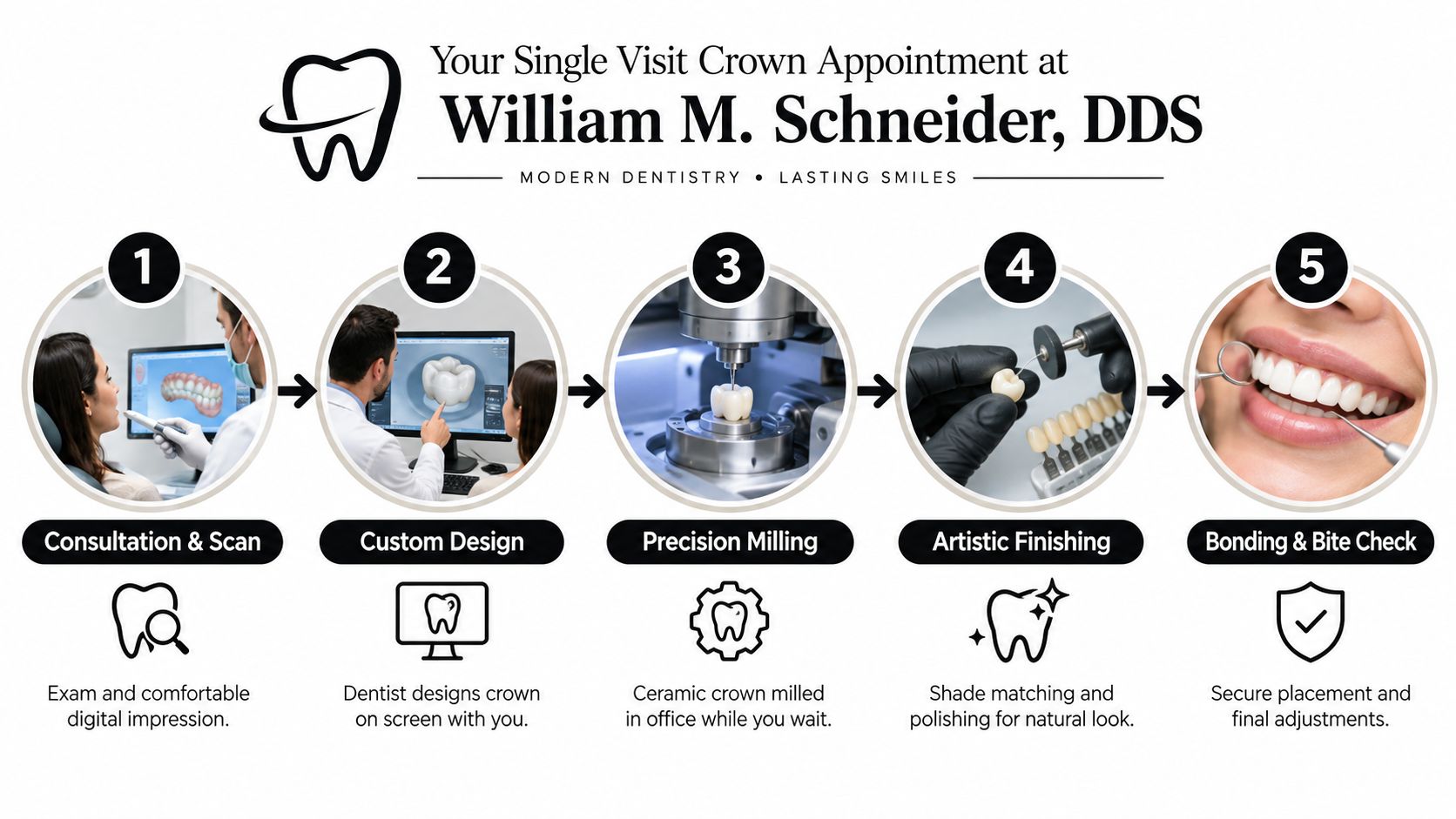
Preparation and scanning
The area is numbed with local anesthesia. William M. Schneider, DDS emphasizes comfortable care, including painless injection techniques and sedation options when appropriate for patients who feel nervous. Once the tooth is comfortable, the dentist cleans and shapes it so the crown has a stable foundation.
Instead of placing impression material in your mouth, the team uses a digital scanner to record the prepared tooth and nearby teeth. The scan helps create a detailed virtual model, and it also allows the dentist to check the design on screen.
Design, milling, and finishing
The dentist designs the crown digitally, considering how it contacts neighboring teeth and how it meets the opposing teeth when you bite. The restoration is then milled in the office while you wait. One clinical description says same-day ceramic restorations can be completed in about 2 hours and usually avoid a temporary crown and a second visit (clinical description of chairside CEREC restorations).
The milled crown may receive custom shading, polishing, or other finishing so it blends with your smile. Before bonding, the dentist tests the fit and checks whether the bite feels balanced. Small adjustments at this stage can help the restoration feel natural rather than high or awkward.
Watch this overview of the digital crown workflow before your appointment:
Bonding and final checks
The final step is more than just placing the crown. The dentist isolates the tooth, applies the selected adhesive and bonding materials, seats the crown, removes excess cement, and checks your bite again. Good isolation helps keep moisture away from the bonding area, which is particularly important for adhesive restorations.
A typical visit may fit into a single appointment, but the exact length depends on the tooth, the preparation, the material, and the time needed for finishing. You won't leave with a temporary crown when the same-day plan is completed as intended.
Same Day Crowns Compared to Traditional Lab Crowns
Same-day and traditional crowns can both restore a tooth's shape, strength, and appearance. The difference is largely in how the restoration is produced and delivered, but material selection and clinical technique remain central to the result.
| Feature | Same Day Crowns | Traditional Crowns |
|---|---|---|
| Appointments | Designed, milled, and placed during one visit when the case is suitable | Usually involves preparation and a later placement visit |
| Impression process | Digital scan | Traditional laboratory impression or digital laboratory workflow |
| Temporary crown | Generally avoided | Commonly used while the permanent crown is fabricated |
| Fabrication | Milled chairside in the dental office | Produced by an outside dental laboratory |
| Fit evaluation | Dentist checks the restoration during the same visit | Dentist evaluates the laboratory restoration at the delivery visit |
| Material options | Selected from materials compatible with the chairside system and case | May offer a broader laboratory range, depending on the prescription |
| Durability | Comparable to traditional crowns in appropriate cases | Established long-term option with material-dependent results |
What the evidence says about durability
A published clinical summary reports five-year survival of 93% to 96% for same-day CAD/CAM crowns, compared with 89% to 96% for traditional crowns. At 10 years, the same summary reports 85% to 90% for same-day crowns and 80% to 96% for traditional crowns, depending on the material and study design (clinical summary comparing same-day and traditional crowns).
A systematic review summarized approximately 93.5% survival at 10 years for same-day crowns versus 94.7% for traditional crowns, with no statistically significant difference (systematic review summary of E4D and traditional crowns). Independent research also found clinically acceptable marginal adaptation for tested CAD/CAM crown materials, with all materials except fiber-reinforced composite falling within the 25 to 40 micrometer ADA specification limits (PubMed study of CAD/CAM crown marginal adaptation).
The takeaway is reassuring but not simplistic. A faster workflow doesn't guarantee a shorter-lasting crown. The tooth, material, preparation, adhesive protocol, and maintenance still determine whether the restoration performs well.
Are You a Candidate for Same Day Crowns
A same-day crown may suit you if you need full coverage for a damaged tooth and the dentist can establish a clean, stable bonding field. Busy professionals and families often value completing treatment in one visit, while patients seeking a cosmetic dentist near me may appreciate the ability to evaluate shade and shape during the same appointment.
Common situations that may call for evaluation include:
- Cracked or weakened teeth: A crown can protect remaining structure when a filling would not provide enough support.
- Large or failing restorations: A tooth with substantial previous dental work may need coverage rather than another filling.
- Cosmetic concerns: A crown may improve the shape or appearance of a tooth when restorative treatment is appropriate.
- Time-sensitive needs: A same-day option may reduce disruption when a tooth breaks before travel, work, or an important event.
The bonding question
The most important candidacy factors may be less visible than the appointment length. The dentist needs enough sound tooth structure, especially enamel, for predictable bonding. The tooth must also be isolated well from saliva and gum fluid, and the preparation must allow the crown to seat securely.
Evidence from a recent practice-based and randomized clinical discussion shows that outcomes can vary by cement strategy. One split-mouth trial found self-adhesive resin cement performed much worse than conventional luting composite used with universal adhesive, showing why bonding protocol matters (PubMed evidence on CAD/CAM restorations, cement strategy, and case selection).
Heavy bite forces, bruxism, deep subgingival margins, and extensive damage may make a traditional laboratory workflow or another material more appropriate. A tooth with an infection may need a root canal before a crown. A tooth that can't be predictably restored may require tooth extraction, followed by discussion of a bridge or dental implants near me.
For more context on when full coverage may be appropriate, review this guide to when you need a dental crown.
Cost Insurance and Value of Same Day Crowns in Walnut Creek
The cost of a crown depends on the clinical situation, not just on whether the crown is made in one visit. Material selection may include options such as lithium disilicate or zirconia, and the appropriate choice depends on the tooth's location, appearance requirements, bite forces, and available tooth structure.
Technology also affects treatment planning. Research on digital restorations shows that CAD/CAM systems don't all perform identically, although the systems evaluated in one three-dimensional study all produced clinically acceptable crowns. That study found significant differences in marginal fit among three CAD programs, with InLab-designed crowns performing best among the systems tested (three-dimensional study of marginal fit among CAD programs).
Understanding value beyond the fee
A single-visit crown may reduce indirect costs, such as time away from work, transportation for another appointment, and the inconvenience of managing a temporary restoration. Those practical savings won't apply equally to every patient, but they're reasonable factors to include when comparing options.
Insurance plans commonly evaluate crowns according to restorative benefits and plan limitations. Coverage varies, so ask the office to review your benefits before treatment. A new patient exam, dental x-rays, and a clinical assessment help the team provide a more accurate estimate because the treatment may change if the tooth needs periodontal care, a root canal, or another procedure first.
Emerging manufacturing methods add another consideration. A 2025 randomized trial found 3D-printed zirconia single crowns were clinically comparable to milled CAD/CAM crowns at 12 months, with similar fracture rates and slightly better clinical success in the printed group. A 2025 scoping review found milling still showed superior accuracy for fixed prostheses overall, while optimized 3D-printed interim crowns could reach similar marginal-gap ranges (recent review of printed and milled digital crowns). These findings support a thoughtful material discussion rather than a one-size-fits-all promise.
Caring for Your New Crown and Booking Your Visit in Walnut Creek
A newly bonded crown should feel secure and comfortable, but your bite may need a small adjustment if the tooth feels higher than its neighbors. Mild sensitivity can occur after treatment, particularly when the tooth had significant decay or preparation. Tell the dental team if discomfort persists, worsens, or affects chewing.
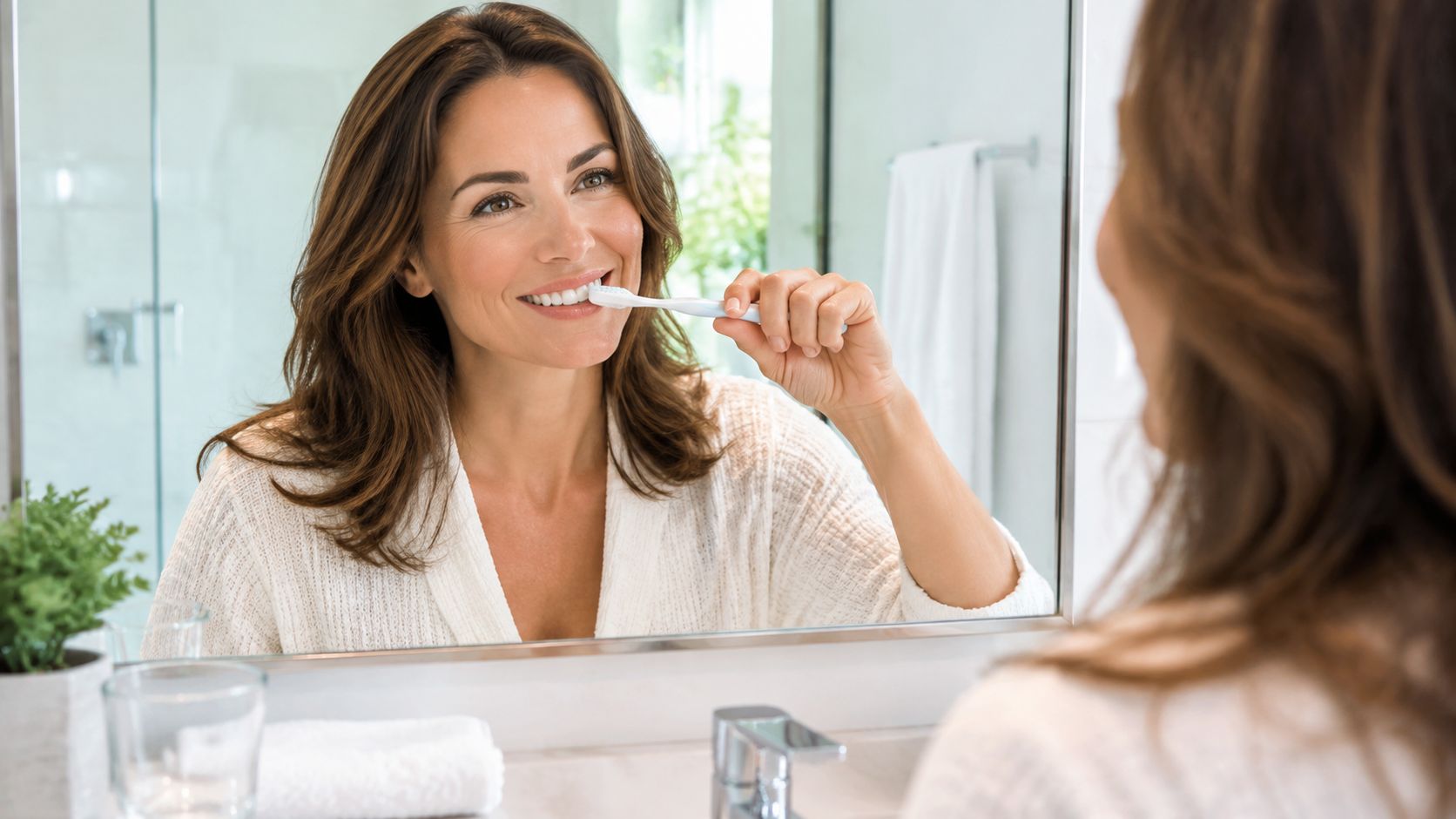
Treat the crown like a natural tooth. Brush along the gumline, clean between the teeth, and keep regular cleaning and exams so the surrounding gums and tooth structure remain healthy. Avoid using your teeth to open packages, and be cautious with very hard foods while the area settles.
If you grind or clench, ask whether a protective nightguard would help. Bite forces can affect both the crown and the tooth beneath it, especially when the restoration is placed on a heavily used back tooth. You can find additional guidance in this resource on how to care for dental crowns.
What your Walnut Creek visit can include
At 1855 San Miguel Dr, patients can expect clear explanations, a comfortable environment, accessibility accommodations, and care designed to meet their oral health goals. The practice provides preventive, cosmetic, and restorative services, including teeth whitening, Invisalign, crowns, bridges, root canals, dental implants, and care for gum disease and sleep apnea. Sedation options may be available when appropriate.
The right next step is an examination, especially if you have pain, a fracture, swelling, or a crown that has come loose. A local dentist near me can determine whether a same-day crown is suitable or whether another treatment will better protect your smile.
William M. Schneider, DDS offers digital restorative care, crown treatment, and dental services for patients in Walnut Creek and the East Bay. Visit William M. Schneider, DDS to request a consultation, discuss same-day crowns, and receive a personalized plan for restoring your comfort, function, and smile.