If you just had scaling and root planing in Walnut Creek and the dentist placed Arestin into your gums, it's normal to feel a little unsure when you get home. Some tenderness is expected, and so are questions, especially if you're trying to tell the difference between ordinary healing and a problem that needs attention. A calm, practical review of the side effects of Arestin can make that first night a lot less stressful.
The big thing to know is that Arestin is placed right into periodontal pockets after deep cleaning, so the most likely side effects show up in the mouth rather than as full-body symptoms. The most common non-dental effects reported in clinical summaries include headache, infection, flu symptoms, and pain in at least 3% of patients, while oral effects can include dental infection, periodontitis, tooth sensitivity, tooth caries, dental pain, gingivitis, and stomatitis (ARESTIN product information). That pattern helps patients in Walnut Creek know what's routine, what's worth watching, and what's urgent.
What matters most after treatment is simple. Mild soreness, temporary sensitivity, and a little bleeding usually fit the expected healing picture. Facial swelling, widespread rash, trouble breathing, or pain that keeps getting worse does not.
When the Dentist Says Arestin and You Wonder What Comes Next
A patient leaves the chair after scaling and root planing, hears that Arestin was placed, and gets home with a sore mouth and a head full of questions. That's a common moment. The gums feel cleaned out, the pockets feel tender, and every twinge can start to look suspicious.
Arestin is meant to support periodontal treatment, not replace the cleaning you already had. Because it sits directly in the gum pockets, the first few days can feel local and a little uneven. Some areas calm down quickly, while others stay irritated longer because they were already inflamed before the medication was placed.
Practical rule: if the discomfort is gradually easing, that usually fits normal healing. If it's intensifying after day three, or if swelling starts moving beyond the treated area, call your dentist.
In Walnut Creek, patients often do best with a simple decision rule. Better today than yesterday is reassuring. Worse today than yesterday deserves a closer look. That's especially true if the symptom isn't just soreness, but a change in swelling, swallowing, or breathing.
If you're reading this at your kitchen table and wondering whether you need to “wait and see,” keep reading with that question in mind. The rest of this guide sorts the common reactions from the rare ones and gives you a clear threshold for when a same-day call makes sense.
What Arestin Actually Is and Why Your Dentist Recommended It
Arestin is a locally delivered antibiotic made of minocycline microspheres. In plain language, that means tiny beads carrying antibiotic medication are placed directly into periodontal pockets after scaling and root planing so the drug can work where the bacteria are concentrated. The treatment is targeted, not swallowed, which is part of why its side-effect profile looks different from an oral antibiotic.
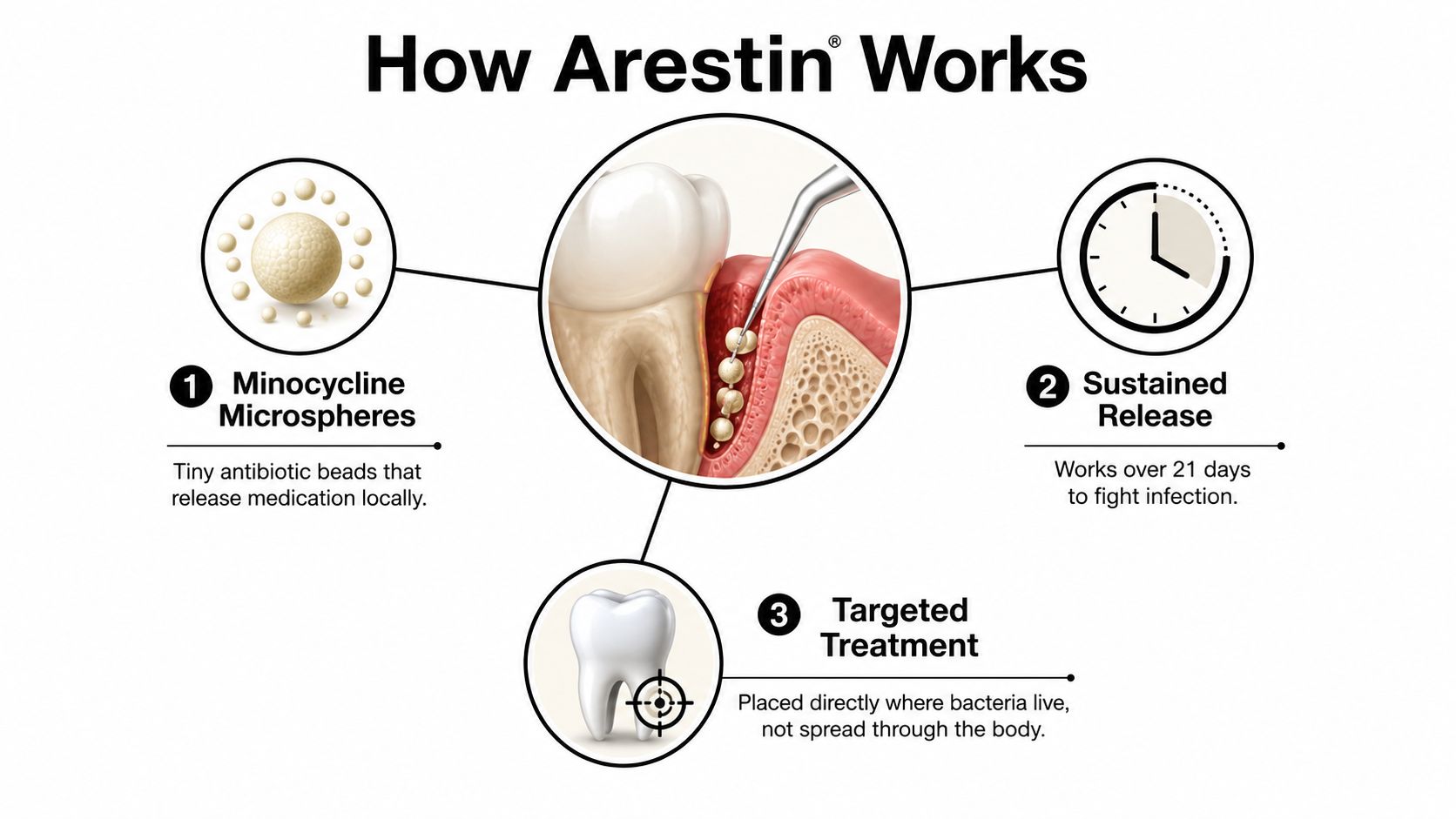
The reason a dentist recommends Arestin is usually periodontal disease. Deep cleaning removes the buildup, but inflamed pockets can still harbor bacteria afterward. Arestin is placed right into those pockets to help control the local environment while the gums settle after treatment. For a patient, that often means a treatment plan focused on both cleaning and control, rather than cleaning alone.
If you want a plain explanation of the treatment itself, this overview from our practice library is a useful companion to the discussion here: What Is Arestin.
The key takeaway is that local delivery changes the trade-off. You may see more mouth-specific symptoms, like tenderness or gum irritation, than you would with a pill. That's why the side effects of Arestin should be judged against what was already happening in the mouth before treatment, not against what people expect from a standard antibiotic.
Common Side Effects and How Often They Actually Happen
The most useful way to think about the side effects of Arestin is to separate what's common from what's alarming. In the FDA labeling, the main non-dental effects were headache (9.0%), infection (7.6%), flu syndrome (5.0%), and pain (4.3%) (FDA label). Secondary drug references also list oral events such as periodontitis (16.3%), tooth disorder (12.3%), tooth caries (9.9%), dental pain (9.9%), and gingivitis (9.2%) (Drugs.com side effects summary).
What those numbers mean in real life
A high periodontitis rate doesn't mean Arestin causes periodontal disease out of nowhere. In many patients, it means the treated site was already inflamed, and the condition is still visible during healing. Tooth disorder is a broad bucket, so it's less useful as a self-check than the actual feeling in your mouth. If the treated area is just sore, especially right after scaling and root planing, that usually fits the expected pattern.
Headache, low-grade body aches, or a flu-like feeling can happen too. Those symptoms are worth monitoring, but they're not automatically a sign of allergy. The practical question is whether they're mild and fading, or whether they're coming with rash, swelling, or trouble swallowing.
Arestin Side Effects at a Glance
| Side Effect | Reported Rate | Type |
|---|---|---|
| Periodontitis | 16.3% | Oral |
| Tooth disorder | 12.3% | Oral |
| Tooth caries | 9.9% | Oral |
| Dental pain | 9.9% | Oral |
| Gingivitis | 9.2% | Oral |
| Headache | 9.0% | Non-dental |
| Infection | 7.6% | Non-dental |
| Flu syndrome | 5.0% | Non-dental |
| Pharyngitis | 4.3% | Non-dental |
| Pain | 4.3% | Non-dental |
| Dyspepsia | 4.0% | Non-dental |
If the mouth feels tender but the trend is improving each day, home care is usually enough. If a symptom is spreading, intensifying, or changing shape, that's the point to call.
Rare but Serious Allergic Reactions to Watch For
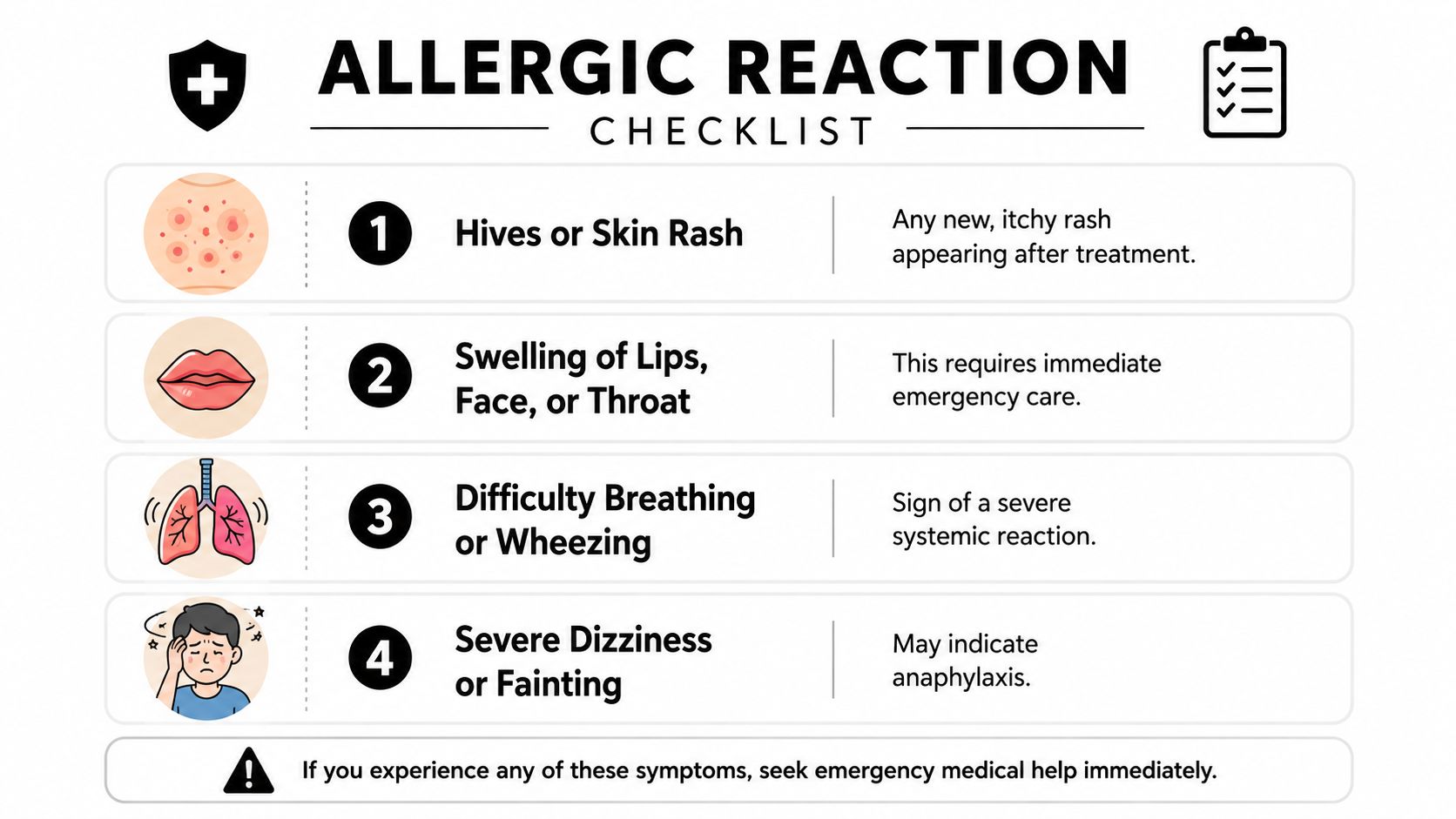
The rare reactions matter because they can start small and become serious fast. Arestin's active ingredient is minocycline, a tetracycline-class antibiotic, and that class can trigger hypersensitivity in some patients. The Canadian product monograph warns about angioedema, and postmarketing reports include swelling of the face, pruritus, fever, and lymphadenopathy (Canadian product monograph).
The symptoms that should never be watched casually
Hives, rash, or swelling of the lips, face, tongue, or throat needs same-day attention. Trouble breathing or swallowing is an emergency. Blistering or peeling skin, especially with fever or swollen lymph nodes, also needs urgent medical evaluation.
Cleveland Clinic's minocycline guidance adds the same warning pattern, including rash, hives, swelling of the face/lips/tongue/throat, trouble breathing or swallowing, fever, blistering or peeling skin, and rash with swollen lymph nodes (Cleveland Clinic). Those aren't ordinary aftercare issues. They're stop-and-call-now symptoms.
A good self-check is simple. If the problem is confined to the treated gum area and is mild, it may be part of recovery. If the problem is spreading beyond the mouth, affecting the lips or throat, or changing the way you breathe or swallow, it's not routine healing.
Who Should Avoid Arestin or Use It With Caution
Some patients should skip Arestin or use it only after a careful review of their medical history. The clearest red flag is a known allergy to minocycline or tetracyclines. If you've had a reaction to that antibiotic family before, tell your dentist before placement.
Pregnancy and breastfeeding deserve extra caution because tetracycline-class drugs have known concerns around fetal and infant development. Children also need special consideration, since this treatment is not meant for routine pediatric use. Patients with severe kidney or liver problems should speak up as well, because the medication choice has to fit the whole medical picture.
Medication and cosmetic concerns that matter in the chair
Some drugs can complicate the decision, including isotretinoin, penicillin-class antibiotics, and anticoagulants. Your dentist may decide the combination isn't the best fit, or may choose a different periodontal plan. Cosmetic concerns matter too, because Arestin has been associated with permanent tooth discoloration to yellow, gray, or brown (WebMD).
Decision rule: if you're pregnant, nursing, allergic to tetracyclines, or worried about tooth color changes, bring that up before treatment, not after.
That conversation isn't meant to scare you off. It's meant to match the therapy to the patient. In many cases, the right answer is a different option.
Aftercare and Monitoring During the First Two Weeks
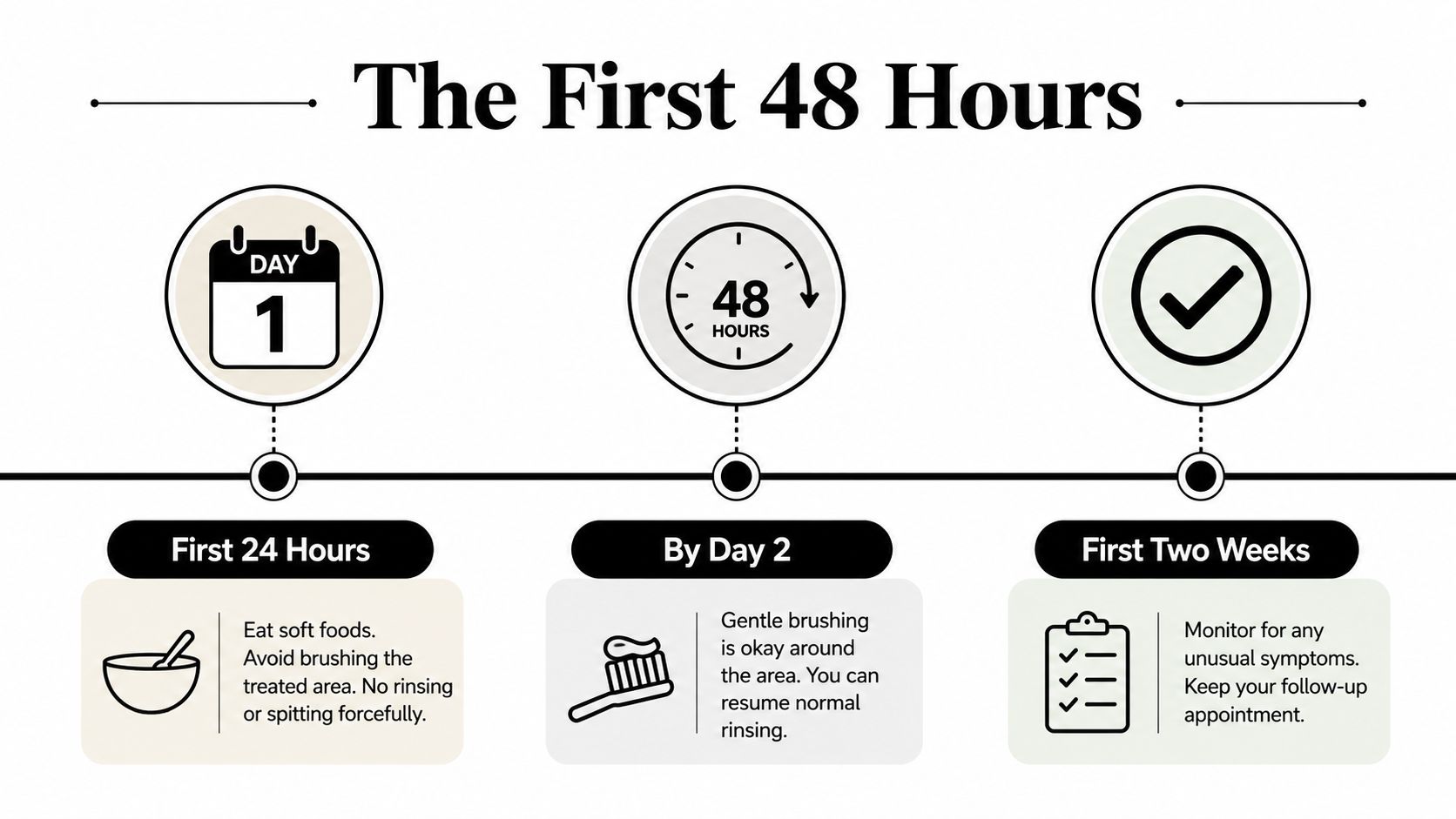
The first 24 hours after placement are the time to be gentle. Soft foods are the safest choice, and you should avoid brushing directly over the treated area, flossing deep pockets, smoking, and straws. If your dentist prescribed an antimicrobial rinse, use it exactly as directed rather than skipping doses.
By days 2 to 3, brushing can usually become more normal around the site, but it should still be soft and careful. The main thing to watch is the direction of symptoms. Improving tenderness is expected. Increasing swelling or pain is the signal to pay attention.
Days 4 through 7 are the point when many patients notice the mouth settling. If pain is getting worse instead of better, that's not something to push aside. If a fever, rash, or facial swelling appears, stop waiting and call.
For a plain procedural reminder about deep cleaning, this page from our practice library can help: Scaling and Root Planing Procedure.
What to monitor during the first two weeks
- First 24 hours: soft foods, no forceful rinsing, no brushing the treated pocket.
- Days 2 to 3: gentle brushing around the area is usually reasonable, while swelling should be settling rather than spreading.
- Days 4 to 7: soreness should trend down. If it trends up, call.
- Days 8 to 14: keep the follow-up visit so the pocket depth and gum response can be checked.
A good rule in Walnut Creek is this. Temporary sensitivity is one thing. Symptoms that move outward, last longer, or get sharper are something else.
Alternatives to Arestin and When Each Option Makes Sense
Arestin is one tool, not the only tool. Some patients do well with systemic antibiotics such as doxycycline or amoxicillin, especially when the infection picture isn't limited to a few pockets. Others respond better to chlorhexidine rinses when the goal is short-term bacterial control without placing medication directly into the tissue.
Matching the option to the mouth
The right choice often depends on how advanced the gum disease is, whether the patient can tolerate oral medication, and whether a targeted one-visit therapy makes more sense than a longer medication course. Periostat may be used when the goal is host modulation rather than local pocket delivery. Flap surgery or LANAP may be considered when the periodontal problem is more advanced and mechanical access becomes part of the treatment plan.
Arestin tends to make the most sense when disease is localized and the clinician wants to treat specific pockets after deep cleaning. Systemic antibiotics reach the whole body, which can be helpful in a different set of situations, but they also bring a broader exposure profile. That difference is important for patients who want a focused approach and for those who are trying to avoid body-wide medication effects.
The best periodontal treatment is the one that fits the pattern of disease, the medical history, and the patient's tolerance for side effects.
That's why a chairside evaluation matters. Pocket depth, bleeding, and the patient's comfort with each option all affect the final plan.
When to Call Your Walnut Creek Dentist and How to Reach Us
Some symptoms are expected. Mild tenderness, light bleeding, and temporary tooth sensitivity can happen after Arestin placement and deep cleaning. What should trigger a same-day call is different: facial or throat swelling, a spreading rash, or severe pain that keeps worsening after day three.
If you're in Walnut Creek or nearby East Bay communities and you're unsure whether what you're feeling is normal, it's better to ask than to guess. An office that knows periodontal treatment, emergency dental concerns, and anxious patients can help sort out whether you need reassurance, a recheck, or urgent care.
William M. Schneider, DDS welcomes patients who want calm explanations, modern care, and a low-stress visit. The office can be reached at (925) 935-2700, and it's located at 1855 San Miguel Dr., Suite 31, Walnut Creek, CA 94596. If you prefer, you can also request an appointment online.
Patients who feel nervous about dental treatment often appreciate knowing that sedation options are available when appropriate. For many people, that reassurance makes it easier to move forward with periodontal care, cleanings and exams, or the next restorative step.
If you're dealing with gum soreness after Arestin, or you're trying to decide whether your symptoms need attention, William M. Schneider, DDS can help you sort out the difference between normal healing and a real problem. Visit William M. Schneider, DDS to schedule a visit in Walnut Creek and get clear guidance on your next step.