You're probably reading this with one question in mind, will I be awake, and if so, how bad is it going to feel? If a dentist in Walnut Creek has told you that your wisdom teeth should come out, it's normal to feel tense before you've even booked the visit. Wisdom teeth twilight sedation is often the middle-ground option that helps anxious patients get through extraction with less stress, less memory of the procedure, and a faster return to normal life than deeper anesthesia.
For many people, the scary part isn't just pain, it's the sounds, the pressure, and the thought of being stuck in the chair while the surgery happens around them. Twilight sedation is designed for that exact moment of fear. It's a comfort choice, but it's also a planning choice, because the right depth of sedation depends on the tooth, the person, and the setting.
When Twilight Sedation Makes Wisdom Teeth Removal Easier
A common Walnut Creek scenario goes like this. A working adult or college student is told one lower wisdom tooth is impacted, the other side has started aching, and the words “tooth extraction” land like a punch in the stomach. The numbing shot is manageable. The idea of hearing tools, feeling pressure, and staying fully aware is what sends the anxiety through the roof.
That's where twilight sedation fits. It gives you a calmer, more detached experience than local numbing alone, without automatically moving you into a full hospital-style anesthetic. For patients in Walnut Creek, CA, and nearby East Bay communities, that middle ground often feels more realistic than choosing between “wide awake” and “fully asleep.”
Practical rule: if you're mostly afraid of the experience, not just the pain, twilight sedation is often the option patients ask about first.
Why anxious patients ask for it
Wisdom teeth removal is one of the most common minor surgical procedures in dentistry, and office-based sedation has been used at scale for decades. A PubMed survey of U.S. practice patterns reported that oral surgeons performed an average of 52.7 third-molar extraction cases per month, with 33.4% using intravenous conscious sedation, compared with 46.3% under general anesthesia and 5.8% with nitrous oxide sedation. In other words, sedation isn't unusual, it's part of routine oral-surgery care in many practices. PubMed survey and safety review
For a patient, the point isn't the category label. It's whether the appointment feels tolerable. Twilight sedation became a mainstream option because it helps reduce anxiety while preserving a quicker recovery than deeper anesthesia for many cases.
A patient usually starts to consider it when one or more of these are true:
- The tooth is impacted or hard to reach. The more stimulation involved, the more sedation tends to matter.
- The idea of being awake feels worse than the extraction itself. That's a real and common concern.
- There are multiple teeth involved. Longer appointments can be harder to manage while fully alert.
- The patient wants little or no memory of the procedure. That amnesic effect is a major reason people choose it.
For someone searching for a dentist near me or a dentist in Walnut Creek, CA, that's the decision. It's not just whether wisdom teeth need to come out. It's whether the removal should feel manageable from the first conversation through the ride home.
How Twilight Sedation Works
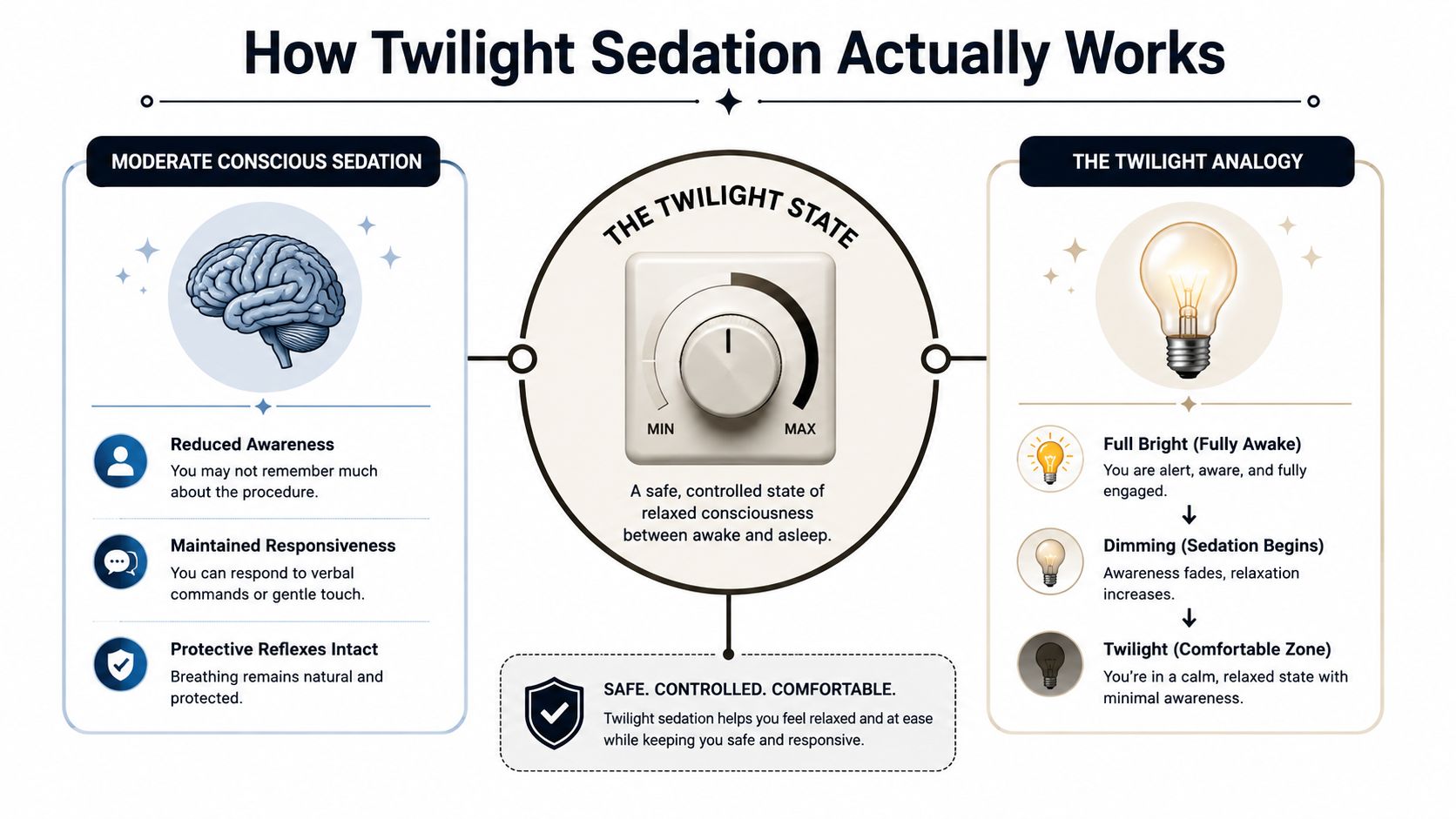
A patient often feels the appointment shift from tense to manageable in stages. The numbing medicine still blocks pain in the extraction area, and the sedation lowers alertness so sounds, pressure, and time all feel less intense.
What happens through the IV
IV “twilight sedation” for wisdom teeth is usually a form of conscious or moderate sedation. The patient keeps breathing on their own and may still respond to simple directions, while the IV route lets the dental team adjust medication more precisely than with oral sedation. That flexibility is one reason it is often chosen for impacted teeth or for visits that involve more than one extraction. Pearl Dental Group
In practice, the team can guide the depth of sedation more closely than with a pill taken before the appointment. Medicine such as midazolam is often used for relaxation, and it may be paired with pain-relieving medication such as fentanyl to reduce discomfort and soften the stress response. Many patients remember little or nothing afterward, which is one reason the procedure can feel much shorter than the time spent in the chair. Oris Dental
The sequence usually feels like this:
- You arrive awake. You know where you are and what is about to happen.
- The IV medication begins working. The anxious edge starts to fade quickly.
- You keep breathing on your own. You may answer a question or follow a short instruction.
- The memory becomes blurry. Many patients recall very little after the appointment.
Mayo Clinic describes IV sedation as a way to help patients feel calm and sleepy, with limited memory of the procedure, while patients may still respond during treatment. That range is what people mean when they talk about twilight sedation. It is not one fixed state. It is a flexible depth of sedation, and the exact experience depends on the medicines used, the dose, and whether the team is aiming for moderate sedation or something deeper. Mayo Clinic wisdom tooth extraction overview
For a plain-language explanation of the process, see this guide on how dental sedation works.
What it usually feels like: pressure, movement, and a blurry sense of time passing, rather than sharp pain or a vivid memory of the procedure.
The easiest way to understand it is to separate pain control from awareness. The local anesthetic handles the pain in the mouth. The sedation changes how much of the visit your mind takes in, so the extraction can feel quieter and less demanding even when the work itself is still being done carefully.
Twilight Sedation Compared to Local and General Anesthesia
Patients usually want one straight answer. Which option lets me stay calm, avoid pain, and get home without a miserable recovery? The honest answer is that each choice trades something for something else.
| Factor | Local Anesthesia Only | Twilight Sedation + Local | General Anesthesia |
|---|---|---|---|
| Awareness during treatment | Fully awake | Relaxed, sleepy, less aware | Fully asleep |
| Memory afterward | Clear memory | Often little or none | No memory |
| Breathing | Normal, on your own | Normal, on your own | Assisted by the anesthesia team |
| Recovery feel | Usually the lightest | Grogginess is common | Deeper recovery period |
| Best fit | Simple, low-anxiety cases | Anxious patients, impacted or multi-tooth extractions | Select complex cases |
| Appointment experience | Most alert, most aware of sounds and pressure | More detached and calm | Most complete loss of awareness |
The real trade-off patients care about
Local anesthesia is enough for some people. It numbs the area, but you stay fully aware of the sounds, motion, and pressure. If you're already nervous, that awareness can make a simple extraction feel huge.
General anesthesia takes the experience all the way to full unconsciousness. That can be useful in select cases, but it usually isn't the first choice for routine wisdom teeth removal if a lighter option will do the job. Twilight sedation sits between those two. It's the option many anxious patients prefer because it softens the experience without automatically requiring the deepest level of anesthesia.
The clinical data in oral-surgery literature helps explain why. In a 2024 Scientific Reports study of 1,260 patients undergoing third-molar extraction, 217 had intravenous sedation and 1,043 had general anesthesia. The IV-sedation group had shorter surgery time, 49.82 minutes versus 60.36 minutes, and shorter anesthesia time, 70.85 minutes versus 91.16 minutes, both with P < 0.001. The same study reported no severe adverse events and no cases of hypoxemia below 90% in either group. Scientific Reports study
A separate retrospective study of ambulatory patients found that IV sedation required less anesthesia time and less recovery-room time than general anesthesia, while comfort and satisfaction stayed high in both groups. That's the kind of difference patients notice most. It doesn't sound dramatic on paper, but it matters when you're trying to get home, rest, and feel human again.
Practical rule: if you want to avoid the full “put under” experience but don't want to stay sharply aware, twilight sedation is usually the compromise patients are looking for.
For someone also considering services like tooth extraction, emergency dentist care, or later restoration such as dental implants near me after healing, the sedation choice often comes down to how much time you want to spend conscious of the procedure itself.
Benefits and Real Risks of Twilight Sedation
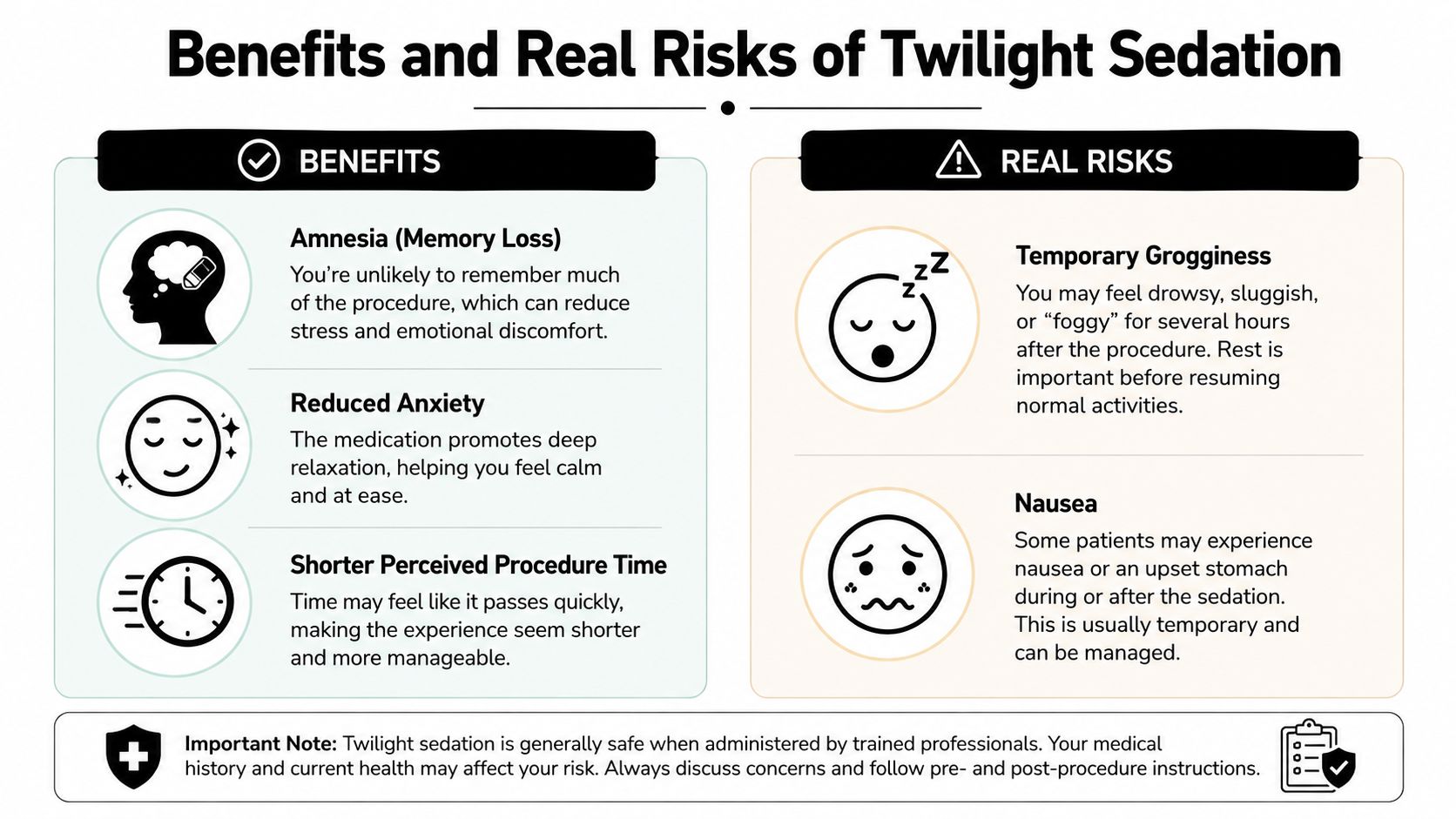
A lot of patients notice the benefit before they can name it. The appointment feels farther away, almost like it is happening in another room, and that psychological distance can make a long extraction much easier to tolerate. Many people remember little or nothing afterward, which reduces the stress of getting through impacted wisdom teeth removal, multiple extractions, or a procedure after a bad dental experience. That is why the depth of sedation is chosen to match the extraction itself, along with the patient's anxiety level and recovery needs.
What patients usually like about it
The advantages are practical, not dramatic.
- Amnesia for the procedure: many patients have little or no memory afterward, which lowers the stress of sitting through the appointment.
- Reduced anxiety: the experience feels less intense, especially for patients who dread being awake for the extraction.
- Calmer recovery than deeper anesthesia: compared with general anesthesia, twilight sedation often allows an easier wake-up and a more predictable same-day recovery.
- Better tolerance for long or complex surgery: when the extraction takes time, it helps to have the patient relaxed instead of tense and fighting the chair.
That flexibility is part of the appeal. A straightforward removal may need only a lighter level of sedation, while a more complex case may call for a deeper level so the patient stays comfortable without drifting all the way into general anesthesia.
What the risks really are
Safety has to stay in view, because comfort alone is not the whole picture. Office-based sedation data in oral-surgery literature are reassuring, but they do not mean there is no risk. A PubMed survey and safety review found a very low adverse-event rate in a large office-sedation review, and the broader estimates summarized in that review also showed mortality rates that were rare. PubMed survey and safety review
The risks that matter in day-to-day practice are grogginess, nausea, temporary over-sedation, and breathing suppression if medication is not carefully managed. That is why a proper sedation team watches oxygen levels, heart rate, blood pressure, and responsiveness throughout the appointment.
The point is not that twilight sedation is a gamble. The point is that it works best when the depth matches the procedure, the patient's medical history, and the office's ability to monitor closely.
Honest takeaway: the safety record is strong when sedation is selected carefully and monitored well, but the right choice still depends on your health history and the complexity of the extraction.
Who Is a Good Candidate and When It Is Not Recommended
The best candidates are usually healthy adults who know they're anxious, want a more detached experience, or are facing impacted third molars that will take more time and manipulation to remove. Twilight sedation also makes sense for patients who strongly prefer an amnesic experience and don't want to remember the details of the procedure afterward.
There are also times when it's not the right fit. Pregnancy, certain respiratory conditions, allergies to benzodiazepines or opioids, and medication interactions can all change the plan. Candidacy is not just about wanting sedation. It's about whether the patient's medical profile and the extraction itself line up with the office's monitoring capability.
A simple self-check before your consultation
- You're a stronger candidate if: you're generally healthy, highly anxious, or dealing with impacted or multiple wisdom teeth.
- You need a more careful discussion if: you take medications that may interact with sedatives, have breathing issues, or have reacted badly to anesthesia before.
- You may need another approach if: pregnancy or a known allergy changes the risk picture.
Most good consultations start with this exact conversation. The dentist or oral-surgery team reviews your medical history, asks about prior sedation experiences, and then matches the depth of sedation to the complexity of the tooth removal. That's the point where calm patient education matters more than the label on the option.
For readers comparing treatment paths and support services, a practice such as William M. Schneider, DDS can discuss sedation alongside broader care, including cleanings, exams, cosmetic dentistry, restorative treatment, and options like Invisalign or dental implants when those are part of the long-term plan.
Before and After Your Appointment
The day of the procedure goes more smoothly when the basics are set up ahead of time. Most sedation visits start with a reminder to fast if the office has given that instruction, wear comfortable clothes, and bring a responsible adult to drive you home. Short sleeves help if the team needs easy IV access, and a medication review helps avoid surprises.
A practical timeline for the day
- Before you leave home: confirm the ride, review your medication list, and leave enough time so you're not rushing.
- When you arrive: the team checks your health history again and confirms the treatment plan.
- During the visit: you become relaxed and drowsy while local anesthesia handles the numbing.
- Afterward: your mouth stays numb for a while, and your memory of the procedure is usually fuzzy.
- At home: rest, drink and eat only what the office approves, and give yourself time to recover.
After the appointment, numbness fades first, then soreness becomes more noticeable. Soft foods usually make more sense than anything crunchy or hot, especially on day one. The practical issue isn't just pain, it's making sure you don't chew on a still-numb cheek or do too much before the sedation fully wears off.
You also shouldn't plan to drive, work, or make important decisions right away. Sedation can leave you groggy long after the procedure is done, even if the surgery itself felt brief.
Practical rule: if the office tells you to bring a driver, treat that as non-negotiable. Twilight sedation and driving don't mix.
The goal is a smooth same-day recovery, not heroic behavior. A quiet evening at home usually helps more than trying to push back into a normal schedule too soon.
What to Expect at William M. Schneider, DDS in Walnut Creek
At William M. Schneider, DDS on San Miguel Drive, sedation isn't treated like a separate, mysterious event. It sits inside a broader, patient-first appointment flow that includes a careful review of your health history, a plain-language explanation of the extraction, and time to ask questions before anything starts. For anxious patients in Walnut Creek and the East Bay, that matters as much as the medication itself.
The office's broader care includes preventive cleanings and exams, cosmetic dentistry, restorative treatment, and services like dental implants, Invisalign, and teeth whitening. That matters because many people who come in for wisdom teeth removal are also looking for a long-term dental home, not just a one-time procedure. If you want more detail on the office's sedation approach, you can read the practice's Walnut Creek sedation dentist information.

A consultation here usually focuses on fit, not pressure. You'll talk through whether the extraction is simple or impacted, what kind of anxiety you're dealing with, and whether twilight sedation is the right depth for your case. If it is, the team can fold it into the treatment plan in a way that keeps comfort and safety front and center.
For many patients, that's what turns a stressful search for a dentist near me into a workable plan. The goal is not to over-treat. The goal is to choose the least intense option that still helps you get through the appointment safely and calmly.
Common Questions About Wisdom Teeth Twilight Sedation
Will I remember the procedure? Many patients remember little or nothing afterward. That amnesia effect is one of the main reasons people choose twilight sedation in the first place.
Will I be completely asleep? Usually, no. Twilight sedation is typically a conscious or moderate sedation state, so you're relaxed and sleepy, but still breathing on your own and often able to respond if needed.
Can I eat beforehand? That depends on the office instructions. If fasting is required, follow it closely, because the team uses those instructions to support safety during sedation.
Can I go back to work or school the same day? You'll likely need the rest of the day to recover. Grogginess can linger, and you won't be able to drive yourself home after the appointment.
What if twilight sedation doesn't feel like enough? The office should review your case, your anxiety level, and the complexity of the extraction before the day of surgery. If a different depth of sedation is more appropriate, that decision gets made through the consultation, not in the middle of the procedure.
If you're in Walnut Creek and you want a calm, clear plan for wisdom teeth removal, William M. Schneider, DDS can help you sort out whether twilight sedation fits your situation. Visit William M. Schneider, DDS to schedule a consultation and talk through your wisdom teeth, your anxiety level, and the recovery you want to plan for.