You're brushing your teeth, you spit, and the sink turns pink or red. That moment can feel much bigger than “just a little bleeding.” Many people immediately wonder if they brushed too hard, if they've got gum disease, or if something more serious is going on. If you've been searching for a dentist near me or an emergency dentist in Walnut Creek, CA because your gums won't stop bleeding, that concern is understandable.
Most of the time, bleeding gums come from irritation and inflammation near the gumline. But “won't stop bleeding” is the part that matters. There's an important difference between gums that bleed a little when you floss and bleeding that keeps going, starts on its own, or seems out of proportion to what triggered it. Knowing that difference helps you decide whether you need routine dental care, prompt periodontal treatment, or urgent medical evaluation.
Worried About Bleeding Gums? A Walnut Creek Dentist Can Help
If your gums bleed once after you floss aggressively, that's one situation. If they bleed every time you brush, leave a metallic taste, or you've noticed swelling and bad breath along with the bleeding, that deserves attention.
The key is not to panic, but also not to brush it off. According to the Cleveland Clinic guidance on bleeding gums, if bleeding persists for longer than two weeks or is accompanied by bad breath or swollen gums, it indicates underlying gum disease or another health condition requiring professional evaluation. That's a practical line in the sand.
What patients often get wrong
A lot of people assume bleeding means they should stop flossing the area. Usually, that makes the underlying problem worse. If plaque is sitting along the gumline, the tissue stays inflamed, and inflamed tissue bleeds more easily.
Others assume any bleeding means a dental emergency. Sometimes it does. Often it doesn't. The useful question is whether the bleeding seems tied to irritated gums or whether it behaves like a clotting problem.
Practical rule: Bleeding linked to brushing or flossing often points to inflamed gums. Bleeding that seems heavy, spontaneous, or hard to stop needs a faster response.
For families and professionals looking for a dentist in Walnut Creek, CA, this symptom is one of the clearest reasons to schedule an exam instead of guessing. A proper evaluation can tell whether you need routine cleaning and exams, periodontal care, treatment for a broken or irritated tooth, or guidance to seek medical care right away.
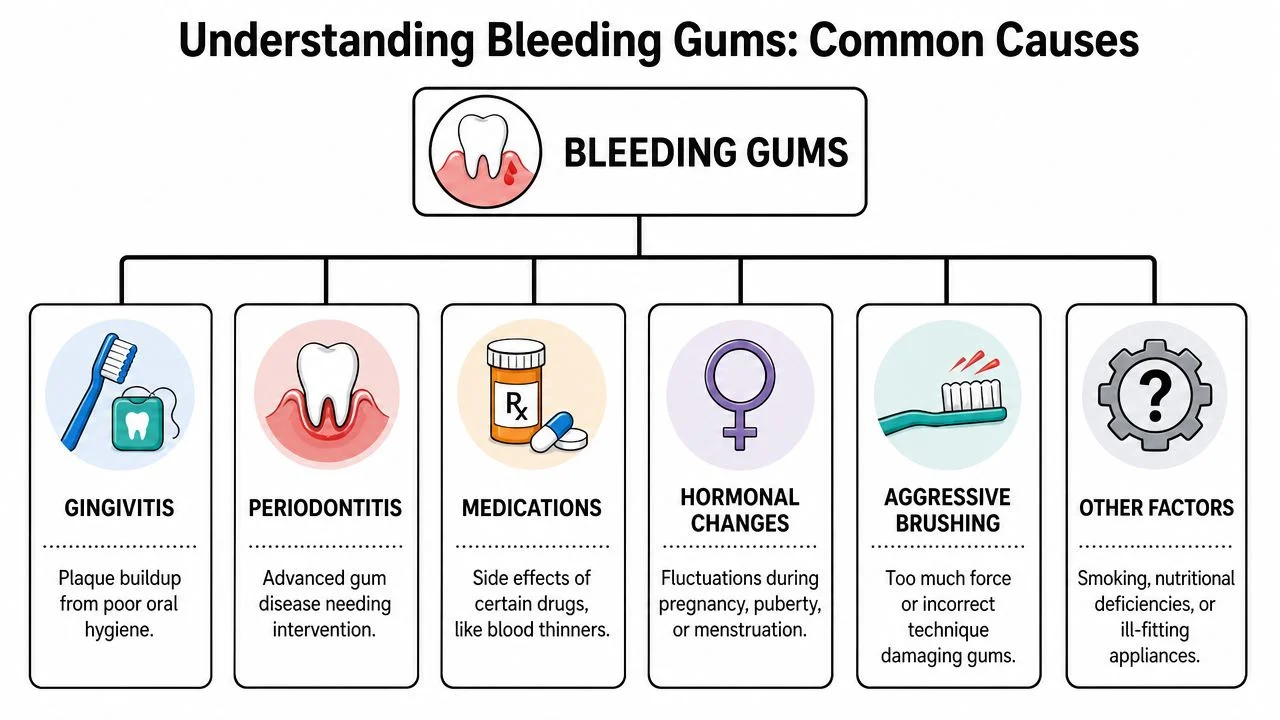
Common Causes of Bleeding Gums
The most common cause is gingivitis, which is the earliest stage of gum disease. It starts when plaque collects along the gumline and triggers inflammation. The tissue becomes red, puffy, and fragile, so even normal brushing or flossing can make it bleed. Gingivitis, the earliest stage of gum disease, is the most common cause of bleeding gums, and the CDC confirms that periodontal disease, which starts as gingivitis, affects over 47% of adults aged 30 and older in the U.S., as summarized in this Delta Dental discussion of bleeding gums.
How plaque turns into bleeding
This process is simple but important. Bacteria in plaque sit where the tooth meets the gum. Your immune system responds. The gums get inflamed. Once that tissue is irritated, it bleeds with very little contact.
If that plaque isn't removed well enough at home and professionally, gingivitis can progress into a deeper periodontal problem. At that point, the issue isn't just bleeding. You can also see gum recession, tenderness, and support loss around teeth.
Other reasons gums may bleed
Not every bleeding gum problem comes from poor brushing habits alone. Several common factors can contribute:
- A new flossing routine can make neglected gums bleed at first because inflamed tissue is finally being disturbed.
- Aggressive brushing with too much force can irritate the gum edge.
- Hormonal changes can make gums more reactive.
- Medication effects can increase bleeding or reduce the mouth's natural defenses.
- Tobacco use raises gum disease risk and can make symptoms harder to read early on.
- Ill-fitting dental appliances can repeatedly rub and inflame one area.
Healthy gums don't usually bleed during normal brushing. Repeated bleeding is a sign to pay attention to, not a sign to stop cleaning.
What this means for treatment choices
There's a trade-off here. If the cause is mild gingivitis, better brushing, daily flossing, and a professional cleaning may be enough. If tartar has built up below the gumline, home care alone usually won't solve it.
That's why a quick online search for cosmetic dentist near me or dental care won't answer the underlying question. The underlying question is whether the bleeding is coming from surface inflammation, deeper gum infection, trauma, or something outside the mouth entirely.
Red Flags That Require Urgent Dental Care
Here's the distinction many articles miss. Most bleeding gums come from localized gum inflammation. Persistent or profuse bleeding that won't stop can be an early sign of systemic conditions like thrombocytopenia or other clotting disorders, which require immediate medical evaluation, as noted in WebMD's review of bleeding gums and other conditions.
That means “my gums won't stop bleeding” should not always be treated like a routine hygiene problem.
When it looks like a gum problem
Localized bleeding often has a pattern. One area bleeds when you brush. The gums look swollen. You may notice tenderness, bad breath, or buildup near the gumline. That's concerning, but it usually follows a dental explanation.
When it looks more urgent
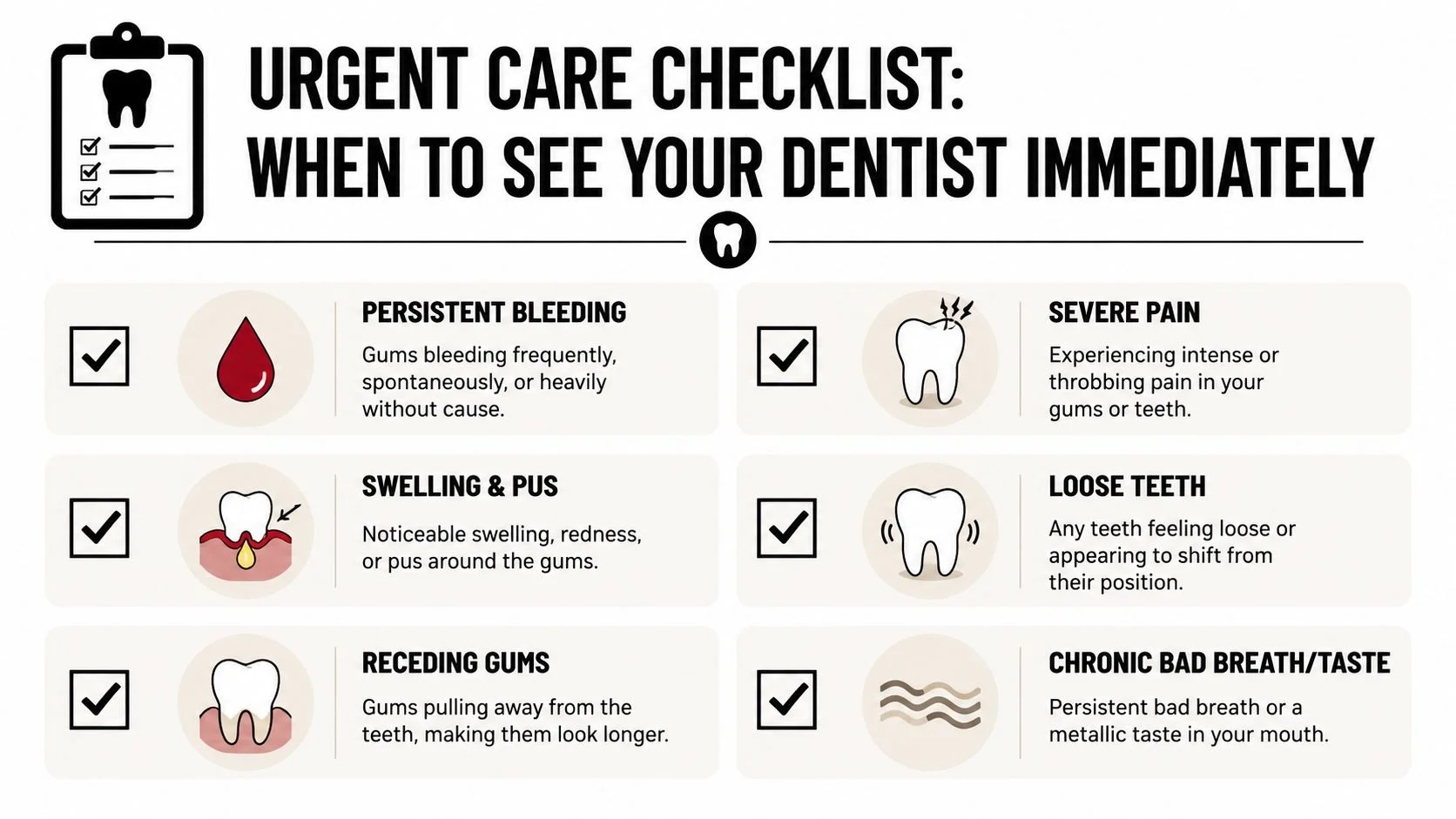
Call an emergency dentist promptly if you have any of these signs:
- Bleeding that keeps going after gentle pressure and doesn't seem to slow down.
- Bleeding that starts on its own rather than only during brushing or flossing.
- Marked swelling or pus around the gums.
- A loose tooth or a tooth that suddenly feels different when you bite.
- Severe pain in the gums, jaw, or a specific tooth.
- A bad taste or persistent odor that doesn't improve with cleaning.
- Receding gums with increasing sensitivity or exposed root surfaces.
If you're also worried about whether a specialist is needed, this guide on when to see a periodontist for bleeding or receding gums can help clarify next steps.
If the amount of bleeding seems out of proportion to what happened in your mouth, don't assume it's “just gingivitis.”
The practical decision
Use common sense here. Mild bleeding during brushing can wait for a dental appointment soon. Bleeding that is heavy, recurring without cause, or paired with signs that your body may not be clotting normally deserves immediate attention. In some cases, the right next step is a dentist. In others, it's urgent medical care.
Professional Treatments for Healthy Gums
When bleeding gums are tied to plaque, tartar, or periodontal inflammation, treatment works best when it starts with a precise diagnosis. A proper exam looks at the gum tissue, checks for pockets around the teeth, and identifies whether the problem is simple gingivitis, a deeper periodontal infection, or irritation from something else such as a rough edge, appliance, or damaged tooth.

The first visit often includes new patient exams, dental x-rays, and a detailed review of your brushing habits, tobacco exposure, health history, and medications. That matters because the World Health Organization oral health fact sheet identifies poor oral hygiene and tobacco use as the two leading risk factors for periodontal disease globally, and a professional exam is important for catching these risks before damage becomes irreversible.
What helps in early cases
If the gums are inflamed but the damage is still limited, a professional cleaning may be the turning point. Removing hardened buildup from places your toothbrush and floss can't reach gives the tissue a chance to settle down.
That visit is also where technique gets corrected. Many people either miss the gumline entirely or scrub it too hard. A softer, more controlled approach usually works better than brushing with force.
What helps in deeper gum disease
If the infection has moved below the gumline, routine cleaning may not be enough. In that case, periodontal therapy such as scaling and root planing may be recommended. This treatment removes deposits from below the gums and smooths the root surfaces so the tissue can heal more effectively.
A simple comparison can help:
| Situation | What often works |
|---|---|
| Mild inflammation near the gumline | Professional cleaning and improved home care |
| Tartar and deeper pockets below the gums | Scaling and root planing |
| Damage from a failing tooth | Restorative evaluation or, in some cases, tooth extraction |
| Missing teeth after advanced disease | Replacement planning, which may include dental implants near me searches from patients ready to restore function |
Some patients also ask about cosmetic concerns once the gums are healthy again. That's the right order. Get the tissue healthy first. Then options like teeth whitening, cosmetic dentistry, crowns, or other restorative dentistry services make more sense.
A short overview of treatment can make the process feel less intimidating:
Preventing Bleeding Gums with At-Home Care
Once the cause is identified, daily habits become the difference between temporary improvement and lasting gum health. Consistency matters more than intensity. Scrubbing harder doesn't fix bleeding gums. Cleaning more thoroughly and more gently usually does.
According to the National Institute of Dental and Craniofacial Research overview of gum disease, consistent and improved oral hygiene can resolve gingivitis-related bleeding within two to three weeks for the vast majority of patients. That's encouraging because it gives you a realistic window for improvement when the issue is uncomplicated gingivitis.
A better home routine
A simple routine works well when done the right way:
- Use a soft-bristled toothbrush and angle it toward the gumline instead of brushing straight across the teeth.
- Brush twice daily with a steady, light touch.
- Floss once daily and curve the floss around each tooth instead of snapping it into the gums.
- Clean before bed even if the rest of the day gets busy.
- Avoid tobacco because it makes gum problems harder to control.
Gentle and consistent beats aggressive and occasional.
What works and what doesn't
Some habits help. Some only feel productive.
| What helps | What usually doesn't |
|---|---|
| Soft brush, proper angle, daily flossing | Scrubbing harder because you see blood |
| Keeping regular cleanings and exams | Waiting to see if it “just goes away” |
| Following personalized home-care instructions | Changing products every few days without fixing technique |
Food choices matter too, but not as a substitute for plaque removal. A healthy diet supports healing. It doesn't replace brushing, flossing, and professional care.
If your bleeding improves over the next couple of weeks, that's a good sign. If it doesn't, or if it worsens, the issue likely needs in-office treatment rather than more trial and error at home.
Your First Step to Healthy Gums in Walnut Creek
For many people, the hardest part isn't the cleaning or the exam. It's making the appointment when they're already anxious, embarrassed, or worried they've waited too long. In practice, those feelings are common. They shouldn't keep you from getting answers.
A good dental visit for bleeding gums should feel calm and clear. You should know what the dentist sees, what the likely cause is, whether dental x-rays are needed, and what the treatment options are right now. If the problem is straightforward, you should leave with a plan. If it looks more complex, you should understand why.
What to expect at a local visit
In Walnut Creek, patients usually want the same things from a new dental office. They want honesty, gentle care, and a plan that makes sense.
That first appointment may include:
- A focused exam to identify where the bleeding starts and whether it's generalized or limited to one area
- Review of symptoms such as swelling, bad breath, tenderness, pain, or loose teeth
- Digital imaging when needed to check support around the teeth
- A practical treatment plan that may involve a cleaning, periodontal therapy, restorative care, or monitoring

Why timing matters
The sooner bleeding gums are evaluated, the simpler treatment often is. Waiting tends to create two problems. Gum inflammation has more time to deepen, and anxious patients spend more time imagining worst-case scenarios.
If you've been searching for a dentist near me, dentist in Walnut Creek, CA, emergency dentist, cosmetic dentist near me, or even dental implants near me because you know your mouth needs attention, bleeding gums are a strong reason to start with an exam. Once your gums are healthy, it becomes much easier to protect your teeth, improve comfort, and plan any cosmetic or restorative work you may want later.
Small symptoms are easier to treat when they're addressed early. Bleeding gums are often the warning sign that gives you that chance.
If your gums won't stop bleeding, don't try to diagnose it from the bathroom mirror. Get it checked, get a clear explanation, and move forward with a treatment plan that fits what's happening.
If you're ready for answers, William M. Schneider, DDS provides compassionate dental care for patients in Walnut Creek and the East Bay. Whether you need a new patient exam, cleaning and exams, periodontal treatment, restorative dentistry, cosmetic dentistry, tooth extraction, or help from an emergency dentist, the office offers experienced, patient-centered care in a comfortable setting. Schedule a visit to address bleeding gums, relieve uncertainty, and take the first step toward a healthier smile.