If you're reading this, there's a good chance daily life with missing teeth, failing dental work, or loose dentures has become exhausting. Meals take more effort than they should. Smiling in photos feels uncomfortable. Even simple conversations can come with a quiet worry about how your teeth look or whether your denture will move.
Many people in Walnut Creek put up with that longer than they need to because they assume the fix will be complicated, painful, or hard to trust. The right full-arch treatment can restore stability, appearance, and confidence in a way that feels much more predictable than is commonly assumed.
At a local dental office, patients looking for a dentist in Walnut Creek, CA, dental implants near me, a cosmetic dentist near me, or even help after years of restorative problems often want the same thing. They want a clear answer, a practical plan, and honest expectations. That's exactly what matters with the All-on-4 implant procedure. It can be life-changing, but only when it's explained truthfully from the start, including the healing phase that many websites gloss over.
Restore Your Smile with All-on-4 Implants in Walnut Creek
A common story sounds like this. A patient has spent years trying to make failing teeth work. Maybe there have been crowns, bridges, repeated repairs, or a tooth extraction that led to more instability over time. Other patients already wear dentures and are tired of the slipping, the rubbing, and the constant awareness that their teeth aren't secure.
That situation affects more than appearance. It changes what you eat, how clearly you speak, and how relaxed you feel around other people. Many people stop ordering certain foods. Some avoid social events. Others keep smiling with their lips closed because they don't want attention on their teeth.
When missing teeth start affecting everyday life
The longer full tooth loss or severe tooth failure goes untreated, the harder it becomes to maintain normal chewing, bite balance, and comfort. It can also complicate other areas of care, especially for those seeking lasting restorative dentistry rather than another short-term patch.
All-on-4 offers a different path. Instead of replacing teeth one by one across a full arch, the treatment uses a small number of strategically placed implants to support a fixed set of teeth. For the right patient, that means moving away from removable dentures and toward something that feels far more stable in day-to-day life.
Many people don't come in asking for a technical procedure name. They come in saying they want to eat comfortably, stop worrying, and feel like themselves again.
A local option for patients who want real answers
In Walnut Creek, people looking for a long-term dental home often want more than a surgical appointment. They want someone who can explain options in plain language, discuss trade-offs openly, and make sure the treatment fits their health, goals, and comfort level.
That same conversation often includes related care such as cleaning and exams, dental x-rays, new patient exams, cosmetic dentistry, and full-mouth restorative planning. For some patients, All-on-4 is the right answer. For others, a different treatment makes more sense. What matters is matching the solution to the person, not forcing every problem into the same category.
Understanding the All-on-4 Implant Concept
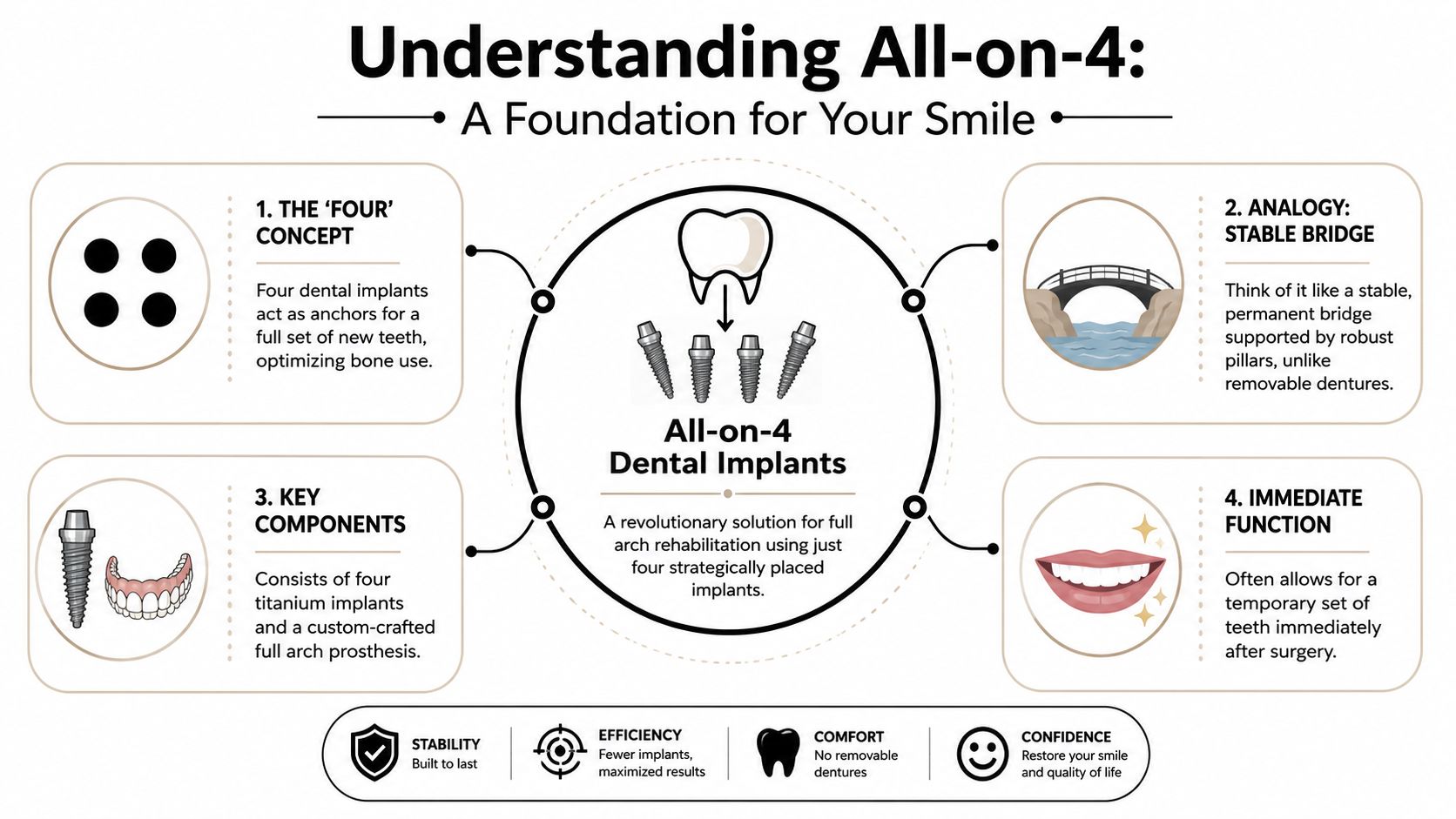
Think of the All-on-4 concept like a bridge supported by a small number of strong pillars. Instead of placing an implant for every missing tooth, four implants are positioned to support an entire full-arch prosthesis. The result is a fixed restoration that doesn't come in and out like traditional dentures.
How four implants can support a full arch
Two implants are generally placed in the front where bone is often stronger and denser. The two posterior implants are tilted in a way that helps use available bone more effectively. That design is what makes the treatment different from older approaches that often required more implants or more extensive grafting before treatment could even begin.
The prosthesis is attached to those implants, so the patient has a fixed set of teeth rather than a removable appliance resting on the gums. That's a major distinction in comfort and function.
A few core parts make the concept work:
- Implant anchors support the arch from within the jawbone rather than relying on suction or adhesive.
- A full-arch prosthesis replaces the visible teeth and restores the smile line.
- Strategic positioning helps the dentist use the bone that's already available in the best possible way.
Why this approach has become so important
For many patients, the appeal isn't just fewer implants. It's the ability to restore a whole upper or lower arch in a way that can reduce complexity and often avoid more invasive preliminary treatment.
The long-term track record is another reason this treatment gets serious attention. The All-on-4 dental implant procedure demonstrates exceptionally high long-term success rates, with studies reporting a survival rate of 98.8% for implants in the lower jaw and 95-97% in the upper jaw, with some data showing a 99.2% success rate over 10 years of follow-up, according to published All-on-4 success rate data.
Practical rule: A strong All-on-4 plan isn't just about replacing teeth. It's about creating a stable foundation that can hold up under real chewing forces over time.
What patients should understand from the start
This is an advanced treatment, but the concept is patient-friendly. Four implants act like the support structure. The bridge restores the smile. The strategic angles help make treatment possible for more people than they expect.
That's why patients searching for dental implants near me or a dentist near me in Walnut Creek often ask about this procedure first when they want a full-arch solution that feels secure, looks natural, and doesn't rely on removable dentures.
Who Can Benefit from All-on-4 Dental Implants
All-on-4 isn't for every dental problem. It fits best when the issue involves major tooth loss, advanced breakdown of the remaining teeth, or serious frustration with dentures. In those situations, it can offer a stable fixed option where piecemeal treatment may not be the smartest long-term choice.
Some patients already have no teeth in one arch. Others still have teeth, but those teeth are failing and likely can't be predictably saved. Many are tired of removable appliances and want something more secure for speaking, smiling, and eating.
Common situations where All-on-4 makes sense
This treatment may be a strong option for people who:
- Have lost most or all teeth in the upper or lower arch and want a fixed replacement rather than another removable denture.
- Are dealing with multiple failing teeth and don't want a cycle of extractions, patchwork repairs, and repeated restorative work.
- Feel unhappy with dentures because of slipping, rubbing, limited chewing confidence, or the need for adhesives.
- Have some jawbone loss and have been told conventional vertical implant placement may be difficult.
The last point matters. Bone changes after teeth are lost, and that's often where treatment planning gets more complex.
Why bone loss doesn't always rule treatment out
A key advantage of this procedure is that it can work as a graftless solution for many edentulous patients. The clinical indication includes patients with a minimum bone width of 5mm and a minimum bone height of 10mm from canine to canine in the maxilla, and 8mm in the mandible, as described in this clinical review of treatment indications.
That doesn't mean a patient can self-diagnose from a mirror or an online article. It means there are clear criteria that can make treatment possible even for people who assume they don't have enough bone.
The best candidates aren't defined by frustration alone. They're defined by anatomy, bite forces, medical history, and whether a fixed full-arch approach will actually serve them well over time.
When another option may be better
Sometimes the better answer is not All-on-4. A patient may benefit more from preserving healthy remaining teeth, using a different implant design, or taking care of urgent issues first, such as infection, gum disease, or a painful broken tooth.
That evaluation often starts with basics. A full exam, updated imaging, and a discussion of your goals matter just as much as the implant conversation itself. Patients looking for an emergency dentist, general dental care, or help after years of incomplete treatment often need that full picture before choosing a final plan.
Your All-on-4 Treatment Timeline with Dr. Schneider
A lot of patients arrive in my Walnut Creek office with the same concern. They understand the goal, but they do not know what daily life looks like between surgery day and the final teeth. That uncertainty is reasonable, and it deserves a clear answer.
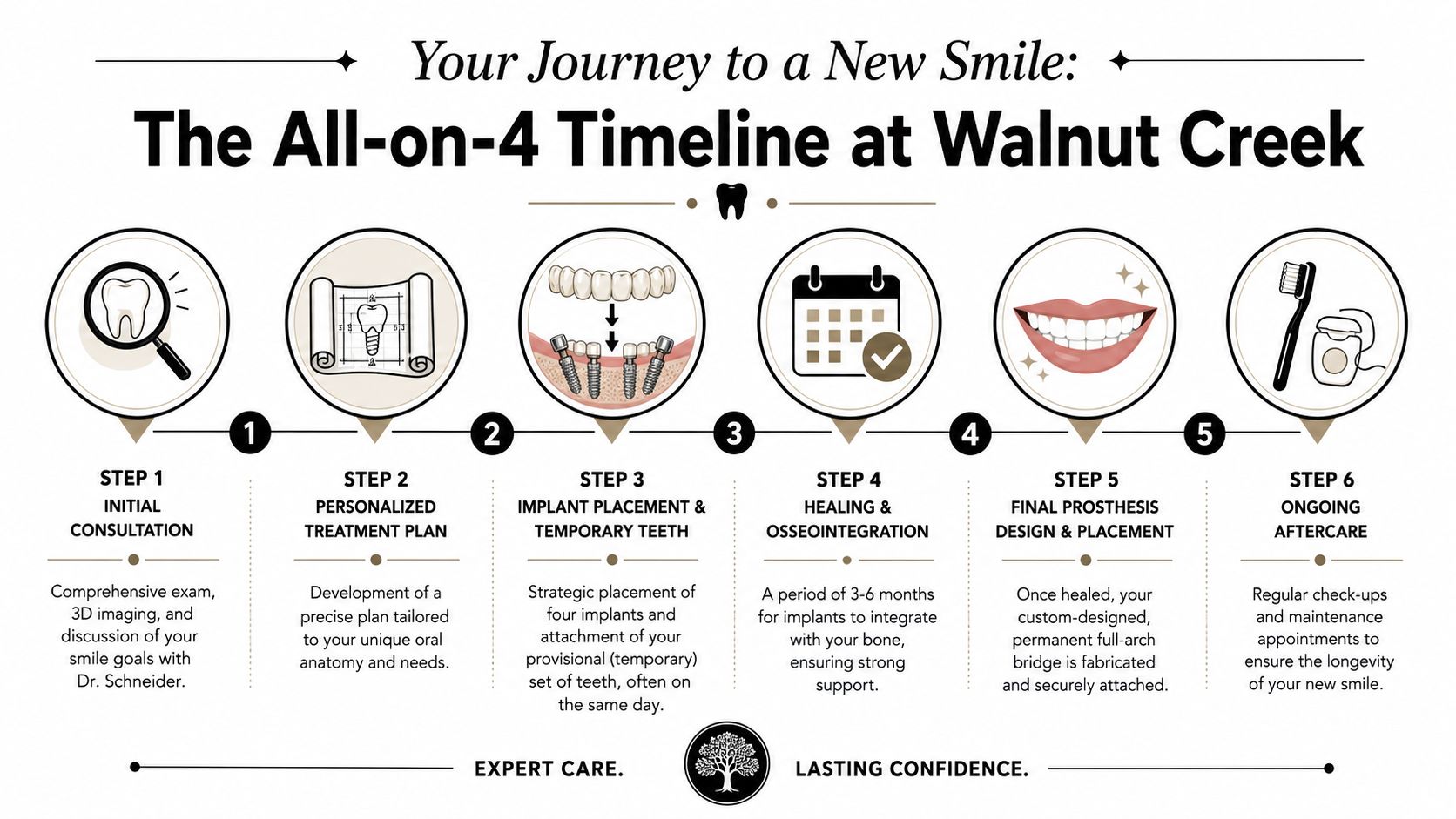
The all on four implant procedure works best when the timeline is explained in plain language. Each phase has a job. First, we confirm that treatment is appropriate. Then we place implants and a temporary fixed bridge. After that, the healing period becomes the main focus, because long-term success depends on what happens during those months, not only on the day of surgery.
Consultation and planning
The first step is a detailed evaluation. I examine the teeth and gums, review your medical history, and study imaging to assess bone shape, available support, and the location of important anatomical structures. That planning guides implant position, bite design, and whether any problem needs attention before surgery.
This visit also sets expectations. We talk about sedation and comfort, your work and home schedule, how much downtime you may need, and what the temporary phase will realistically require from you. If there are failing teeth, active infection, or unstable dental work, those issues become part of the treatment sequence instead of an afterthought.
Patients who want a broader overview of recovery can review this dental implant healing timeline before surgery.
Surgical day and immediate teeth
On the day of surgery, the focus is stability and safety. In many cases, the back implants are placed at an angle so we can use available bone more effectively and avoid key anatomical areas. That approach can reduce the need for bone grafting in the right patient.
Most patients leave with a fixed temporary set of teeth. That matters emotionally as much as it does cosmetically. You do not spend this phase without a smile.
The temporary bridge has a specific purpose, though. It helps you look presentable and function in a limited way while the implants bond with the bone. It is not built for unrestricted chewing, and saying that clearly prevents a lot of frustration later.
Here's a visual overview of the process:
The healing period patients need explained clearly
This is the part many articles rush through, but patients feel it every day.
During the first stretch of healing, soreness, swelling, and speech adjustment are common. Individuals generally improve steadily, but they still need to be careful with cleaning, follow instructions closely, and avoid putting too much force on the new implants.
The middle phase often feels better than the first, which can create false confidence. Patients may be tempted to test tougher foods because the temporary teeth feel secure. That is where discipline matters. The implants may feel stable before the bone is ready for full chewing pressure, and overload during healing can compromise the result.
I tell patients the same thing in direct terms. Leaving with teeth and chewing normally are different milestones.
A soft-food diet is usually part of this stage, and that can be the most overlooked trade-off of All-on-4. It is manageable, but it takes planning. Patients do better when they know that recovery is not only about discomfort. It is also about diet, patience, and protecting the investment while the foundation matures.
Final restoration and follow-up care
Once healing is far enough along and the implants are integrating as expected, we move to the final bridge. At that point, we refine the bite, confirm fit, and choose materials that suit the patient's function, appearance goals, and maintenance needs. The final teeth should look natural, feel balanced, and be designed for long-term cleaning and service.
Care does not stop at delivery. William M. Schneider, DDS coordinates full-arch treatment with regular exams, maintenance visits, and ongoing implant monitoring in Walnut Creek, because even excellent implant work needs follow-up to stay healthy over time.
For many patients, this is when the treatment starts to feel complete. The smile looks more natural, speech feels more settled, and eating becomes less cautious once the final restoration is in place and healing goals have been met.
All-on-4 Benefits Compared to Dentures and Other Implants
Patients rarely choose All-on-4 in a vacuum. They usually compare it to two alternatives. One is a removable denture. The other is replacing a full arch with a larger number of conventional implants. Both options can work in the right setting, but they solve different problems and come with different trade-offs.
Compared with traditional dentures
Dentures can restore appearance quickly, but they rest on the gums and don't provide the same fixed feel as implant-supported teeth. That difference shows up in daily life. Stability affects how comfortable you are while eating, talking, and laughing.
All-on-4 changes that experience because the prosthesis is secured to implants rather than sitting loosely over tissue.
| Option | Day-to-day feel | Main limitation |
|---|---|---|
| All-on-4 | Fixed and anchored | Requires surgery and healing |
| Traditional dentures | Removable | Can shift and feel less secure |
| Conventional implant approach | Fixed | Often more complex for a full arch |
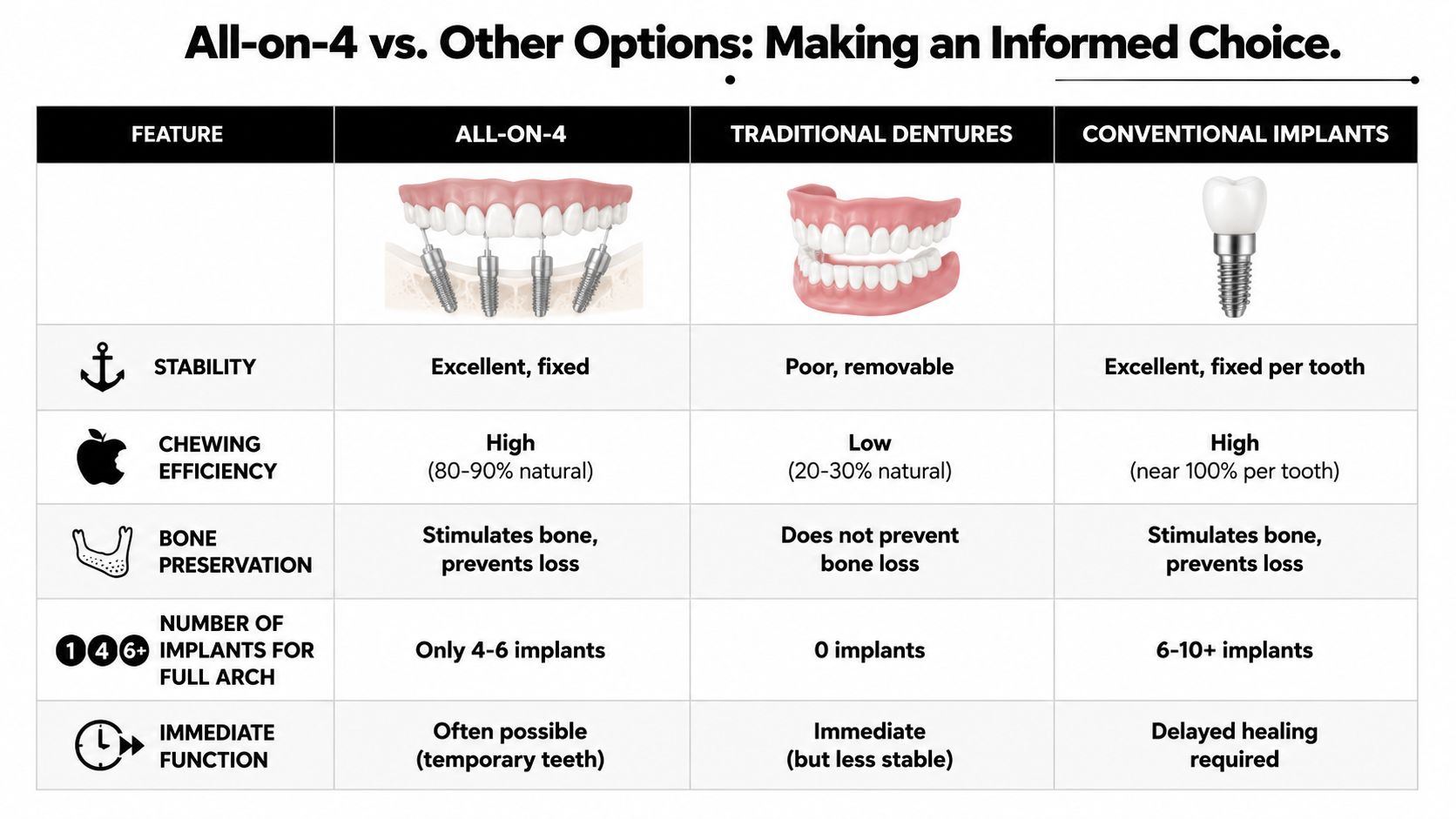
For patients who are tired of adhesives, sore spots, and limited confidence, a fixed solution often feels like a major step forward.
Compared with a full arch of more conventional implants
Replacing an entire arch with a larger number of implants can be effective, but it may involve more surgery, more cost, and a more demanding anatomical setup. All-on-4 was designed to use implant position strategically so a full-arch prosthesis could be supported efficiently.
The technical detail that matters most is the tilt of the back implants. The All-on-Four protocol's two posteriorly angled implants (tilted at 30°–45°) allow prostheses with up to 12 teeth, avoiding critical anatomical structures and eliminating the need for bone grafting procedures that increase cost and recovery time associated with other implant methods, according to this clinical review of the protocol.
That design can make treatment available to patients who might not be ideal candidates for more traditional full-arch implant layouts.
A removable denture can replace teeth. A well-planned fixed full-arch restoration can replace teeth and restore confidence in how the mouth functions.
What about All-on-6
Some patients hear different numbers and assume more implants always means better treatment. That's not how responsible planning works. The number of implants depends on anatomy, bone quality, bite demands, and prosthetic design.
In other words, the right treatment is the one that fits the patient. Sometimes that means four. Sometimes it means a different full-arch design entirely. A careful evaluation matters more than a label.
All-on-4 Costs Recovery and Aftercare in Walnut Creek
A common Walnut Creek scenario is this: a patient is excited about finally getting rid of a loose denture, then gets nervous when the conversation turns to healing, food choices, and fees. That concern is reasonable. Full-arch implant treatment is a major decision, and clear expectations matter as much as the surgery itself.
The total cost reflects several parts of care, not just the implants. Planning, imaging, surgery, temporary teeth, the final bridge, follow-up visits, and long-term maintenance all affect the final number. The fee can also change if bone quality, bite forces, or medical factors make the case more complex. A written treatment plan helps patients see what is included and what may fall outside the original estimate.
The healing phase deserves a more honest explanation
Many offices highlight same-day teeth. Patients should also hear the part that takes patience. After implant placement, there is a transitional healing period that often lasts several months. During that time, the implants are integrating with bone, and the temporary teeth are not meant to handle every food you may want to eat.
This is the stage people are often underprepared for.
The patients who do best usually treat this period seriously. They stick to a soft diet, avoid testing the temporary bridge, and come in for adjustments when something feels off. Recovery is generally manageable, but it is still recovery. Some swelling, soreness, speech adjustment, and changes in chewing confidence are normal early on.
A few practical realities matter:
- A soft-food diet protects the implants while they heal.
- Temporary teeth may need small adjustments as tissues settle.
- Full chewing strength usually comes later, after the final prosthesis is delivered.
- Skipping instructions can increase the risk of implant overload or prosthesis problems.
Aftercare is part of the treatment, not an extra
Long-term success depends on maintenance at home and in the office. Fixed full-arch teeth collect plaque differently than natural teeth, so patients need specific cleaning instructions and regular professional checks. That includes monitoring the gums, the fit of the prosthesis, and the bite over time.
Patients who want a practical starting point can review daily care steps for dental implants and fixed restorations. We tailor those instructions to the patient, because hand skills, medical history, and prosthesis design all affect the best home-care routine.
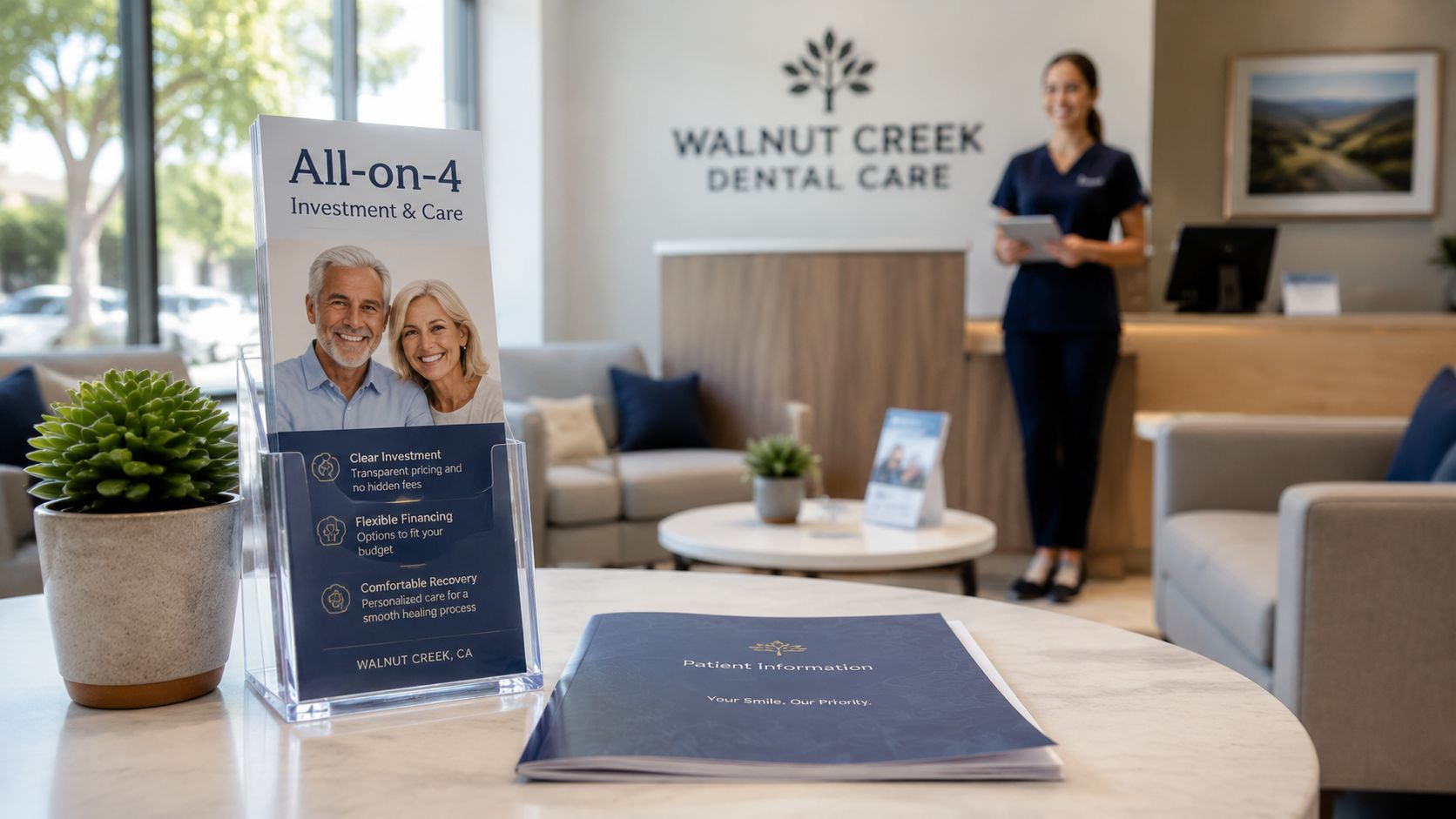
Financing may be available depending on the treatment arrangement. Ask for the details in writing. Patients in Walnut Creek usually feel more comfortable when they know exactly what is covered, what follow-up care is expected, and what the healing period will realistically require.
Your All-on-4 Implant Questions Answered
A common concern I hear in Walnut Creek is simple: patients want fixed teeth, but they do not want surprises after surgery. That is a fair concern. Good All-on-4 planning includes honest answers about discomfort, healing, food choices, maintenance, and whether this option fits the person sitting in the chair.
Is the procedure painful
Comfort is managed during treatment with local anesthesia and, for some patients, sedation. In practice, anxiety before surgery is often harder than the procedure itself.
After surgery, expect soreness, swelling, and a few days where you need to take it easy. That does not mean something is wrong. It means your body is healing. The goal is to keep you comfortable, monitor you closely, and make adjustments if healing is not tracking the way it should.
How long do All-on-4 teeth last
All-on-4 teeth can serve patients well for many years, but they are not maintenance-free. The implants and the prosthesis are different parts of the system, and they do not always wear at the same rate.
Long-term success depends on daily cleaning, bite forces, grinding habits, regular checkups, and the material used for the final teeth. Some prostheses need repair, relining, or replacement over time. I tell patients to plan for maintenance from the start, because that is part of protecting the investment and the health of the tissues underneath.
What can I eat while healing
Healing comes in stages. Your diet does too.
Early on, food choices are more limited than many offices explain, and that temporary phase matters. Soft foods help protect the implants while they bond with the bone. Trying to chew tougher foods too soon can create problems that are avoidable with a little patience. Patients usually do better when they prepare for that period ahead of time instead of assuming fixed teeth mean a full return to normal eating right away.
Is this better than getting another denture
For many patients, a fixed full-arch prosthesis feels more secure and more natural than a removable denture. It can improve confidence with speaking, socializing, and day-to-day comfort.
Still, removable treatment is the better choice for some people. Bone anatomy, medical history, hand dexterity, budget, and personal preference all matter. Honest treatment planning means saying so clearly. The right option is the one that fits your health and your goals, not the one that sounds more impressive.
Why choose a local Walnut Creek office for this kind of care
Full-arch implant treatment requires follow-up, maintenance, and timely access to your dentist if something feels off. That is one reason local care matters. If your bite needs adjustment, your temporary teeth need refinement, or you have questions during healing, it helps to see a team that already knows your case and can respond without delay.
If you are considering full-arch tooth replacement and want a clear conversation about whether the All-on-4 implant procedure fits your needs, schedule a consultation with William M. Schneider, DDS. Patients in Walnut Creek can get personalized guidance on treatment options, comfort measures, healing expectations, and long-term maintenance so the decision feels informed and realistic.