You may be searching for a dentist near me because you want straighter teeth without the brackets, wires, and visible hardware associated with traditional braces. For many adults in Walnut Creek, CA, Invisalign clear aligners offer a discreet, removable way to improve crowding, spacing, and selected bite concerns while fitting around work, family, meals, and social events.
At William M. Schneider, DDS, Invisalign is considered as part of complete dental care, not as a stand-alone cosmetic purchase. A consultation can also identify gum concerns, cavities, worn fillings, or other issues that should be managed before orthodontic treatment begins. The important question isn't just whether clear aligners look appealing. It's whether they can move your teeth predictably, whether you'll wear them consistently, and whether a different or hybrid approach would give you a more stable result.
What Invisalign Clear Aligners Are and How They Became Mainstream
An adult in Walnut Creek might arrive for a consultation with a familiar goal: straighten a few crowded front teeth, improve a smile before important events, or correct shifting that occurred after earlier braces. They may want cosmetic dentistry that doesn't announce itself every time they speak. Invisalign clear aligners address that preference with a series of custom-made, transparent trays that fit over the teeth and apply controlled pressure to guide gradual movement.
Each aligner is designed for a particular stage of treatment. Patients typically wear one tray for about 1 to 2 weeks before moving to the next, although the prescribing clinician may adjust that schedule for the case. The trays are removable for meals and oral hygiene, which makes cleaning and flossing more straightforward than cleaning around fixed brackets. A patient-friendly explanation of aligner changes describes this staged approach and the gentle pressure used to reposition teeth.
From an early niche to a familiar orthodontic option
The modern Invisalign story began with FDA clearance in 1998 and introduction to the U.S. market around 1999, marking a major step in modern clear-aligner orthodontics. Early labeling focused on patients with permanent teeth and excluded several complex bite and growth conditions. As attachments, planning tools, and auxiliaries improved tooth-movement control, the system expanded into broader clinical use, including cases that were more involved than the earliest adult aligner cases. Align Technology's account of expanded Invisalign labeling documents that progression.
The platform's adoption now reflects both patient and provider use. Align Technology reported that by 2025, Invisalign had treated over 22 million patients worldwide, including more than 6.5 million teens and growing kids, and had manufactured over 2.4 billion clear aligners globally. The company also reported more than 295,000 active Invisalign-trained doctors in 2025. Align Technology's 2025 company information shows how the system moved from a niche cosmetic option toward a widely used orthodontic platform.
That scale doesn't mean Invisalign is right for everyone. It means patients have more treatment experience and clinical planning options to evaluate. A local consultation still matters because tooth shape, bone support, bite relationships, restorations, and daily habits determine whether aligners are a sensible choice.
How Invisalign Moves Your Teeth Step by Step
Invisalign treatment is easier to understand when you view it as a sequence of small decisions rather than a single purchase of plastic trays. The dentist first studies your teeth and supporting tissues, then creates a movement plan, checks how each aligner fits, and monitors whether your mouth is responding as expected.
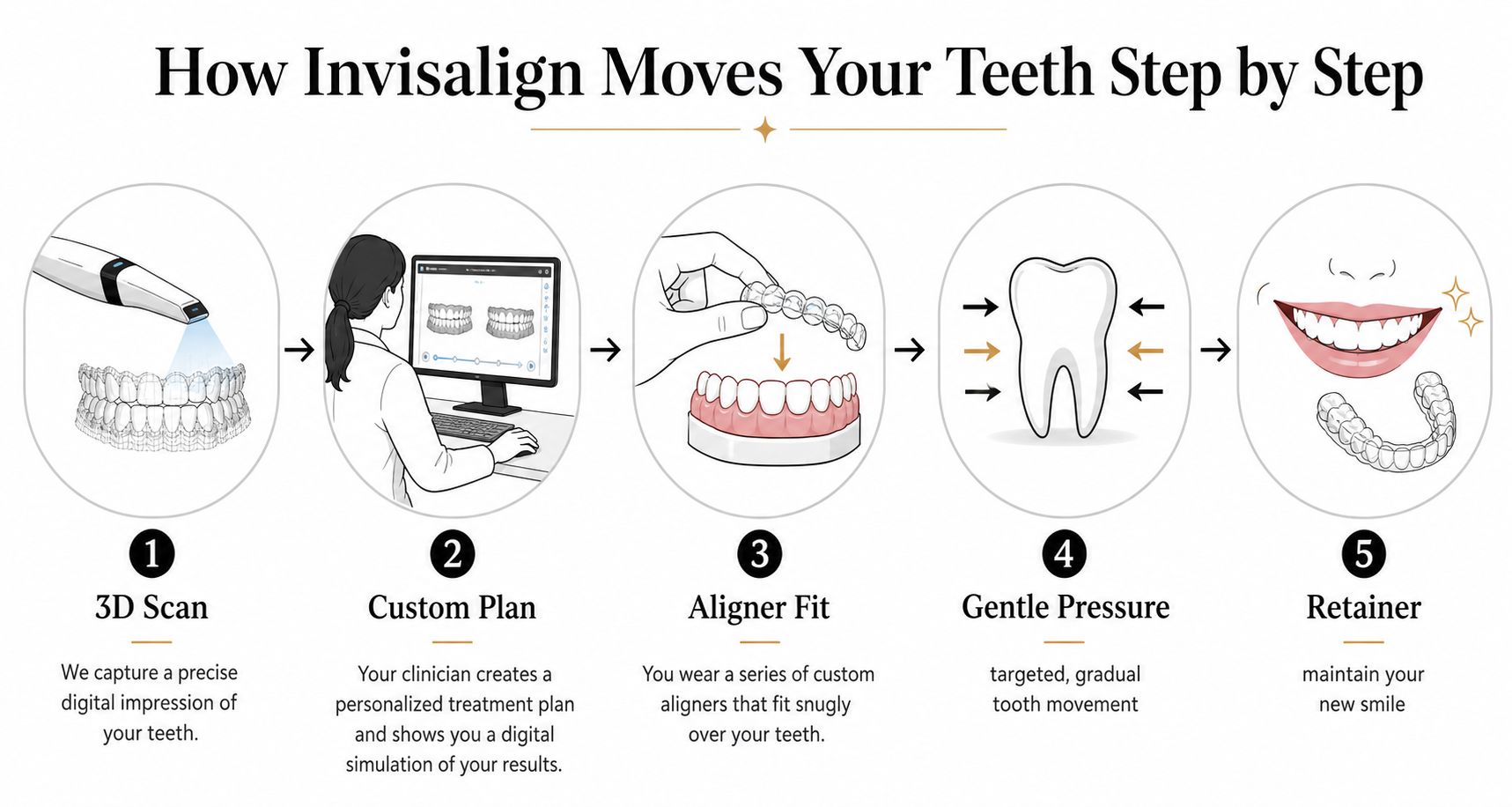
The treatment sequence
Examination and digital records. The first visit may include a clinical exam, photographs, dental x-rays when appropriate, and a digital scan. The scan creates a three-dimensional record without the discomfort of traditional impression material. Your dentist also evaluates your bite, gums, existing fillings or crowns, and the position of tooth roots.
Treatment planning. The clinician maps the intended movement from the starting position toward the planned result. The digital simulation is useful, but it isn't a guarantee that every programmed movement will occur exactly as shown. The plan must make biological and clinical sense, not just look attractive on a screen.
Aligner delivery and fit check. Once your trays arrive, the office checks that they seat correctly. Some cases use small tooth-colored attachments or other auxiliaries to give the aligner better contact and force. You receive instructions for inserting, removing, cleaning, storing, and changing trays.
Incremental movement. Each aligner makes small adjustments rather than large shifts. The tray applies gentle, consistent pressure, and the tooth responds over time as the surrounding supporting tissues remodel. Aligners are commonly changed after about 1 to 2 weeks, based on the prescribed schedule. Clinical guidance on the Invisalign process and follow-up visits describes incremental movement and check-ins commonly scheduled every 6 to 8 weeks.
Refinement and retention. Progress reviews determine whether teeth are tracking with the plan. If a movement falls behind, the dentist may rescan, alter the sequence, or order refinement trays. When active treatment ends, retainers help hold the teeth in their new positions. Retention isn't an optional cosmetic extra. Teeth can shift after orthodontic treatment, especially when retainer use stops.
A weekly change schedule may be appropriate with SmartTrack and SmartForce features, while an earlier recommendation used a two-week interval for each 0.25 mm of programmed movement. Align's published white paper explains that changing intervals depend on the system and treatment protocol.
Invisalign vs Traditional Braces Compared
The choice between Invisalign and fixed braces isn't a contest with one universal winner. It depends on the movement required, your willingness to manage removable trays, the appearance you prefer, and how much control the case needs.
| Factor | Invisalign Clear Aligners | Traditional Braces |
|---|---|---|
| Appearance | Clear trays are generally less noticeable during conversation and smiling. | Brackets and wires are visible, although ceramic options may reduce contrast. |
| Removability | You can remove trays for eating, brushing, and flossing. | Appliances remain attached during meals and hygiene. |
| Hygiene | You can brush and floss without working around brackets, but you must clean the trays and teeth consistently. | Brushing and flossing require careful cleaning around brackets and wires. |
| Food routine | Aligners are removed for meals, so food restrictions are less central. | Hard or sticky foods may damage brackets or wires and require caution. |
| Control of movement | Often effective for alignment and crowding, with limitations for some complex movements. | Fixed appliances provide continuous engagement and may offer more predictable control in difficult cases. |
| Patient responsibility | Success depends strongly on wearing and changing trays as directed. | The appliance stays in place, although hygiene and appointment cooperation still matter. |
| Refinements | Additional trays may be needed when teeth don't track as planned. | Adjustments occur through wire and bracket changes, with treatment progress evaluated in person. |
Where the evidence becomes more nuanced
Clinical reviews find that clear aligners can work well for alignment and crowding, but they are less predictable for occlusal contact finishing, buccolingual inclination control, vertical tooth movement, anterior-posterior correction, and rotation of rounded teeth. One systematic review found no significant difference in treatment time compared with conventional fixed appliances, while also noting greater relapse risk after treatment in some cases. This clinical review of clear aligners and fixed appliances helps explain why a polished digital preview shouldn't replace a candid discussion about limitations.
A patient who has mild crowding and values removability may find Invisalign practical. Someone with a severe bite discrepancy, difficult molar movement, or a need for highly controlled rotations may receive a recommendation for braces, attachments, elastics, or a hybrid plan. The right comparison is not “invisible versus metal.” It's which appliance can achieve a healthy, stable bite under the conditions you can realistically follow.
Who Makes a Good Candidate for Invisalign
A strong Invisalign candidate usually has a correctable alignment concern, healthy enough gums and teeth to support movement, and the discipline to wear removable trays consistently. Adults with mild to moderate crowding, spacing, selected overbite or underbite concerns, crossbite, or rotated teeth may respond well, but the diagnosis matters more than the label on the box.
Recent evidence on rotational movement illustrates why candidacy needs careful review. A 2025 systematic review reported accuracy ranging from 36% to 85%, with an average near 65%, and connected the variation to tooth shape, staging, and adjunctive strategies. The systematic review on rotational tooth movement reinforces a practical point: wear time helps, but it can't make every movement equally predictable.
Situations that deserve closer planning
| Issue | Invisalign | Braces or Hybrid |
|---|---|---|
| Mild crowding or spacing | Often a reasonable option after a full exam. | Useful when movement needs stronger fixed control. |
| Minor relapse after earlier braces | Frequently considered when teeth have shifted modestly. | May be preferred if relapse is extensive or the bite has changed substantially. |
| Mild to moderate bite correction | May work with attachments and carefully planned staging. | More likely when correction is severe or requires stronger mechanics. |
| Rounded-tooth rotations | Can be attempted, but tracking may be less predictable. | Often offers more direct control for difficult rotations. |
| Severe skeletal discrepancy | Aligners alone may not correct the underlying jaw relationship. | Braces, orthodontic appliances, or surgical evaluation may be needed. |
| Severely tipped molars or major movement | Requires especially cautious evaluation and may need auxiliaries. | Fixed or hybrid treatment may provide better control. |
Compliance is part of the diagnosis
Patients must be prepared to wear aligners for about 20 to 22 hours each day and follow the prescribed exchange schedule. Teens can qualify when most permanent teeth have erupted and they can manage the responsibility. Adults should consider work travel, meals, public speaking, childcare, and habits that might make consistent wear difficult.
A consultation at a Walnut Creek dental office should include scans, photographs, a clinical exam, and dental x-rays when needed to evaluate bone support and root positioning. Existing restorations, active gum disease, cavities, and smoking habits may affect timing, tray appearance, or overall suitability. Treating those concerns first can protect both the orthodontic result and your broader oral health.
How Long Invisalign Treatment Really Takes
Treatment time depends on the movement required and how closely the teeth follow the plan. For most patients, Invisalign commonly falls in the 12 to 18 month range, although straightforward cases may finish sooner and complex cases may take longer. This treatment-time overview explains why case complexity and compliance influence the schedule.
The often-quoted ranges of 4 to 6 months for mild spacing or minor relapse and 18 to 24 months for complex cases involving major bite concerns or difficult rotations should be treated as planning examples, not promises. The clinician needs to examine your teeth before assigning a meaningful estimate.
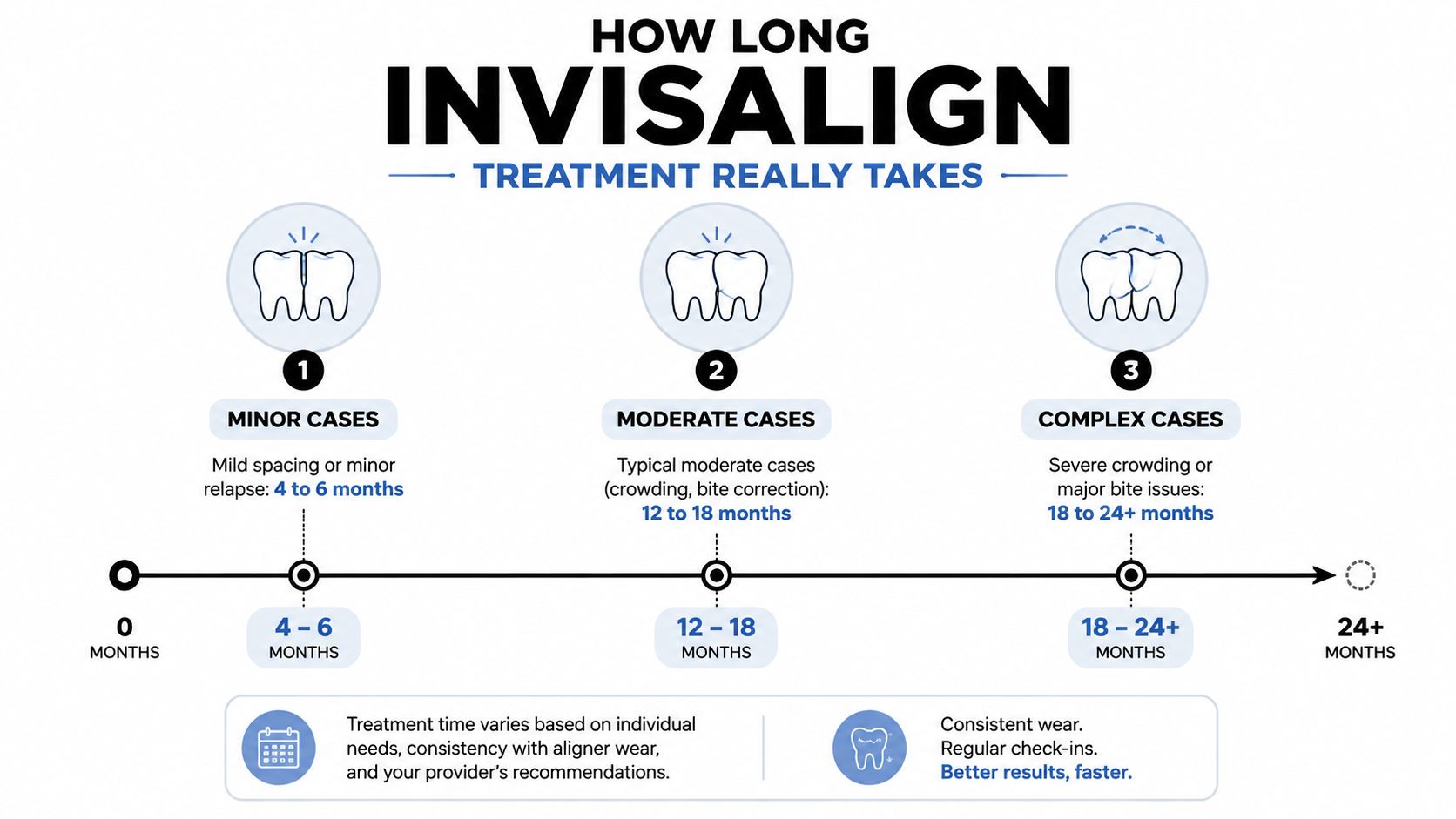
What can change the schedule
- Wear consistency: Leaving trays out for long periods gives teeth less opportunity to respond to the planned force.
- Movement difficulty: Rotations, vertical movements, molar changes, and bite corrections may need more staging and monitoring.
- Appointment attendance: Check-ins commonly occur every 6 to 8 weeks, allowing the dentist to identify tracking problems before they become larger delays.
- Refinement needs: A tooth may not follow the digital plan precisely, so additional scans and trays can extend active treatment.
- Biological response: Teeth move through living bone and supporting tissues, and individual responses vary.
A material-performance review found that SmartTrack, also called LD30, showed a significant reduction in indentation modulus and Martens hardness after wear. The reported changes included an indentation-modulus SMD of -2.41, a 95% confidence interval from -3.39 to -1.43, and P<0.001, while Martens hardness showed an SMD of -3.38, a 95% confidence interval from -6.24 to -0.52, and P=0.02. The meta-analysis of aligner material performance helps explain why timely tray changes, staging, and wear compliance matter.
Active treatment ends when the planned movements are complete. Retention begins immediately afterward and continues indefinitely in some form, because teeth remain capable of shifting. Your final retainer protects the work you invested in rather than marking the end of responsibility.
Cost Considerations and Ways to Manage the Investment
Invisalign pricing varies because treatment isn't identical from patient to patient. A case with modest alignment needs may require fewer trays and less complex planning than a case involving attachments, bite correction, interproximal reduction, and several refinement rounds. The practice should explain what the quoted fee includes before you commit.
A published patient guide places many Invisalign cases in a $3,500 to $8,000 range, depending on complexity, provider experience, and geographic market. This overview of Invisalign treatment cost can help you understand why two treatment plans may have different fees without assuming that the lower quote represents better value.
| Cost Factor | What It Means | Financing Option |
|---|---|---|
| Number of aligner trays | More planned movement generally requires more stages. | Ask whether the fee includes the complete prescribed series. |
| Attachments and auxiliaries | Tooth-colored attachments or other tools can support difficult movements. | Confirm whether placement and removal are included. |
| Refinement rounds | Additional trays may be needed if teeth don't track exactly as planned. | Ask how refinement scans and trays are handled. |
| Retainers | Retention protects alignment after active treatment. | Confirm whether initial retainers are bundled or billed separately. |
| Insurance benefits | Orthodontic coverage may have a lifetime maximum rather than an annual limit. | Request a benefits review before treatment begins. |
| HSA or FSA funds | Eligible orthodontic expenses may be paid with pre-tax dollars. | Check your plan rules and contribution balance. |
| Payment plans | Monthly arrangements can spread the investment over time. | Ask about in-house plans or third-party financing such as CareCredit. |
A transparent consultation should review insurance reimbursement, HSA or FSA contributions, payment plans, follow-up visits, and retainer replacement policies. Patients should also compare the scope of care, not only the starting price. A plan that includes careful monitoring and realistic refinement support may prevent confusion later, while a low initial quote may leave important services outside the package.
Daily Care and Maintenance That Protects Your Results
Clear aligners are convenient because you can remove them, but that convenience creates a daily responsibility. Aim for 20 to 22 hours of wear each day, removing the trays only for eating, drinking anything other than cool water, brushing, or flossing. Skipping a few hours can seem harmless, yet repeated gaps may leave teeth behind schedule and extend active treatment.
A routine that works in real life
In the morning and evening, brush your teeth gently with a soft toothbrush and non-abrasive toothpaste. Rinse the aligners with lukewarm water, and don't use hot water because heat can distort the plastic. Clear antibacterial soap, denture cleaners, or dedicated aligner crystals may help remove buildup. Colored mouthwash can stain trays, so avoid using it as an aligner-cleaning solution.
Remove trays before coffee, tea, or red wine. If you eat crunchy foods such as apples, take the aligners out and cut the food into smaller pieces. After meals, rinse your mouth and the trays before reinserting them, especially when brushing immediately isn't possible.
Practical rule: Your aligner case is part of the treatment. Use it whenever the trays aren't in your mouth, rather than wrapping them in a napkin where they can be lost or discarded.
Handling common problems
If an aligner cracks or no longer seats properly, don't force it over your teeth. If you lose a tray, the right next step depends on where you are in the schedule. You may need to return to the previous tray or move ahead, but that decision should be based on timing and fit, not guesswork. Call the Walnut Creek office for guidance, particularly if the next tray feels loose, painful, or impossible to seat.
For a more detailed home routine, review this guide to cleaning Invisalign aligners. Consistent cleaning protects the trays from odor and discoloration, while brushing and flossing protect the teeth underneath them. Invisalign doesn't replace preventive dental care, including professional cleanings, exams, and periodontal checks.
A 2025 study of an AI mobile app for clear-aligner therapy reported adherence improving from 85% to 92% and patient engagement scores increasing from 4.2 to 7.3. The published adherence study points toward a useful future direction, practical tools that help patients follow through. The same research area also shows that comfort, confidence, convenience, and disruption to daily life shape patient needs alongside mechanics.
Getting Started at William M. Schneider, DDS in Walnut Creek
Your first appointment should feel like a conversation, not a sales presentation. At William M. Schneider, DDS, the visit can begin with a digital scan, photographs, and a clinical examination while you explain what bothers you about your smile. You might be concerned about front-tooth crowding, an old orthodontic relapse, a bite that feels uneven, or the practical challenge of wearing aligners during a busy workday.
The dentist reviews your goals alongside your oral health. Gum inflammation, cavities, worn restorations, or inadequate bone support may need attention before teeth are moved. If another service is appropriate, such as restorative dentistry, tooth extraction, crowns, bridges, dental implants, or treatment for gum disease, that broader plan matters more than rushing into aligners. Patients who begin with a search for a cosmetic dentist near me may discover that a healthy foundation is the first step toward a better-looking smile.
A plan built around your daily routine
After records are reviewed, the office discusses projected tooth movement, the likely treatment range, possible attachments, the chance of refinements, and the retention plan. Cost conversations can include insurance, HSA or FSA contributions, and available payment arrangements. If you're also searching for teeth whitening, restorative care, or a long-term dentist in Walnut Creek, CA, coordinating those needs in one dental home can make treatment easier to manage.
When the aligners arrive, a fit-check appointment confirms seating and reviews insertion, removal, and cleaning. Follow-up visits are commonly scheduled every 6 to 8 weeks, with progress reviews and refinement scans when needed. Preventive cleanings and periodontal checks continue during treatment because straightening teeth doesn't remove the need for routine dental care.
William M. Schneider, DDS serves Walnut Creek and the broader East Bay with general, cosmetic, restorative, and Invisalign care. The practice also provides dental x-rays, new patient exams, emergency dental services, tooth extraction, dental implants, root canals, crowns, bridges, sleep apnea care, and sedation options when appropriate. That range is useful when an orthodontic consultation uncovers needs beyond alignment.
If you're looking for a dentist near me, an emergency dentist, or dental implants near me in Walnut Creek, CA, the same office can help evaluate the immediate concern and outline appropriate next steps. For Invisalign, the most valuable first step is an honest assessment of what aligners can accomplish predictably for your teeth.
William M. Schneider, DDS offers Invisalign clear aligner consultations, preventive cleanings, periodontal evaluations, restorative dentistry, and personalized smile planning for Walnut Creek patients. Visit William M. Schneider, DDS to request a consultation and discuss whether Invisalign is the right path toward a healthier, straighter smile.