A toothache has a way of taking over everything. You notice it when you sip coffee, when you chew on one side, and especially when you lie down at night and the throbbing suddenly feels louder. Many people in Walnut Creek and the East Bay wait a little too long because they hope the pain will fade on its own, or they worry the visit will be expensive, inconvenient, or uncomfortable.
That delay is often what turns a manageable problem into a much bigger one. Knowing when to see a dentist for tooth pain can help you protect the tooth, avoid unnecessary suffering, and make a smarter financial decision before a simple fix becomes a more involved procedure.
Your Guide to Tooth Pain Relief in Walnut Creek CA
You wake up with one sore tooth and tell yourself you'll watch it for a day. By lunch, cold water stings. By evening, chewing is miserable. By bedtime, you're searching for a dentist near me, wondering whether this is something that can wait until the weekend or whether you need help sooner.
That pattern is common. Tooth pain often starts with uncertainty. Some discomfort comes from a minor irritation. Some signals a cavity, a crack, or inflammation inside the tooth. Some pain means infection is developing and needs prompt care.

Many patients are surprised to learn how often untreated dental pain sends people to the hospital. In the United States, tooth-related complaints led to an average of 738,000 emergency department visits annually between 1997 and 2000, according to this analysis of emergency dental visits. The problem is that an emergency room usually can't provide the definitive dental treatment that fixes the cause.
Practical rule: If the pain is persistent, worsening, or interfering with sleep, eating, or concentration, it's time for a dental evaluation.
For patients looking for a dentist in Walnut Creek, CA, the main goal is simple. Find out what is causing the pain before it escalates. A careful exam, appropriate dental x-rays, and a clear treatment plan usually answer the question quickly.
Why guessing usually backfires
Tooth pain doesn't always stay in one lane. A mild cold sensitivity can point to a cavity. Pain when biting may mean a crack or inflammation around the tooth. Swelling can mean the issue has moved beyond irritation into infection.
Waiting can feel like the cheaper option in the moment. In practice, it often does the opposite. Small dental problems usually have smaller solutions. Larger infections, deeper decay, and broken teeth require more treatment, more time, and more recovery.
The right next step
If you're in pain now, don't focus on diagnosing yourself from symptoms alone. Focus on triage. Is this urgent? Is it manageable until tomorrow? Is this one of the cases where you need same-day attention?
The sections below will help you sort that out clearly and safely.
Urgent vs Non-Urgent Tooth Pain Symptoms
Some toothaches can wait a short time for a regular appointment. Others need same-day dental attention. A few require emergency medical care right away. The difference usually comes down to the character of the pain, the presence of swelling, and whether the problem is spreading beyond the tooth.
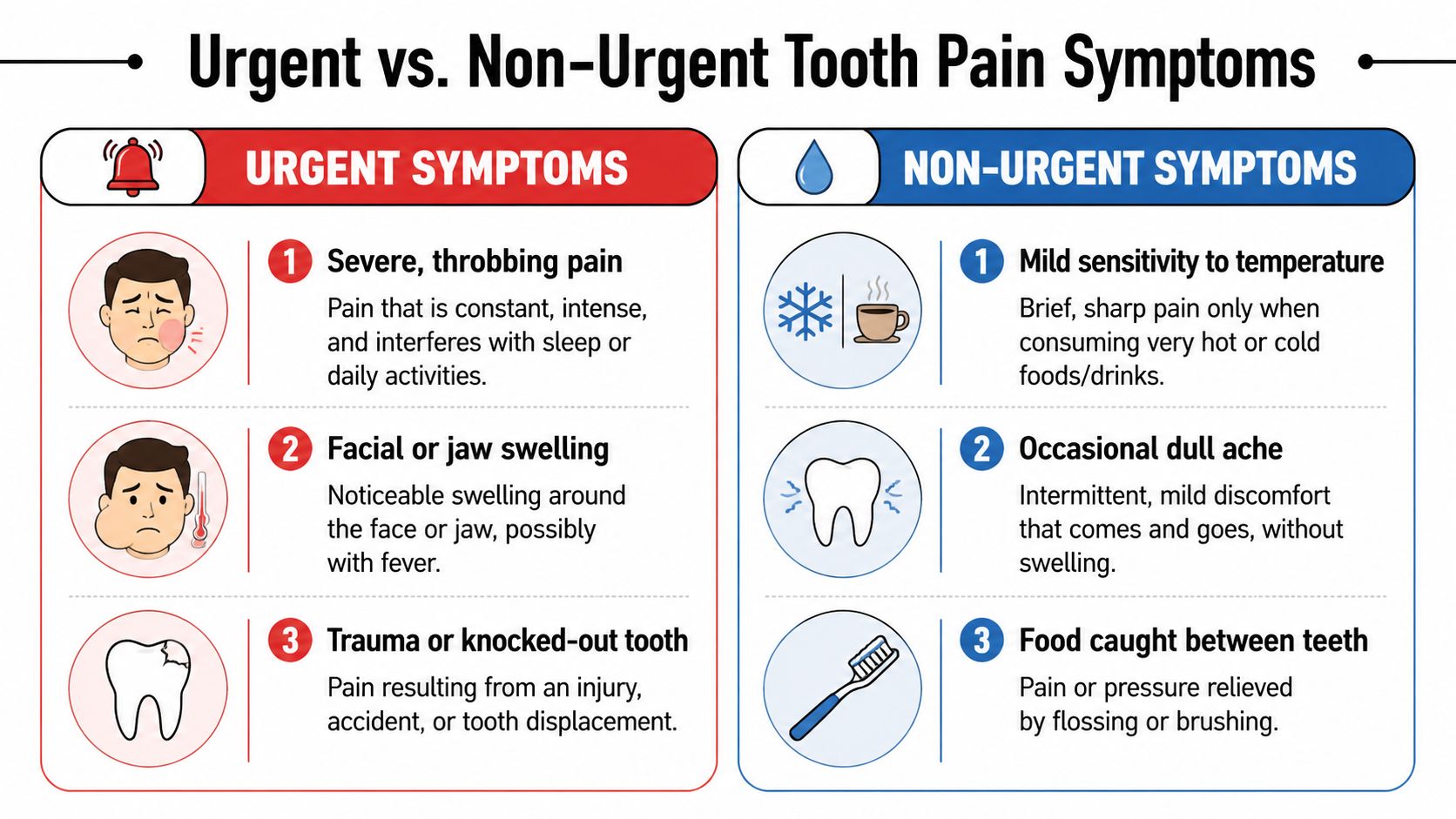
See a dentist soon
These symptoms usually mean you should arrange a prompt dental visit, even if you don't need the hospital.
- Brief pain with cold, heat, sweets, or acidic foods. Temporary trigger-based pain can suggest reversible pulpitis, which means the nerve is irritated but may still be saved with treatment such as decay removal and a filling, based on clinical guidance on pulpal pain and abscesses.
- A dull ache when chewing. This can come from a filling that's failing, a crack, early infection around the root, or inflammation from clenching.
- Food trapping between teeth. If the pressure improves after flossing, the issue may be localized, but it still deserves attention if it keeps returning.
- Lingering sensitivity that isn't severe. This can point to exposed root surfaces, enamel wear, a cavity, or an old restoration that no longer seals well.
Same-day or urgent dental care
These symptoms should move to the top of your list because the tooth is more likely to need immediate treatment.
- Spontaneous pain that lasts minutes and isn't tied to a specific trigger. Lingering, unprovoked pain is more consistent with irreversible pulpitis, which generally means the tooth won't settle down with home care alone and may need root canal treatment or extraction.
- Pain that keeps you from sleeping or functioning. Severe throbbing pain often means the inflammation has moved deeper into the tooth.
- Swelling in the gums, jaw, or cheek. Visible swelling is a major red flag. An acute apical abscess can cause rapid-onset pain, marked tenderness, and firm or fluctuating swelling.
- A tooth that feels suddenly high or extremely tender to tapping. That can happen when inflammation develops around the root tip.
If you have sudden dental pain with swelling, don't wait to see whether it settles down. That combination needs prompt evaluation.
Seek emergency medical care now
A dentist should evaluate most tooth pain, but some situations go beyond a routine dental problem.
| Symptom | Why it matters | Best next step |
|---|---|---|
| Difficulty swallowing | Swelling may be spreading into deeper tissues | Seek emergency medical care |
| Difficulty breathing | Airway involvement is an emergency | Go to the ER immediately |
| Rapid facial swelling with worsening pain | Infection may be progressing quickly | Same-day emergency evaluation |
| Trauma with major displacement or uncontrolled bleeding | Injury may affect bone and soft tissue | Immediate emergency assessment |
If you've had a fall, sports injury, or other blow to the mouth, don't assume the pain will declare itself later. Trauma can damage a tooth internally even when the crown looks mostly intact.
Safe At-Home Care for Managing Tooth Pain
Home care can help you get through the next few hours. It can't remove decay, seal a crack, or treat an abscess. The goal is short-term relief while you arrange professional care.
What usually helps
Start simple. Rinse gently with warm salt water if the area feels inflamed or if food is trapped around the tooth. Brush carefully and floss the area once, because debris caught between teeth can create sharp pressure that feels bigger than it is.
A cold compress on the outside of the cheek can reduce swelling and blunt throbbing. Stick with soft foods and chew on the opposite side. Avoid very hot, very cold, sugary, or acidic foods if they trigger the pain.
For medication, current guidance supports non-opioid pain relief first. Clinical evidence shows that a combination of an NSAID like ibuprofen and acetaminophen is more effective for acute dental pain than either medicine alone, and often works better than opioids, according to this review of acute dental pain management.
Use over-the-counter pain medicine exactly as directed on the label, and don't take it if your physician has told you to avoid it because of ulcers, kidney disease, liver disease, allergy, or another medical reason.
What doesn't help, or can make things worse
A few common home remedies create more problems than they solve.
- Don't place aspirin on the gum or tooth. It can irritate or burn soft tissue.
- Don't use heat on a swollen face. Heat can aggravate swelling.
- Don't keep chewing on the painful side to test it. Repeated pressure can worsen a crack or inflamed ligament.
- Don't start leftover antibiotics. The wrong antibiotic, dose, or timing can muddy the picture without solving the source.
Use home care as a bridge, not a solution
If the pain disappears after medicine, the dental problem may still be there. Pain relief means the symptoms are quieter, not necessarily that the cause is gone.
That distinction matters. Temporary relief is useful. Delay is what gets expensive.
Common Causes of Tooth Pain and Modern Dental Solutions
Tooth pain usually makes more sense once you connect the symptom to the structure underneath. Enamel has no nerve. Dentin is more sensitive. The pulp inside the tooth contains the nerve and blood supply. The gums, ligament, and bone around the tooth can also hurt.
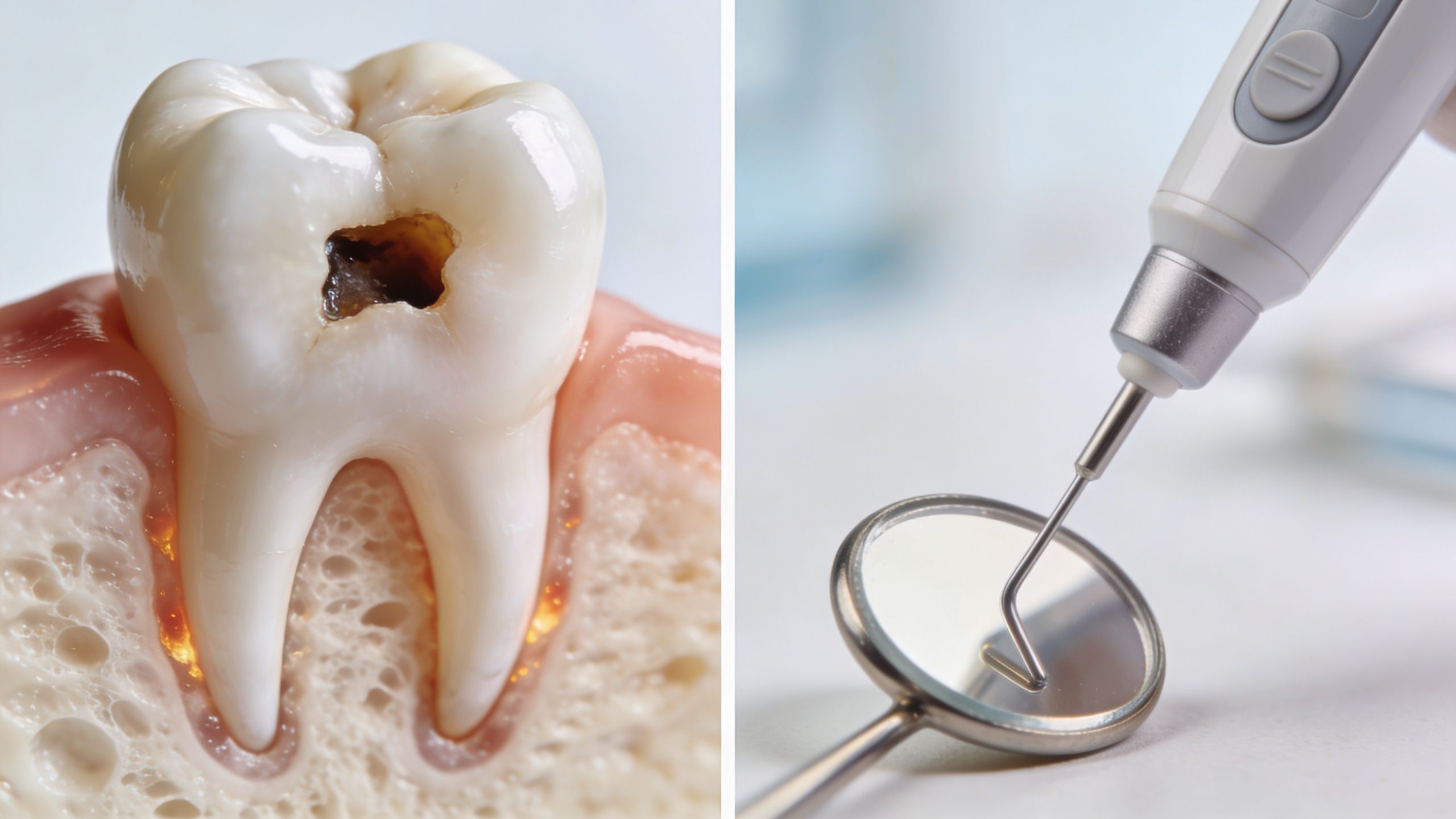
Cavities and failing fillings
A small cavity may cause brief cold sensitivity or no symptoms at all. As decay moves deeper, the tooth often becomes reactive to sweets, temperature, or biting.
The modern solution depends on how much structure is involved. Early decay may be treated with a filling. A larger area may need a crown to protect the remaining tooth. If the nerve has been permanently damaged, treatment may shift to root canal therapy or extraction.
For patients wondering whether a painful tooth may need endodontic treatment, this guide on how to know if you need a root canal can help explain the usual signs.
Cracked teeth and bite-related pain
Cracks are tricky because some don't show clearly at first. A patient may say, "It only hurts when I bite down a certain way," or, "I can't tell which tooth it is." That's a classic pattern.
Treatment depends on the depth and direction of the crack. Some teeth can be stabilized with a crown. Others need root canal treatment if the crack has irritated the pulp. If the fracture extends too far into the root, tooth extraction may be the most predictable option.
A missing tooth doesn't have to stay missing. When replacement is needed, dental implants near me becomes a common search for a reason. An implant can restore function and help prevent shifting and bite imbalance after extraction.
A short visual overview can make these decisions easier to understand:
Gum disease, abscesses, and wisdom teeth
Pain doesn't always start inside the tooth. Inflamed gums, deep periodontal pockets, localized gum infections, and partially erupted wisdom teeth can all create tenderness, swelling, and pain with chewing.
Treatment may include a deep cleaning approach for gum disease, drainage of an infected area, antibiotics when appropriate, or extraction if a tooth can't be predictably saved. The key is matching the treatment to the source rather than guessing from the symptom alone.
When it isn't really a tooth problem
Not every "toothache" comes from a tooth. Pain that feels shocking, burning, spreads across the face, or is triggered by light touch, speaking, or brushing can point to a non-dental cause such as sinus disease or trigeminal neuralgia, as described in Banner Health's guidance on tooth pain that isn't dental.
A good dental exam doesn't just find cavities. It also helps rule out dental causes so you don't lose time chasing the wrong treatment.
That matters for patients with persistent pain and "normal" looking teeth. Sometimes the most helpful dental visit is the one that identifies when another specialist should be involved.
Why Acting on Tooth Pain Saves Your Health and Wallet
Patients don't delay dental care because they don't care. They delay because they're busy, uncertain, or worried about cost. That's understandable. It's also one of the most expensive decisions patients make without realizing it.
Research summarized in this review of delayed dental care and financial barriers notes that American adults delay dental care more than any other health service, often because of cost concerns. The problem is what happens next. A small issue keeps moving.
The common financial pattern
A cavity doesn't stay politely contained forever. Decay moves deeper. A crack can spread. Gum infection can damage supporting bone. The treatment path becomes more involved because the condition became more involved.
Here's the practical trade-off:
- Early visit. Exam, dental x-rays, and a smaller restoration if the problem is caught in time.
- Delayed visit. Root canal treatment, crown, extraction, or replacement of a missing tooth with a bridge or implant.
- Long delay. More pain, more disruption, and fewer conservative options.
Why prompt care is a form of cost control
For families and professionals in Walnut Creek, CA, this isn't only about avoiding pain. It's about avoiding escalation. If you address the problem while the tooth is still structurally sound, you often preserve more natural tooth and reduce the chance of bigger treatment later.
That doesn't mean every sore tooth becomes a major procedure. It means no dentist can offer the least invasive option after the damage has already progressed past that point.
The cheapest dental treatment is often the one you do earlier, not the one you postpone.
This is also why routine cleaning and exams, new patient exams, and dental x-rays matter even when nothing hurts. Preventive care doesn't just protect oral health. It protects your options.
What to Expect During Your Tooth Pain Exam
Most anxious patients feel better once they know what the visit will look like. A tooth pain exam is focused, practical, and designed to answer one question first. What is causing the pain?

What happens first
The appointment usually begins with a conversation, not a procedure. You'll be asked where it hurts, what triggers it, how long it lasts, whether it wakes you at night, and whether you've noticed swelling, pressure, or a recent injury.
Those details matter because pain patterns often narrow the diagnosis. A sharp response to cold means something different from throbbing pain that starts on its own.
The exam and imaging
Next comes the clinical exam. The dentist may inspect the tooth, gums, bite, old fillings, and surrounding tissues. Gentle tapping, pressure testing, or temperature testing may be used to identify which tooth is responsible and whether the nerve is still healthy.
Dental x-rays are often part of the visit because many painful problems hide below the surface. Decay between teeth, infection at the root, bone loss, and fractures don't always show clearly to the naked eye.
If you'd like a broader overview before your appointment, this page on what happens during a dental exam walks through the basics.
The treatment discussion
Once the source is identified, the next step is a clear explanation of your options. That might mean a filling, crown, root canal, gum treatment, monitoring, referral, or tooth extraction if the tooth can't be predictably restored.
Good dental care should leave you understanding three things:
| What you should know | Why it matters |
|---|---|
| What the diagnosis is | So you're not making decisions in the dark |
| What the treatment choices are | So you can weigh short-term and long-term outcomes |
| What happens if you wait | So you understand the real risk of delay |
Patients with dental anxiety often worry most about pain control. Modern local anesthetic techniques, careful injection methods, and a calm pace make a major difference. For some patients, sedation options may also be appropriate.
If you're nervous, say so early. Anxiety is common, and it changes how the team plans the visit so you can get through it more comfortably.
Schedule Your Appointment for Tooth Pain Relief Today
If you're dealing with tooth pain, the safest assumption is that your body is asking for attention. Some causes are minor. Some are urgent. None improve because they were ignored.
For anyone searching for an emergency dentist, a dentist near me, or a dentist in Walnut Creek, CA, the right move is to get the tooth evaluated before the problem becomes harder to treat. Prompt care can relieve pain, protect the tooth when possible, and help you avoid the larger health and financial consequences of waiting.
If your pain includes swelling, trouble swallowing, trouble breathing, or rapidly worsening symptoms, seek immediate emergency care. If the pain is persistent, triggered by chewing or temperature, or not going away, schedule a dental visit as soon as possible.
Taking action now gives you the best chance at a simpler solution.
If you need prompt, compassionate help, contact William M. Schneider, DDS to schedule your visit. You can call the office or visit the practice online to request an appointment. The office is located at 1855 San Miguel Dr., Suite 31, Walnut Creek, CA, and welcomes patients from Walnut Creek and the East Bay who need trusted care for tooth pain, preventive dentistry, restorative treatment, cosmetic dentistry, tooth extraction, and dental implants.